Valitse organisaatio
CAF (Campaign Application Form) template preparation instructions
Julkaisupäivä: Apr 30, 2026
Kuvaus
The part of the preparation that often takes the longest, because it involves legal teams and other stakeholders, is the Terms of Service & Privacy Policy preparation.
Ratkaisu
Company Info and Contact Info fields:
These fields should be populated with the relevant information for the business that will be using the short code to reach out to their customers via SMS (texting).
Campaign Title:
The Campaign Title/Program name should be brief and include the brand name.
Example: XYZ Used Truck Alerts. Note that informational or info alerts is not acceptable per the latest Sprint guidelines. Other examples of compliant names include: ABC Promo Alerts, XYZ Weather Alerts, Acme Bank Account Alerts, etc.
Program (Campaign) Category/Service Types:
Please select the category that best matches your short code use case:
Alerts - An SMS campaign that provides urgent, relevant information to a mobile subscriber. Alerts campaigns can be utilized to provide customers with bank account notifications, store opening events, product shipping alerts, and many more.
Voting/Polling - SMS campaigns that allow subscribers to text in their vote/answer for a particular poll or survey. They allow brands to gather important customer information for creating valuable customer profiles & future campaigns with more precise customer targeting.
Sweepstakes/Contests - SMS campaigns that offer subscribers the opportunity to text in to the short code to be entered to win a prize. These are commonly referred to as "Text2Win" campaigns.
Information on Demand - An SMS campaign that allows customers to request business or product information on demand (as soon as they see your advertisement) via a text (one message per user). These are commonly referred to as “Auto Responder” campaigns.
Coupons/Advertising/Marketing - Mobile Marketing, Coupons or Deals are text messages sent to your targeted audiences or customers to offer the latest products, services, discounts, events and upcoming offers.
Each type of Program Service Type will typically require separate short codes, and should be determined based on your opt-out strategy. For example, should a customer opt-out of a program, they will opt-out for all programs being managed by a short code (they cannot opt out to a subset of programs being managed under a particular short code), so best practices suggest that you combine program types to address your opt-out strategy. Standard Program Service Type for LiveMessage (and conversational messaging) is Alerts.
Program (Campaign) Description:
The Program Description provides the ecosystem partner and carriers, an overview of the campaign that you will be deploying with the short code being submitted for approval.
Example: XYZ provides High Availability SMS communications targeted at the Enterprise sector. SMS messages are sent by employees to our customers for notification of either service events and/or maintenance windows regarding the services provided on an Opt In basis.
Description of Call to Action:
A call to action (CTA) is a message or verbiage provided on your website or other customer facing literature, which asks your subscribers to do something. This could be Opting In to receive messages from the business, or requesting help. Whatever the case, your CTA has to be well designed and carefully placed if it’s going to be effective at prompting the desired response.
Your Call to Action should include what type of program you are running & the nature of the SMS messages that your subscribers will be receiving. Messages must be delivered to a consumer’s mobile device only after the user has opted in to receive them. A user might indicate interest in a program in several ways. For example, a user might:
Web Opt-in: Enter a phone number online,
Keyword Opt-in: Send an MO message containing a keyword,
Paper Opt-in: Sign up at a point-of-sale location, or
Phone Opt-in: Over the phone and/or using interactive voice response (IVR) technology.
Calls-to-action must be clear and accurate; consent must not be obtained through deceptive means. For example, opt-in details cannot be displayed obscurely in terms and conditions related to other services. Enrolling a user in multiple short code programs based on a single opt-in is prohibited, even when all programs operate on the same short code.
Recurring-messages short code programs should send a single opt-in confirmation message that displays information verifying the customer’s enrollment in the identified program. The opt-in confirmation message must be delivered immediately after the customer opts into the program.
Additionally, opt-in messages must contain the program (brand) name or product description, customer care contact information, opt-out instructions, product quantity or recurring-messages program disclosure, and the “message and data rates may apply” disclosure.
The opt-in for all short code programs must comply with all legal and regulatory requirements, including the Telephone Consumer Protection Act, 47 U.S.C. § 227, and the Federal Communication Commission’s rules under 47 C.F.R. § 64.1200.
For example, the express written consent obtained for any program that is “telemarketing” [as defined by 47 C.F.R. § 64.1200(f)(14)] must, unless exempt from the requirement, include the elements of “prior express written consent” set forth in 47 C.F.R. § 64.1200(f)(8). That rule requires a clear and conspicuous disclosure informing the user that:
By opting in, the user authorizes the seller to deliver or cause to be delivered to the user messages using an automatic telephone dialing system; and
The user is not required to opt in (directly or indirectly) as a condition of purchasing any property, goods, or services.
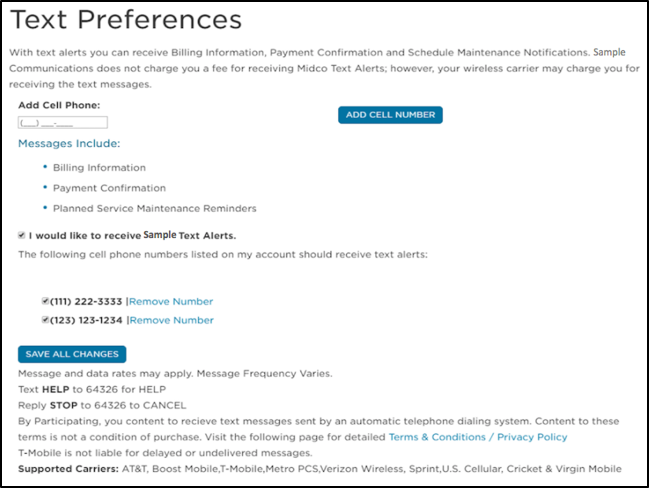
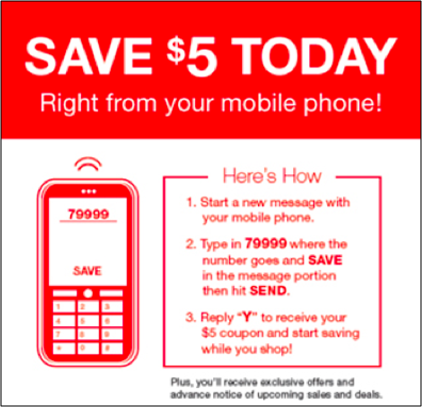
Two Examples of Calls to Action are shown below:
Web Opt-In example:
Key Word Opt-In example:
Sample Alert (MT):
Provide a typical alert (MT) that customers will receive during the program. Sample MT should contain the following: Service description, Program Sponsor, Frequency of messaging, Customer support information (HELP), Opt-Out information (STOP) & Additional carrier costs (e.g. Msg&Data Rates May Apply)
Example: XYZ Maintenance Alerts. New release 4.1. Maintenance window 4AM-6AM ET. Msg freq. varies. Reply HELP for help. Reply STOP to cancel. Msg&Data Rates May Apply
Regulatory Compliance and Consent Management
Your SMS Program will utilize either a Single Opt-In or Double Opt-In methodology for subscribers to join your SMS Program. Please fill out the applicable section, based on the type of opt-in you will be using.
Single Opt-In - When a subscriber opts in to a program via one subscriber-initiated message to a service provider as prompted by the terms of the program - for example, when a subscriber texts JOIN HEALTH ALERTS to a short code, that subscriber is opting in to the service.
Double Opt-In - when a subscriber opts in to a program via two, subscriber-initiated messages to a service provider as prompted by the terms of the program - for example, when a subscriber texts JOINCHAT to a short code and then responds to a confirmation MT message prompt yes in order to confirm acceptance of premium charges and terms and conditions, and join the service. Double Opt-In will apply when you need to verify a phone number provided by the user (e.g. web or paper opt-in).
Opt-In Keyword (MO):
The Opt-In keyword (or Opt-In MO) is the keyword that your customers will text to your short code in order to subscribe to your SMS Program. This is only necessary if keyword opt-in is your CTA.
Confirmation Message (MT):
This is the SMS message that will be sent back to a subscriber after they have texted the Opt-In Keyword (MO) to your short code, to confirm their sign-up.
The MT / Confirmation MT should contain the following: Service description, Program Sponsor, Frequency of messaging, Customer support information (HELP), Opt-Out information (STOP) & Additional carrier costs (e.g. Msg&Data Rates May Apply)
Example: Thanks for joining XYZ Maintenance Alerts. Msg freq. varies. Reply HELP for help. Reply STOP to cancel. Msg&Data Rates May Apply
Initial Opt In (MT) Message-Used when Double Opt-In is implemented:
This is the SMS message that will be sent to a subscriber after they have texted the Opt-In Keyword (MO) to your short code. The subscriber will then need to text in the Double Opt In keyword or PIN.
The Double Opt In (or PIN) MT should contain the following: Double Opt-In keyword/action, Program sponsor (Defined as the program name, company name or brand associated with the campaign.), Frequency of messaging, Customer support information (HELP), Additional carrier costs (e.g. Msg&Data Rates May Apply).
NOTE: Opt-out information (STOP) does not need to be in the initial PIN (or Reply Y) MT message. MT message not to exceed 160 characters.
Example: Welcome to XYZ Maintenance Alerts: Reply Y to confirm. Msg freq. varies. Msg&Data Rates may apply. Reply HELP for help.
Double Opt In (MO):
This is the keyword that a subscriber will text to your short code after they have first sent the Opt-In Keyword (MO) & received the Double Opt-In MT (i.e. this will be the subscriber’s response message to the Double Opt-In MT).
Allowable, affirmative Double Opt-In keywords include: Yes, Y, Go, Okay, OK, Accept, Agree, Join, Confirm
Opt Out (MO):
Functioning opt-out mechanisms are crucial for all text messaging programs. Programs must always acknowledge and respect customers’ requests to opt out of programs. However, depending on the use case, some short code programs are not required to advertise opt-out instructions. Short code programs must respond to, at a minimum, the universal keywords STOP, END, CANCEL, UNSUBSCRIBE, and QUIT by sending an opt-out message and, if the user is subscribed, by opting the user out of the program. Subsequent text, punctuation, capitalization, or some combination thereof must not interfere with opt-out keyword functionality.
Recurring-messages programs must also display opt-out instructions at program opt-in and at regular intervals in content or service messages, at least once per month. Opt-out information must be displayed in bold type on the advertisement.
A program may deliver one final message to confirm a user has opted out successfully, but no additional messages may be sent after the user indicates a desire to cancel a short code program.
Opt Out (MT):
The STOP MT should contain the following:
Service description, Program Sponsor, Confirmation that no further messages will be received, a method to contact customer service (either toll free number or support email address), if 'HELP for help' is included then 'Msg&Data Rates may Apply' should be included as well.
Example : You have been unsubscribed from XYZ Maintenance Alerts and will receive no further msgs. More info. Reply HELP or call: 800-555-5555 Msg&Data Rates May Apply
Help MO:
This is the keyword(s) that subscribers will send to your short code in order to receive Customer Support information.
Customer care contact information must be clear and readily available to help users understand program details as well as their status with the program. Customer care information should result in users’ receiving help. Programs must always respond to customer care requests, regardless of whether the requestor is subscribed to the program. At a minimum, the HELP keyword must return the program name and further information about how to contact service providers.
Short code programs should promote customer care contact instructions at program opt-in and regular intervals in content or service messages, at least once per month.
Help MT:
The HELP MT should contain the following:
Service description, Program Sponsor, Frequency of messaging, TWO methods to reach customer support, Opt-Out information (STOP) & Additional carrier costs (e.g. Msg&Data Rates May Apply) Customer support info — Either a toll-free number, Web address, or e-mail address.
Note that Sprint requires a toll-free number for all programs and T-Mobile requires a URL for all programs. Note that the URL must be clear. Such as 'http://chil.is/textinfo' for users of feature phones.
Example: XYZ Maintenance Alerts: For more info, Call: 1-800-555-5555 or visit http://xyzweather/sms. Msg freq. varies. Reply STOP to cancel. Msg&Data Rates May Apply.
Toll Free Phone Helpline:
Customer Support Email:
CTIA provides these guidelines:
Customer care contact information must be clear and readily available to help users understand program details as well as their status with the program. Customer care information should result in users’ receiving help. Programs must always respond to customer care requests, regardless of whether the requestor is subscribed to the program. At a minimum, the HELP keyword must return the program name and further information about how to contact service providers. Short Code programs should promote customer care contact instructions at program opt-in and at regular intervals in content or service messages, at least once per month.
Customer support info — Either a toll-free number, Web address, or e-mail address.
Note: T-Mobile requires a toll-free number for financial services messaging and when used, T-Mobile requires that a URL must be clear such as 'http://chil.is/textinfo' for users of feature phones.
Note: Toll free numbers must be represented as 888-888-8888. Forms like 8888888888 or 888.888.8888 will not be approved by carriers.
Knowledge-artikkelin numero
000380700
Ratkaisiko tämä artikkeli ongelmasi?
Anna palautetta, jotta voimme kehittyä!
