Vælg en organisation
Open phone number as a link in Marketing Cloud Email
Udgivelsesdato: Nov 4, 2025
Beskrivelse
You can hyperlink a phone number using both text-based and image-based links. Learn the steps for both methods below.
Note: "Click-to-Phone" links are not tracked just as "mailto" links are not. This is because the action is internal to the Subscriber's phone system, and doesn't involve routing traffic to an external server, like normal HTTP links do. Yahoo Mail (and some webmail clients) often disable or do not support certain clickable links, including tel: links, for security or compatibility reasons.
Løsning
Email Editor
1. Open the Email Editor within any email.
2. Click any Content Box within an email to be edited.
3. Click Modify Content.
4. Enter the phone number.
5. Highlight the Phone Number.
6. Click Insert Link.
7. In the "Link To" dropdown, click Other.
8. In the "Link URL" field, Enter "telephone number." For example, tel:555-555-5555.
9. Click OK | Save.
Note:
You are not required to add any area code to the phone number.
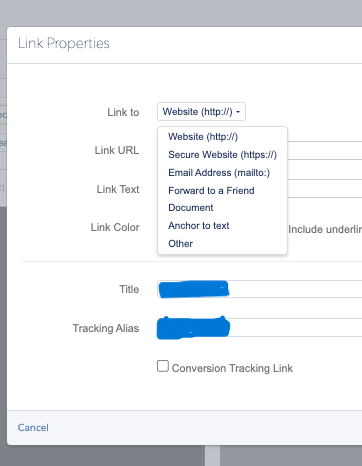
Image-based Links
1. Open Email Editor within any email.
2. Click any Content Box within an email to be edited.
3. Click Modify Content.
4. Highlight the existing image.
5. Click Insert Link.
6. In the "Link To" dropdown, click Other.
7. In the "Link URL" field, Enter "telephone number." For example, tel:555-555-5555.
8. Click OK | Save.
Yderligere ressourcer
Related discussion: https://trailhead.salesforce.com/trailblazer-community/feed/0D54V00007OuNNsSAN
Related read: Marketing Cloud Email Does Not Display Correctly on a Mobile Device
Vidensartikelnummer
000387317
Løste denne artikel dit problem?
Giv os besked, så vi kan forbedre os!
