Seleccionar una organización
Understand Percent Focus in Salesforce Maps Territory Planning
Fecha de publicación: Aug 21, 2026
Descripción
Salesforce Maps Territory Planning uses the % Focus option in the Legend to help you evaluate how balanced your territories are. This article explains what % Focus means, how it's calculated, and how to use it to identify and fix imbalanced territories.
Solución
This article answers the question: what does the % Focus option mean in Salesforce Maps Territory Planning, and how do you use it to balance territories? The % Focus option in the Legend allows you to express any numeric value as a percentage of the focus, which is calculated as:
`Territory Value / Avg. Value for Focus`
Why Use % Focus
The purpose of % Focus is to convert balancing criteria from raw values to a percent value that can be used to measure the relative size of a territory and calculate the overall imbalance for a given focus. The closer the number is to 100%, the better balanced that territory is. The closer to 100% each territory in a given focus is, the better balanced that focus is.
% Focus also makes it easy to convert numbers that are harder to interpret (such as Annual Revenue or Scores) into a more digestible percentage.
Example
Consider the following example:
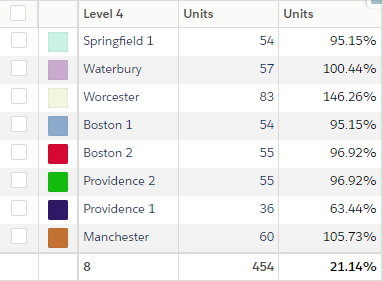
- Providence 1 is undersized because its % Focus is less than 100%
- Worcester is oversized because its % Focus is greater than 100%
- The overall imbalance for the focus is 21.14% which is outside the recommended range of 10%
- The overall imbalance could be reduced by moving accounts from Worcester to Providence 1
How the Imbalance Is Calculated
The imbalance calculation is the standard deviation of the % Focus values, meaning that the closer each territory is to 100% then the closer the imbalance will be to 0%.
Recursos adicionales
Número del artículo de conocimiento
000389062
¿Resolvió este artículo su problema?
¡Háganos saber cómo podemos mejorar!
