Organisation auswählen
B2C Commerce: Troubleshooting Japanese Search Issues
Veröffentlichungsdatum: Apr 24, 2026
Beschreibung
This article explains the mechanism of Japanese search on B2C Commerce sites and how to resolve issues where products do not appear in search results.
Lösung
How Product Search Works: Index and Query
Product data used in the site catalog is stored in a database. However, directly querying the database every time a shopper performs a search would increase the database load and degrade site performance. Therefore, site searches utilize a pre-built index based on the product data. When a search occurs, a query is executed against this index using the search phrase. This full-text search mechanism enables fast and efficient site searches.
How to Investigate Japanese Search Issues
Given the mechanism above, if a specific product does not appear in Japanese search results, you must investigate the cause by checking the details of the index and the query. In Business Manager, you can verify these details in the following locations:
Steps to Check Individual Product Indexes
- Navigate to Merchant Tools > Search > Search Indexes.
- Click on Product Index.
- Click the Documents tab.
- Enter the Product ID and click Find.
Note: For phrase searches, the content-text field (e.g., content-text@L:ja_JP) is a critical field referenced during the query.
Steps to Check Query Details
- Navigate to Merchant Tools > Search > Search Index Query Testing.
- Enter the search phrase, select the appropriate Japanese locale, and click Find.
Note: For a product to appear in the search results, every token in the query generated on this testing screen must perfectly match the product index.
Matching Example
Assume a product index is created with the terms "ほげら" and "ふが".
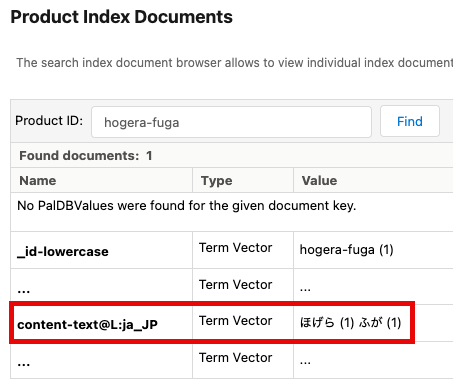
In this case, the following query matches the index for both "ほげら" and "ふが", so the product will result in a hit:
Example of a successful query
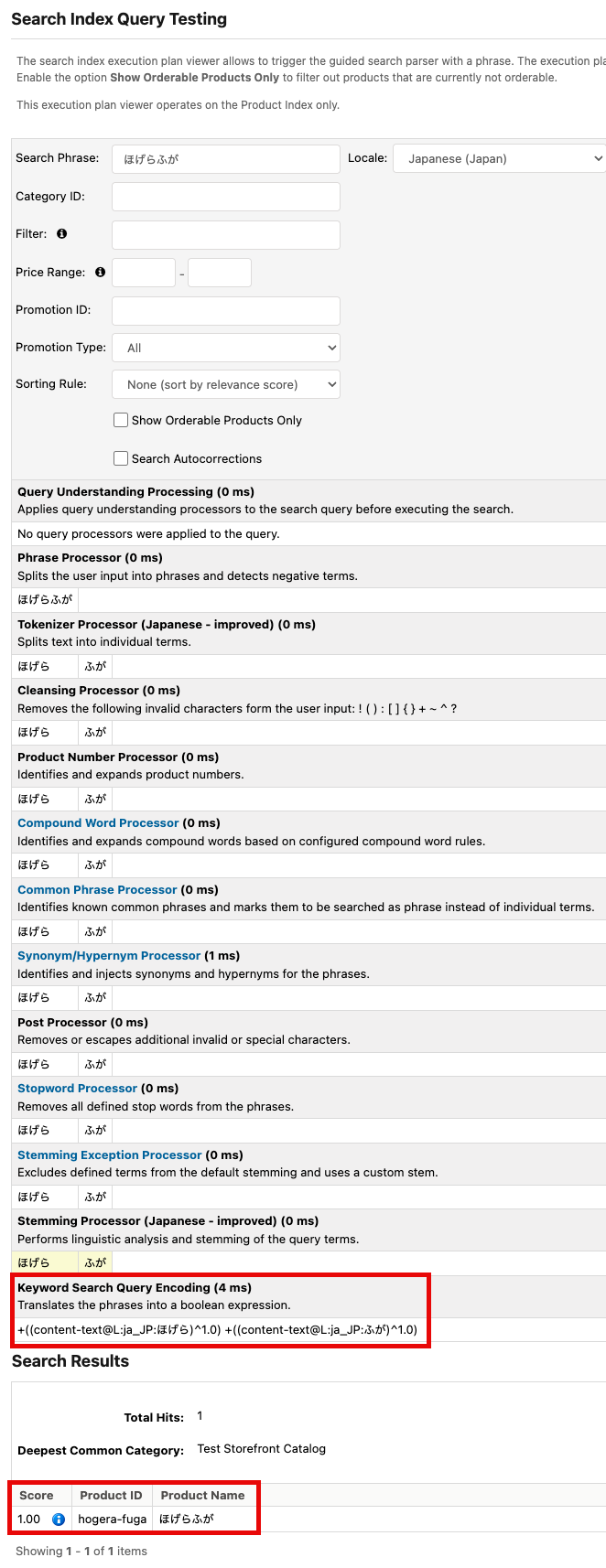
+((content-text@L:ja_JP:ほげら)^1.0) +((content-text@L:ja_JP:ふが)^1.0)(Since both "ほげら" and "ふが" exist in the index's content-text@L:ja_JP field, the search is successful.)
On the other hand, in the following query, "ほげ" does not match the product index "ほげら", so the product will not be found:
Example of an unsuccessful query
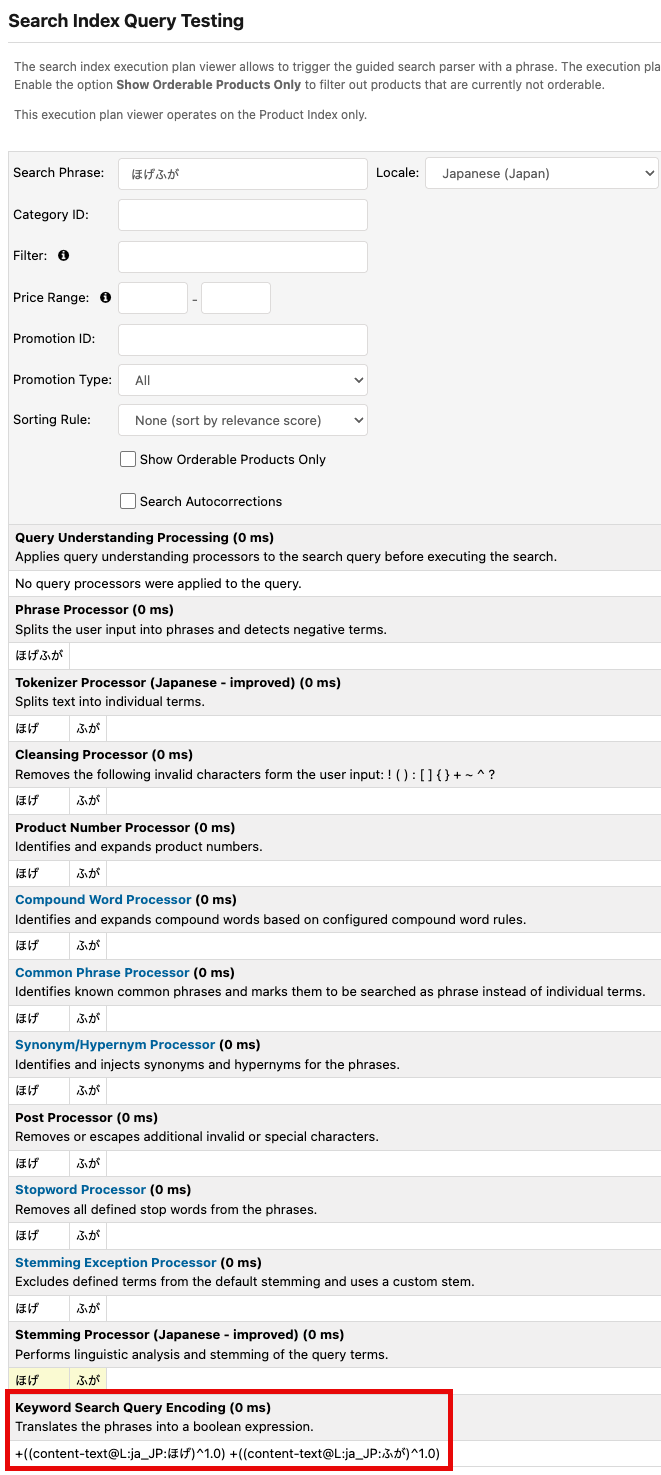
+((content-text@L:ja_JP:ほげ)^1.0) +((content-text@L:ja_JP:ふが)^1.0)(Since "ほげ" does not exist in the index's content-text@L:ja_JP field, the search fails.)
About Japanese-Specific Processing
Unlike English, Japanese does not use spaces to separate words. Therefore, when analyzing product data or search phrases, the system performs token splitting based on morphological analysis dictionaries and internal algorithms. Additionally, split tokens undergo processing to convert verb conjugations to their base forms and remove particles (助詞).
Depending on the specific configurations or particular Japanese phrases, the results of this language processing can cause the query and index to mismatch, leading to products not being found as expected.
If this issue occurs, please try the following two settings first:
- Strict Japanese Search/Index Matching: Enable
Location: Administration > Global Preferences > Feature Switches - Stemming: Japanese - improved
Location: Merchant Tools > Search > Search Indexes > Language Options
In addition to the above settings, configuring search dictionaries like Japanese Custom Dictionaries or Synonyms can also resolve matching issues.
Problem Types & Solutions Overview
Please check the table below for a summary of Japanese search issues that can be resolved using these features:
| Problem Type | Product Name (Example) | Search Phrase (Example) | Effective Feature | Effect |
| The product name (a phrase separated by spaces) and search phrase match exactly, but there is no search hit. |
こいのぼり 小物 (Includes space) | こいのぼり | Strict Japanese Search/Index Matching | The query generated by the search phrase will now match the product index of the same name. |
| No search hit for relatively long compound word phrases (especially Katakana). | マルチビタミンミネラルサプリメント | マルチビタミンミネラル | Stemming: "Japanese - improved" | The token splitting result of the compound word will no longer include the compound word itself. |
| Proper nouns (especially Hiragana) are not recognized as tokens. | あすとろぬいぐるみ | あすとろ | Japanese Custom Dictionary | By forcing the system to recognize "あすとろ" as a token, "あすとろぬいぐるみ" will successfully hit when using that phrase. |
For more details on each feature, please refer to the following articles:
Nummer des Knowledge-Artikels
000397156
Konnten Sie Ihr Problem mithilfe dieses Artikels lösen?
Geben Sie uns Feedback, damit wir uns verbessern können.
