Välj en organisation
How to Calculate VPC and VPN License Requirements
Publiceringsdatum: Mar 2, 2024
Uppgift
GOAL
Determine what entitlements are required for a connecting to a Cloudhub VPC via IPSec VPN.
Steg
Important: The article assumes prior knowledge of these concepts:
- A Virtual Private Cloud (VPC) is an extension of your network, which is hosted in your Cloudhub organisation. Refer to About Provisioning a VPC for information on VPC configuration.
- A Virtual Private Network (VPN) provides connectivity between the Cloudhub VPC and a remote location, such as your data center. Refer to About VPC Connectivity Methods for information on other connectivity options.
BACKGROUND
The Anypoint Platform Base Subscription includes a 2x VPC license. This entitles the organisation to 2 VPCs. Once the limit is reached, the Create VPC option is disabled in the user interface.
VPN licenses are bundled with the VPC license, so each VPC license also entitles the organisation to 1 VPN gateway, with a connection to 1 public IP address in a remote location. That is to say, 1 VPC License = 1 VPC entitlement + 1 VPN entitlement.
DEPLOYMENT SCENARIOS
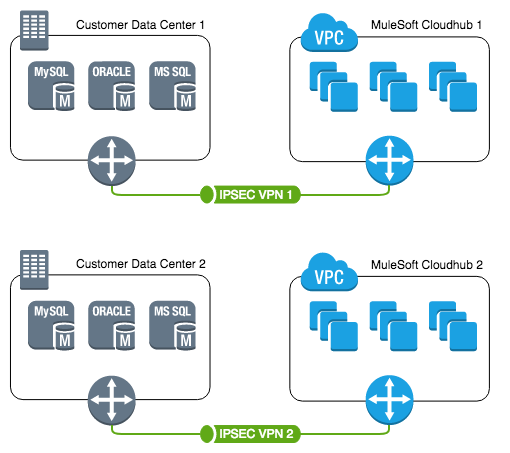
1. Using a 1:1 relationship, each VPC can connect to a single public IP address at a remote location.
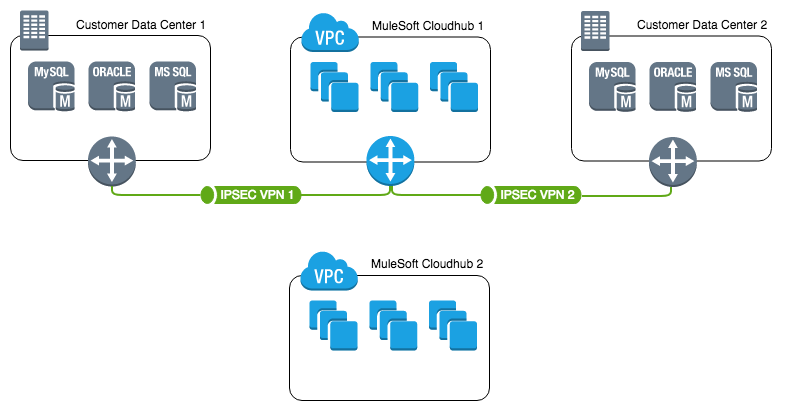
2. A strict 1:1 relationship is not mandatory, so you may use both licenses to connect a single VPC to a public IP addresses at 2 remote locations (this leaves no licences for connectivity to the second VPC).
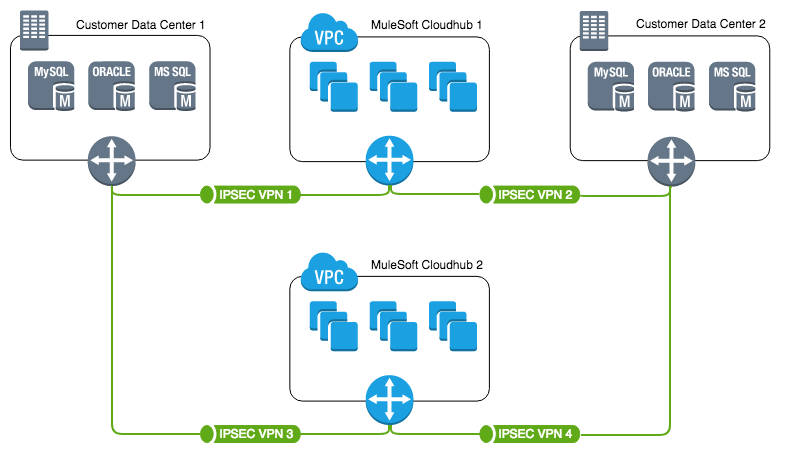
3. Connecting both VPCs to two remote locations would require 4 VPC licenses, even when using the same 2 public IP addresses.
In summary, each remote location that needs to be accessible from the Cloudhub VPC, will require an additional VPC license.
Knowledge-artikelnummer
001114580
Löste denna artikel ditt problem?
Berätta för oss vad vi kan förbättra!
