Organisation auswählen
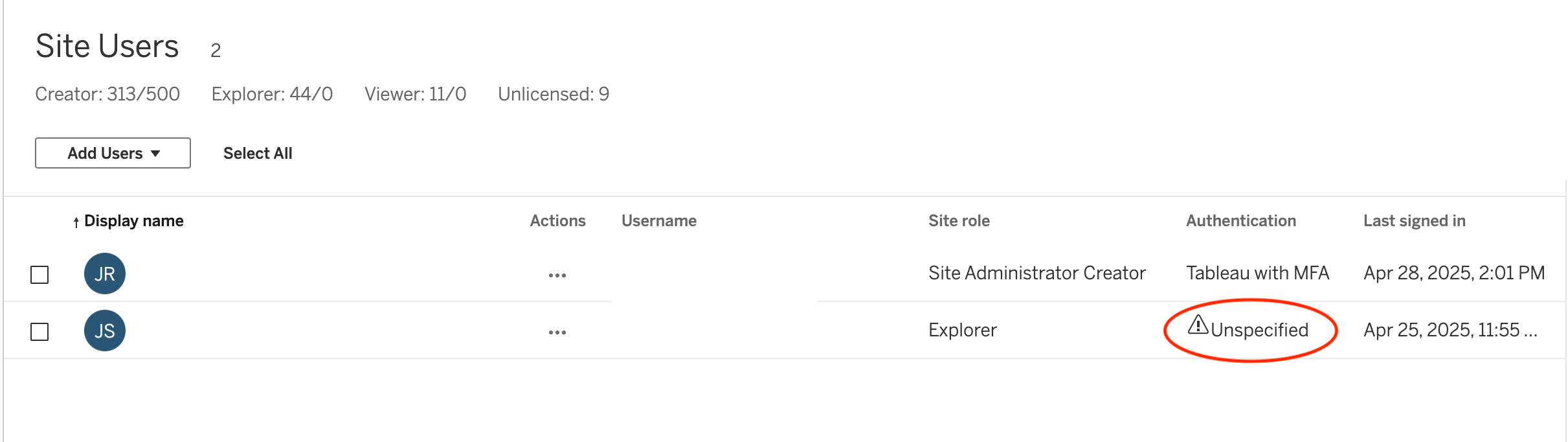
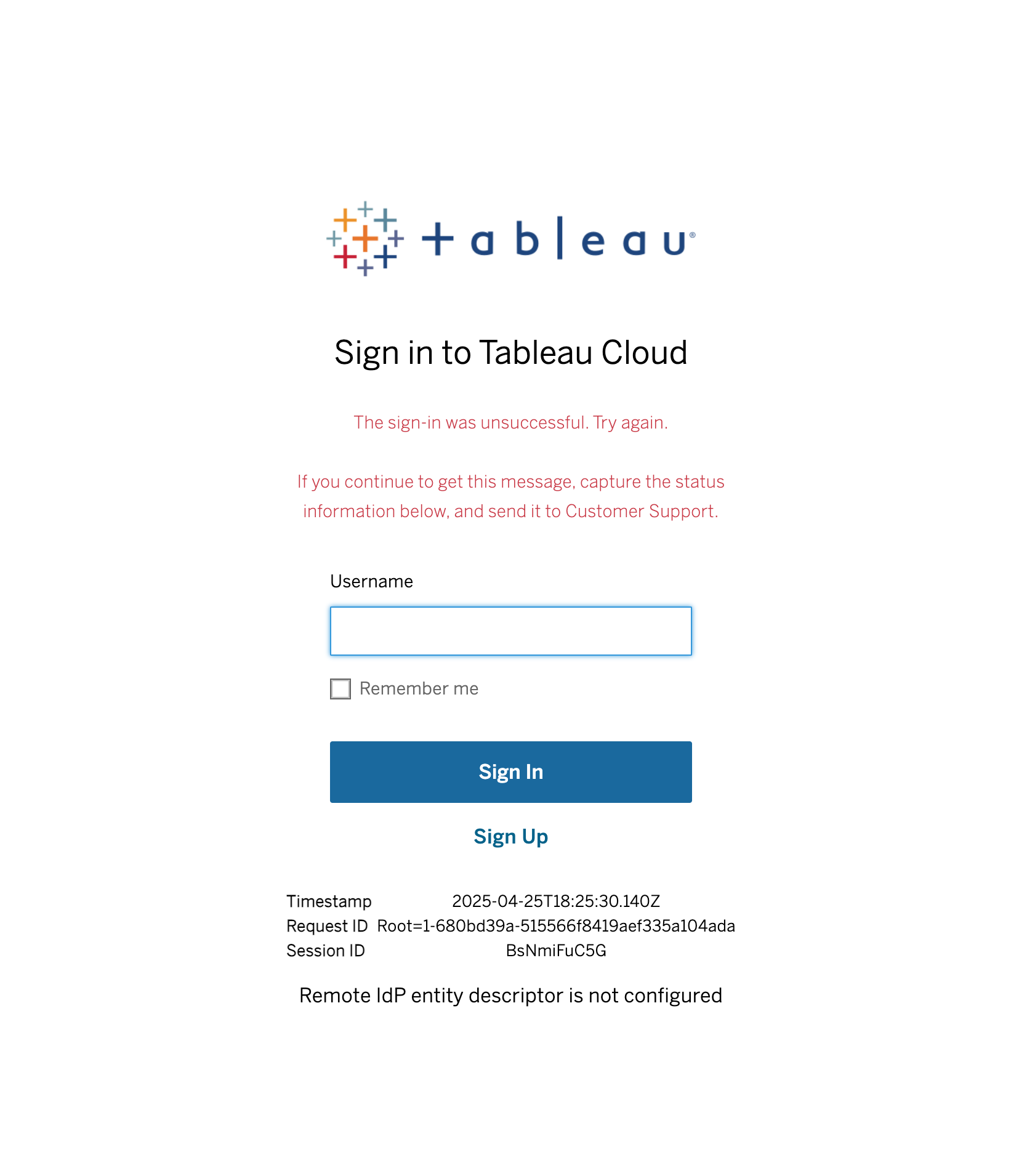
When adding users to Tableau Cloud via Rest API, the user's authentication method is listed as "Unspecified" and the user gets error "Remote IdP entity descriptor is not configured" on login attempt
Veröffentlichungsdatum: Apr 3, 2026
Beschreibung
When adding a user to Tableau Cloud via Rest API, the user may show in Tableau Cloud with an authentication method as "Unspecified." The user may or may not be able to log in. This is expected behavior if the site has multiple IdP configurations, as the specific configuration for that user was not specified.
The User may also see the error on login "Remote IdP entity descriptor is not configured"
Lösung
This error means that the user was added with the authSetting parameter set to SAML, but the site had multiple SAML IdP configurations set. If there are multiple IdP configurations, switch to using the IdpConfigurationId parameter instead.
The quick workaround is to change the user's sign-in method in Tableau Cloud. After changing to the correct SAML Configuration, they will be able to log in via that method. However, this would be a workaround to the incorrect Rest API configuration.
To resolve the Rest API code issue:
- First, run the List Authentication Configurations for Site call from the Site Methods
- Remove the authSetting parameter from the add user to site call.
- Use the appropriate Luid from the configurations in step 1 in the idpConfigurationId parameter.
Zusätzliche Ressourcen
Add user to site (Rest API)
https://help.tableau.com/current/api/rest_api/en-us/REST/rest_api_ref_users_and_groups.htm#add_user_to_site
SAML Requirements for Tableau Cloud
https://help.tableau.com/current/online/en-us/saml_online_requ.htm#idp-reqs
Note: Tabserverclient currently does not have this parameter. Please open a request on github to add that functionality.
Nummer des Knowledge-Artikels
004693708
Konnten Sie Ihr Problem mithilfe dieses Artikels lösen?
Geben Sie uns Feedback, damit wir uns verbessern können.
