Välj en organisation
Multiple functional group not being acknowledged in Partner Manager X12 file
Publiceringsdatum: Sep 16, 2025
Beskrivning
The Partner Manager does support generating a 997 acknowledgment for each functional group, but there is an important condition: the functional group type must be different.
If there are multiple GS segments with the same functional group type (for example, all GS segments being of type PO within the same ST segment), then the system generates only a single acknowledgment for that group. This means that even if multiple purchase order groups are included, they are consolidated into a single 997.
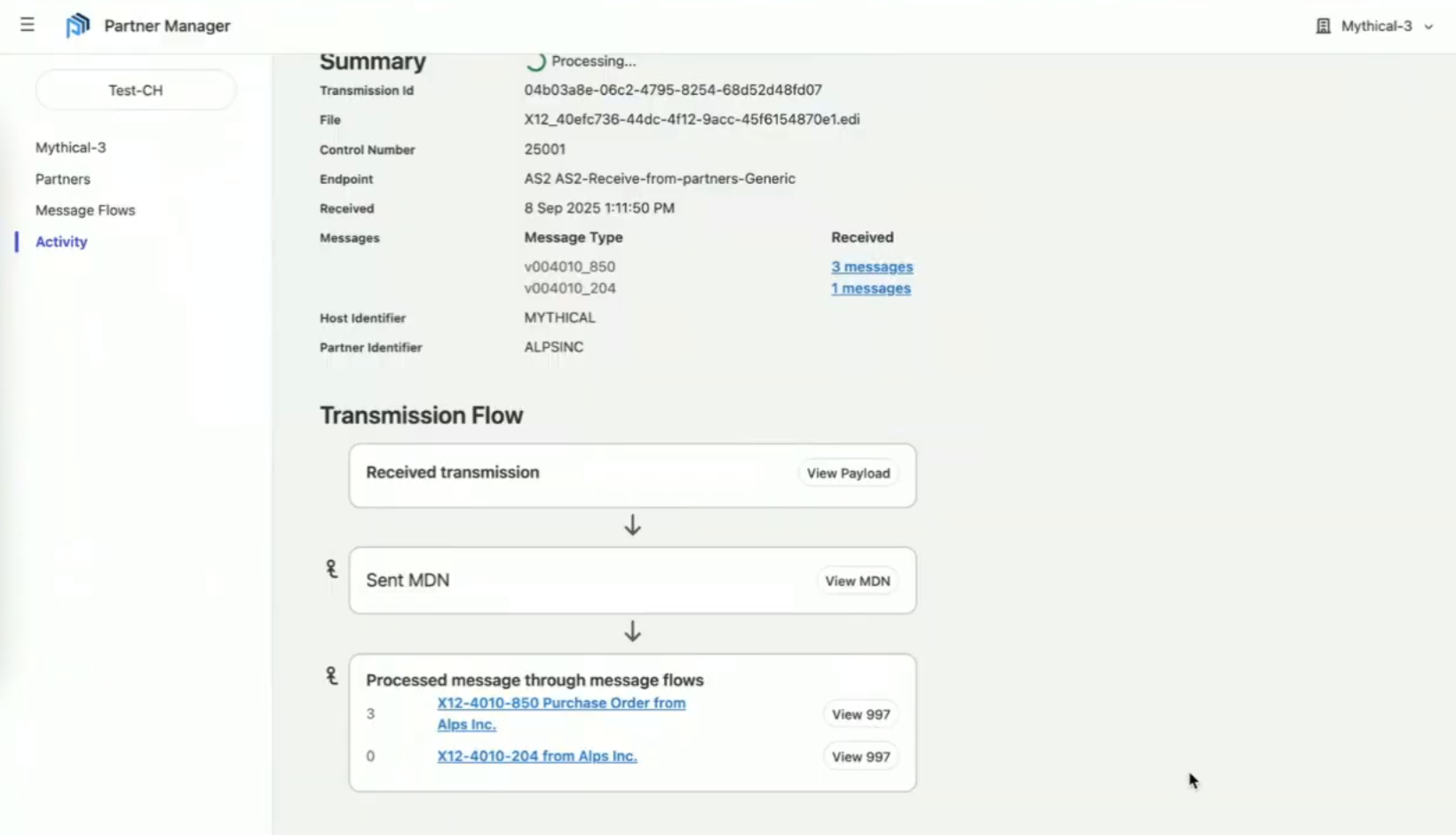
On the other hand, if the incoming file contains functional groups of different types (for example, a PO with transaction set 850 and an SM with transaction set 204), the Partner Manager generates a separate 997 acknowledgment for each type. In this case, each functional group type is recognized independently, and the acknowledgments are issued accordingly.
This behavior ensures that acknowledgments correctly reflect the structure of the EDI file while avoiding unnecessary duplication when multiple groups of the same type are present.
Sample of multiple 997 acknowledgements:
Lösning
To ensure proper acknowledgment processing, it is important that the functional group types (GS) in the X12 file are configured as distinct values for each functional group.
The Partner Manager generates separate 997 acknowledgments only when the functional group types are different. If multiple GS segments share the same type (for example, all GS segments being PO/850), they are consolidated, and only a single 997 acknowledgment is created.
To meet the acknowledgment requirements, review the structure and configuration of your X12 file and confirm that:
- Each functional group (GS/GE pair) is assigned a unique functional group type when separate acknowledgments are expected.
- The GS values are not duplicated across multiple functional groups unless consolidation into one acknowledgment is intentional.
- Different transaction set types (e.g., PO/850 and SM/204) are correctly grouped under their respective GS segments.
By setting up the functional groups with distinct GS values, you can ensure that Partner Manager generates the appropriate number of acknowledgments in line with your trading partner agreements.
Knowledge-artikelnummer
005167240
Löste denna artikel ditt problem?
Berätta för oss vad vi kan förbättra!
