Organisation auswählen
Flex Credit Consumption Behavior for Prompt Templates Invoked via Platform Event-Triggered Flows
Veröffentlichungsdatum: Sep 24, 2026
Beschreibung
When invoking a Prompt Template from a Platform Event-Triggered Flow, administrators may observe that no Flex Credits are consumed in the Digital Wallet or Einstein consumption screens, despite successful generative AI executions and prompt predictions.
Lösung
This is expected behavior and is working as designed. Flex Credit consumption is entirely dependent on the metering user context at the time the prompt is processed.
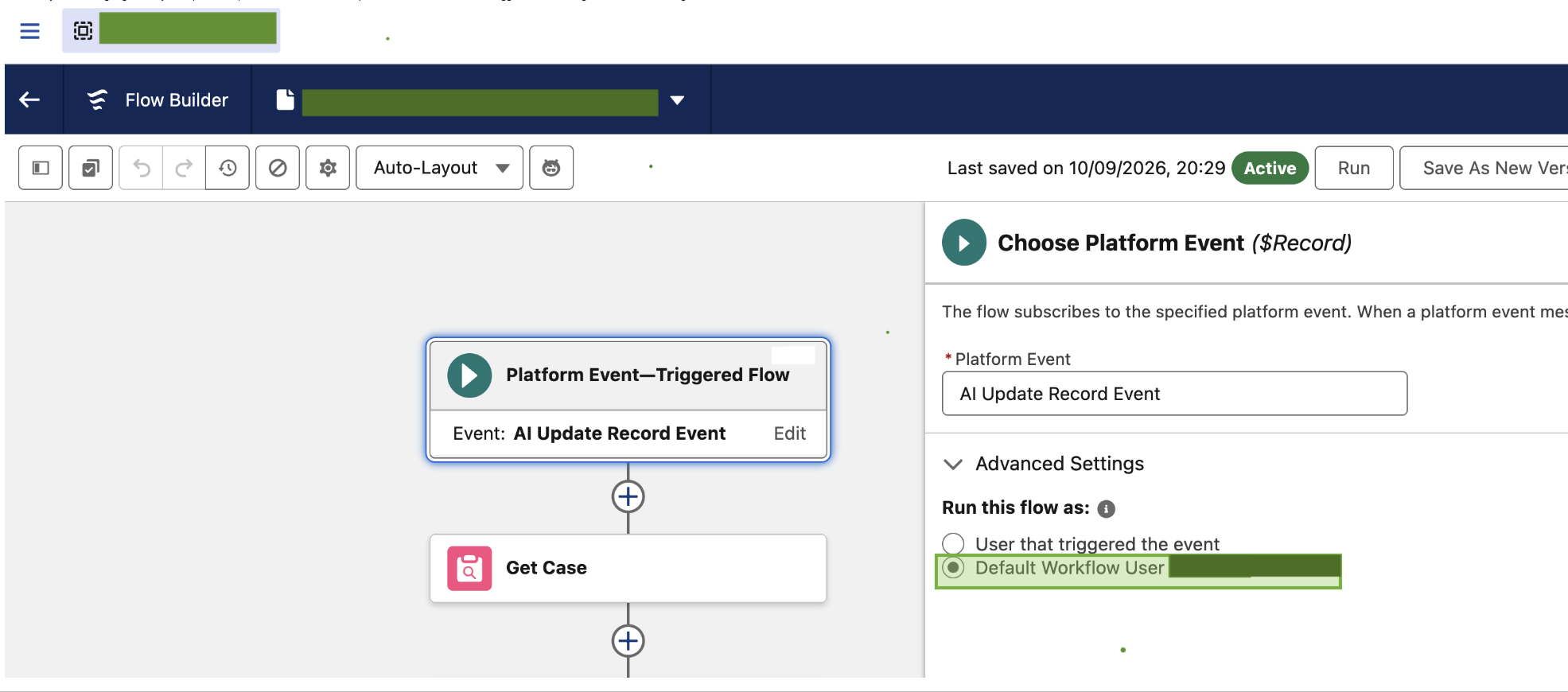
Platform Event-Triggered Flows allow administrators to specify a running user context.
-
Unmetered Scenario: If the Platform Event Flow is configured to "Run As" a specific user, and that user is assigned the Unmetered AI Usage Permission Set License, the LLM call is processed under that user's context. Consequently, Flex Credit consumption is bypassed. This applies through the full chain:
Platform Event Flow (set runs as user with an unmetered license user) → invokes any Invocable Process → calls an Autolaunched Flow (runs in the same unmetered user context) → calls a Prompt Template Action (runs in the same unmetered user context). -
Metered Scenario: If the prompt is processed under a user who does not have the Unmetered AI Usage license, or if it runs as a generic system user, the usage will be metered and Flex Credits will be consumed.
To ensure your metering aligns with your expectations, review the "Run As" user specified in the Platform Event-Triggered Flow settings and check their assigned Permission Set Licenses.
Note: Unmetered usage is limited to a maximum of 30 LLM calls per minute per user. This limit is not currently technically enforced in the product.
Please refer: Metering for Agentforce and Generative AI Usage
Zusätzliche Ressourcen
Unmetering Logic for Global Unmetering
Configure User Permissions for Unmetered Licenses
Metering for Agentforce and Generative AI Usage
Nummer des Knowledge-Artikels
005460511
Konnten Sie Ihr Problem mithilfe dieses Artikels lösen?
Geben Sie uns Feedback, damit wir uns verbessern können.
