
You are here:
Multi-Level Decomposition Modeling
A multi-level decomposition is an order decomposition configuration where a sales order is recursively decomposed into lower tiers.
A sales order can be decomposed into a number of Customer-Facing Services orders and these Customer-Facing Service Orders are decomposed into Resource-Facing Service Orders. You can use multi-level decomposition to ensure re-use between order decomposition configurations. In particular, multiple products could re-use the same Customer-Facing Services decompositions, thus reducing the time to introduce a new product.
For example, TV Service can be sold independently or within a Triple Play offer. However, you want to use the same billing process in both situations. Most implementations would follow a phased approach and go to production with services as they are built. However, once all the product lines have been configured for fulfillment, it should be possible to create commercial bundles, such as triple-play and quad-play, without much impact on the fulfillment side because the processes used for individual services should also apply to a bundle. This use case is easily supported through decomposition. When creating a higher-level bundle, you can add a decomposition relationship to the grouping product and the decomposition results in only one fulfillment request for that product.
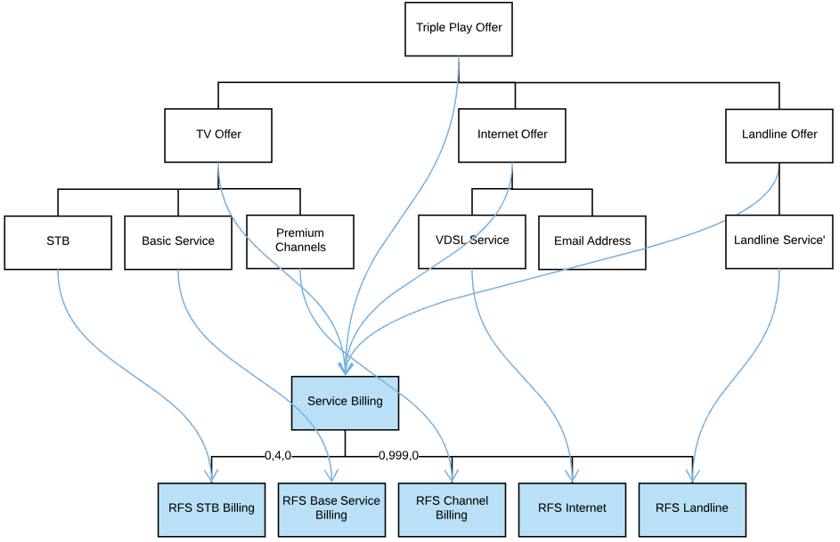
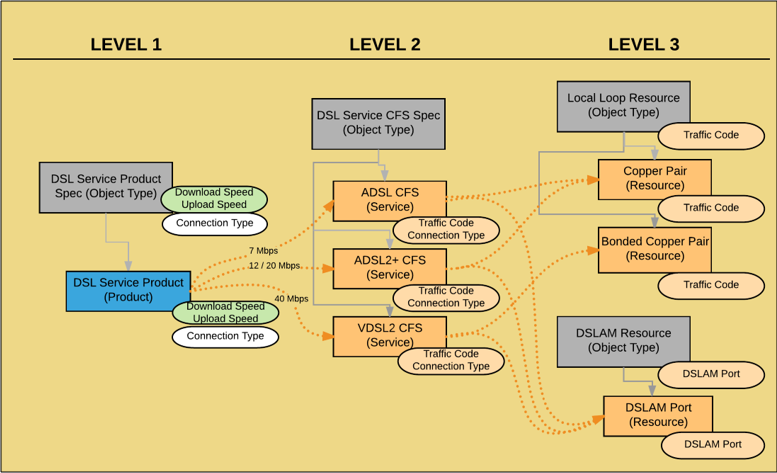
You can use Multi-stage decomposition to model the technical catalog in multiple levels according to TM F’orum's SID modeling. You can model the technical catalog with the CFS layer that decomposes to the RFS layer. The CFS layer models the service as perceived by the commercial layer, whereas the RFS layer models the service as perceived by the fulfillment systems. The CFS layer allows for more formal modeling of the service but the RFS layer is critical for the fulfillment.
When modeling with multiple layers, you can change the resource-facing layer without impacting the higher CFS (at least in theory). This allows a much smoother transition from one provisioning system to another. While the RFSs would need to be redesigned, the CFS layer would remain the same.
In the following figure, there are multiple decomposition relationships that must be created from second-level products to third-level products. Note, however, that this is not a one-to-many (1:M) relationship because at runtime, only one product is selected at the second-level of decomposition, and that single product will be decomposed using the appropriate decomposition relationship.
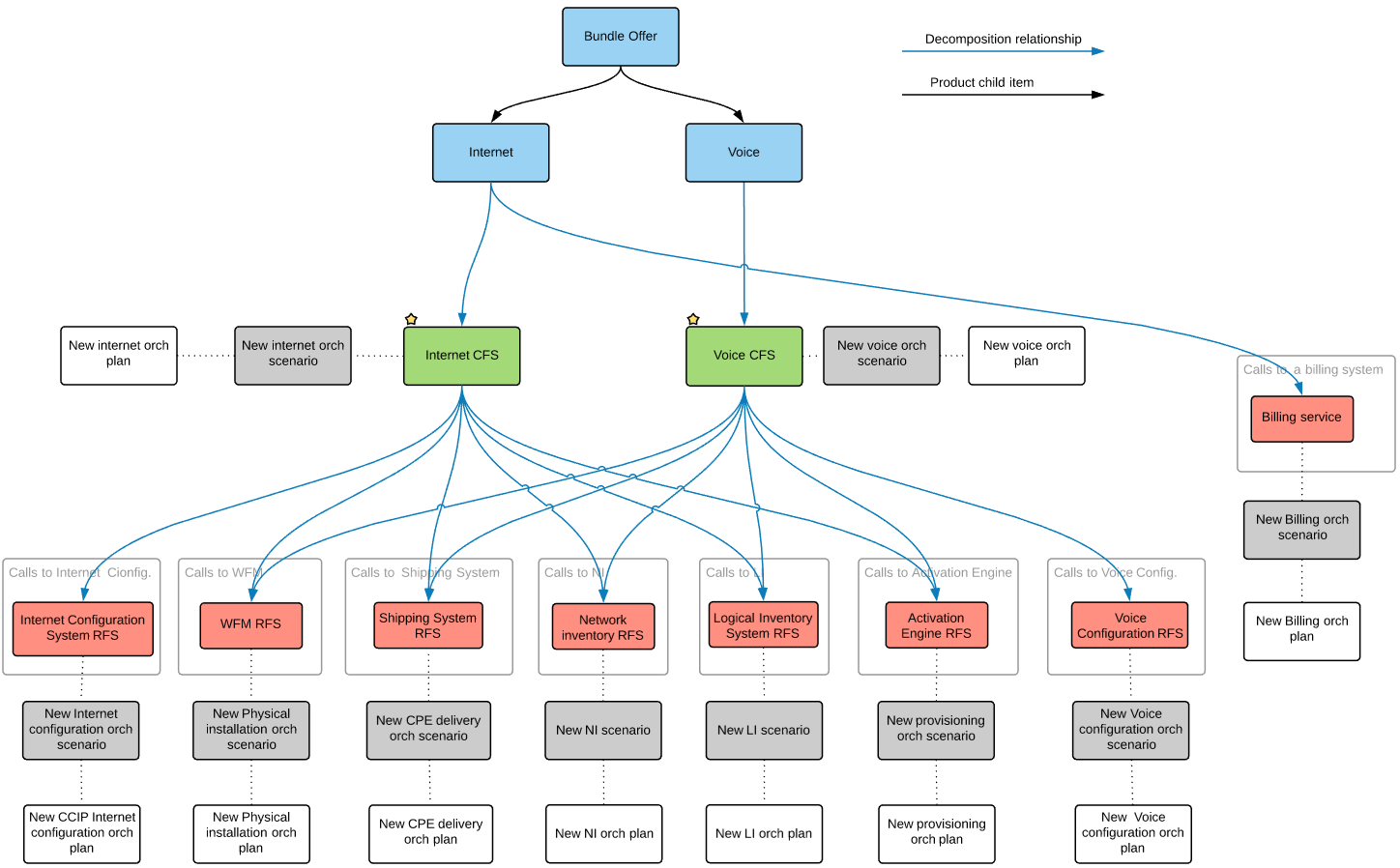
As an example, there are two commercial products — Internet and Voice. Parameters that are required to activate a service are defined at the commercial product level, such as Internet or Voice, because they are either entered manually when creating the order, or are passed from an interface.
You decompose each product to a separate Customer Facing Service (CFS). In this example, the CFSs are not visible to customers, but serve as an intermediate interface to receive parameters collected at the order time from the product and pass the values to different RFSs.
Decomposing a product to a CFS enables you to:
-
Logically group RFSs
-
Optionally create an aggregated orchestration plan at the CFS level with key milestones that you can track, and on which you can report progress. It does not replace the orchestration plan you create at the RFS level.
To fulfill each service, the system must communicate with multiple external systems in a specific order. This could include, for example, communicating with an activation engine to request configuration of network elements and performing different operations, such as resource reservation, resource inventory, and billing updates.
In the given example, we define a set of RFSs to communicate with external systems, such as the workforce management system, delivery system, and the inventory system.
The following is a visual representation of the described example:
Another use of multi-stage decomposition may occur when you need to send information from multiple sources to multiple instances, such as when you need to provision TV channels individually instead of simultaneously. You may also need to send information found on the TV service. To accomplish this, you use many-to-one patterns to build a CFS from multiple sources and then use a one-to-many pattern to decompose the CFS into specific RFSs.
In Order Management Plus, field propagation in multi-level decomposition relationships is only valid for original order fields.
