You are here:
Orchestration Scope
The Scope field on an orchestration plan definition defines a default scope for orchestration items contained by a plan if the item does not have a scope defined.

By default, the scope value is set to None.
Orchestration scope enables you to decide whether to create a separate orchestration item for a given combination of order items/fulfillment request lines and orchestration item definitions, and how to resolve dependencies between orchestration items at runtime.
The following scopes are supported:
Global: Contains all items in the plan. These Orchestration Items are generated for all Order Item and Fulfillment Request Lines belonging to the order being decomposed and Fulfillment Requests produced by the decomposition.
Order: Contains all orchestration items produced for a commercial order or fulfillment request.
Main Order Item: Contains all orchestration items produced for a given top-level order item or fulfillment request line, as well as all directly and indirectly related child order items or fulfillment request lines.
Order Item: Contains all orchestration items produced for a given order item or fulfillment request line. For orchestration item definition and orchestration plan definition, the Order Item scope and Swimlane scope are identical. There's no difference between them.
Swimlane: Contains all orchestration items produced for a given order item or fulfillment request line and a given orchestration plan definition. Any specification can have more than one active orchestration plan definition for a given order item or fulfillment request lines, so there may be one or more swimlane scope instances within any given order item scope instance.
For orchestration item definition and orchestration plan definition, the Order Item scope and Swimlane scope are identical. There's no difference between them.
Sales Bundle: Contains all orchestration items produced for a given root order item (that is, a bundle).
Note If you don't see the Sales Bundle option, then you must add it in the Fields and Relationships in two spots: The Orchestration Dependency Definition Scope, and the Orchestration Item Definition Scope.
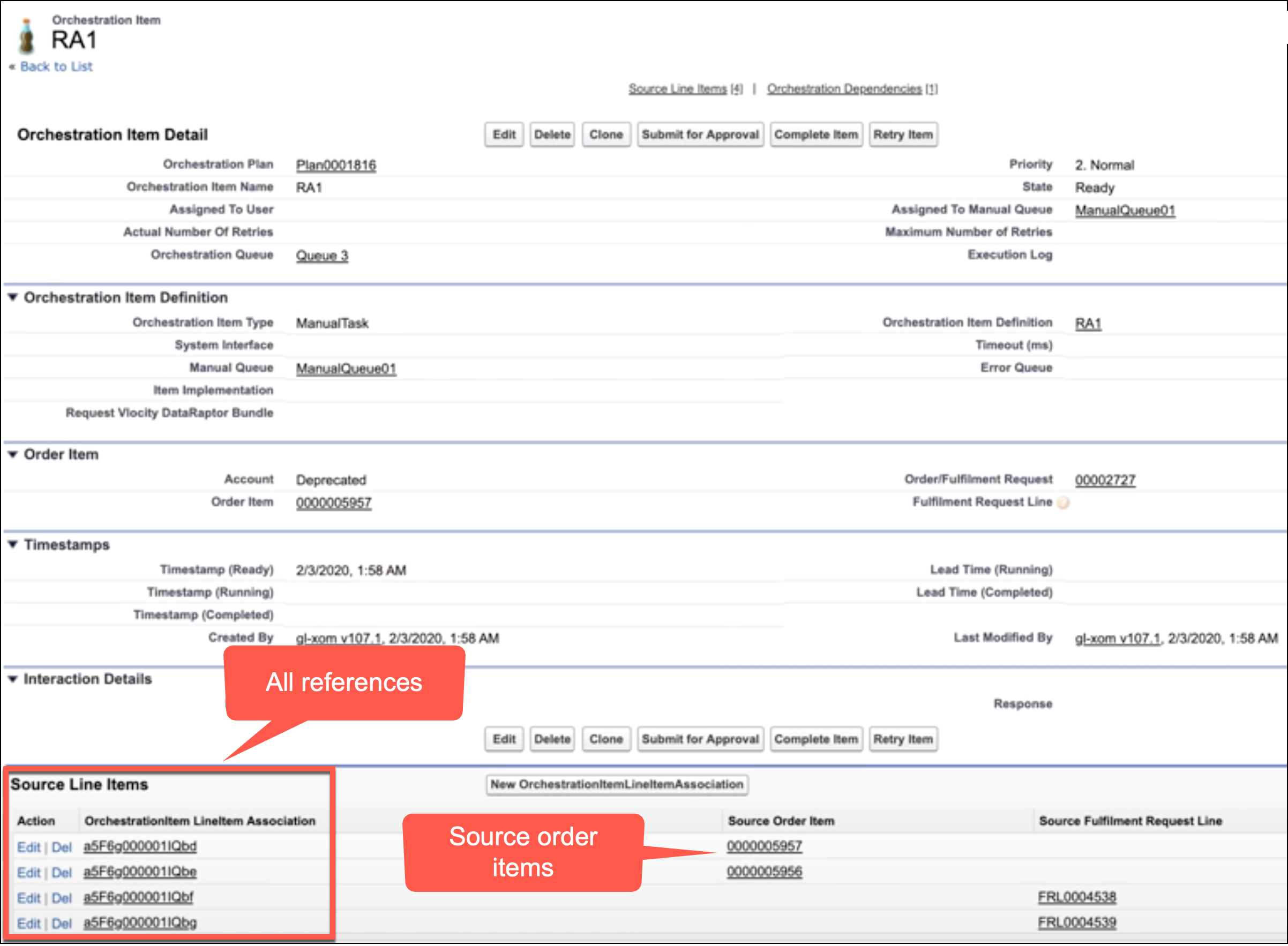
Note that some scopes result in one orchestration item having references to several order items. You can see these associations on the Orchestration Item page.
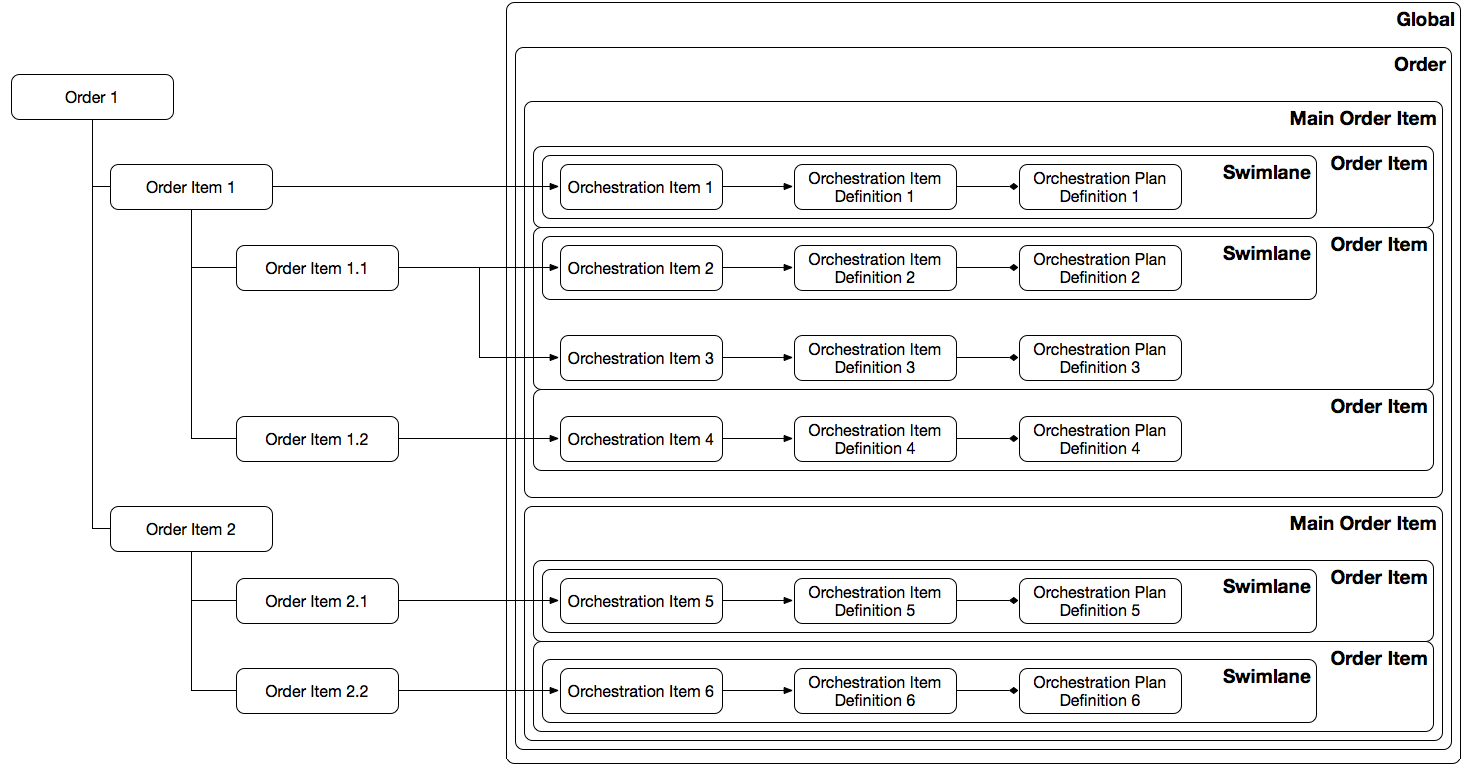
There is a "containment relationship" defined for scope instances corresponding to scopes. In the following example, scope instances for upper scopes contain scope instances for the lower scopes:
Instances of global scope contain order, main order item, order item and swimlane scope instances.
Instances of order scope contain main order item, order item and swimlane scope instances.
Instances of main order item scope contain order item and swimlane scope instances.
Instances of order item scope contain swimlane scope instances.