Data Processing Engine Definition to Calculate Purchase Credit and Bonus (Example)
Cloud Kicks provides a 5% year-end purchase credit to accounts based on their total
effective orders that ended between January 1 and November 30. The salespeople associated with
these orders are also rewarded with 0.5% of the total order amount as a bonus. The purchase
credit and bonus are granted to the accounts and salespeople on December 1 each
year.
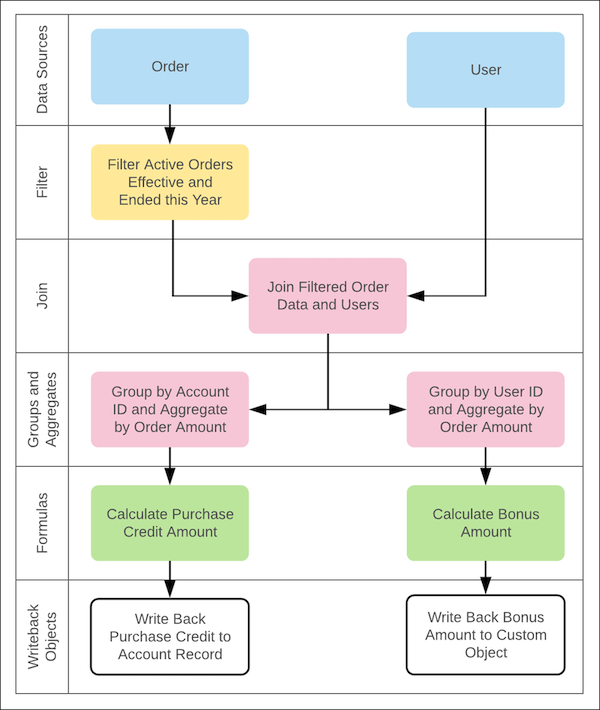
The Cloud Kicks admin uses a Data Processing Engine definition to calculate the account
purchase credit and the sales bonus. The purchase credit is written back to a Purchase Credit
Amount custom field on the Account object. The bonus is written back to the Salesperson Bonus
custom object along with the user ID and email of the salesperson.
Here's how the Data Processing Engine definition is designed:
Create a Definition to Calculate Purchase Credit and Reward The Cloud Kicks admin created and activated a Data Processing Engine definition to calculate and update the purchase credit for accounts based on their orders. The definition is also used to calculate the bonuses to be awarded to the salespeople associated with the orders.
Run the Definition to Update Purchase Credit and Bonus An admin creates a flow to run the activated Data Processing Engine definition. The admin wants to schedule the flow to write back the results to the target objects and fields automatically on December 1, every year.
Did this article solve your issue?
Let us know so we can improve!

Loading
Salesforce Help | Article
Cookie Consent Manager
General Information
Required Cookies
Functional Cookies
Advertising Cookies
General Information
We use three kinds of cookies on our websites: required, functional, and advertising. You can choose whether functional and advertising cookies apply. Click on the different cookie categories to find out more about each category and to change the default settings.
Privacy Statement
Required Cookies
Always Active
Required cookies are necessary for basic website functionality. Some examples include: session cookies needed to transmit the website, authentication cookies, and security cookies.
Functional Cookies
Functional cookies enhance functions, performance, and services on the website. Some examples include: cookies used to analyze site traffic, cookies used for market research, and cookies used to display advertising that is not directed to a particular individual.
Advertising Cookies
Advertising cookies track activity across websites in order to understand a viewer’s interests, and direct them specific marketing. Some examples include: cookies used for remarketing, or interest-based advertising.