You are here:
How Decision Tables Work with Media Plans
The decision table-based reference implementation to ensures that the quick action availability and the Line Item Configuration panel setting for ad placements are driven by the configuration of media plans and ad placements.
Required Editions
| Available in: Lightning Experience |
| Available in: Enterprise, Performance, and Unlimited editions with Media Cloud - Growth or Media Cloud - Advanced |
Parent Decision Table for Media Plans
Parent Decision Table for Media Plans decides works as a router. When a media plan is opened or refreshed, this decision table is run behind-the-scenes. The decision table looks at the media plan's configuration and decides which child decision tables to run. The child decision tables actually control the configuration of ad placements in media plans.

The inputs to the decision table (1) such as the media plan's related opportunity deal type, quote status, and quote original action type decide the decision table's output (2). The outputs are the API names of the decision tables to run.

| Media Plan Configuration | Output |
|---|---|
|
These two decision tables are run:
|
ASM Draft Grid Rules Decision Table and ASM Draft Amend Grid Rules Decision Tables
Both decision tables decide which quick actions are available on the Ad Placement table and which Line Item Configuration panel tabs are available for ad placements in media plans. The ASM Draft Grid Rules decision table is run for media plans that media planners and sales reps are currently working on and haven't been converted to orders. The ASM Draft Amend Grid Rules decision table is run for media plans that are created for amended orders by ad operations specialists.
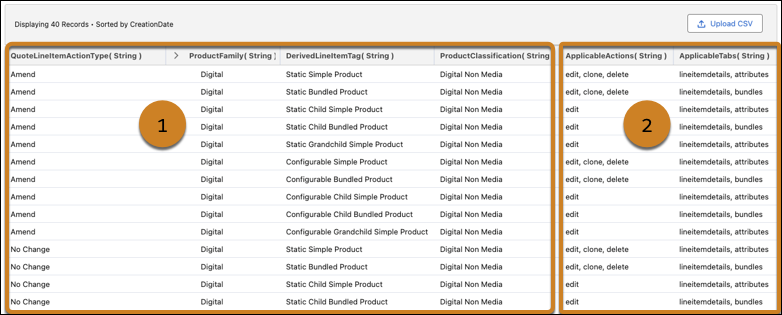
The inputs to the decision table (1) such as the media plan's media type and the related quote line action type, and the ad placement's product configuration and product classification decide the decision table's output (2). The output includes the keys of the quick actions and Line Item Configuration panel tabs that are available for ad placements. Keys are values that uniquely identify quick actions and tabs.
| Business Scenario | Media Plan and Ad Placement Configuration (Input) | Quick Actions and Line Item Configuration Panel Tabs (Output) |
|---|---|---|
| The decision table is deciding the configuration of a static simple ad placement which is a service in a media plan that a media planner is working on. |
|
|
| The decision table is deciding the configuration of a configurable bundled product which is an ad product that an ad operations specialist is amending for an order. |
|
|
ASM Draft FieldConfig Rules Decision Table and ASM Draft Amend FieldConfig Rules Decision Table
Both decision tables decide which fields are available for media planners, sales reps, and ad operations specialists on the Line Item tab of the Line Item Configuration panel for ad placements in media plans. The ASM Draft FieldConfig Rules decision table is run for media plans that media planners and sales reps are currently working on and haven't been converted to orders. The ASM Draft Amend FieldConfig Rules decision table is run for media plans that are created for amended orders by ad operations specialists.
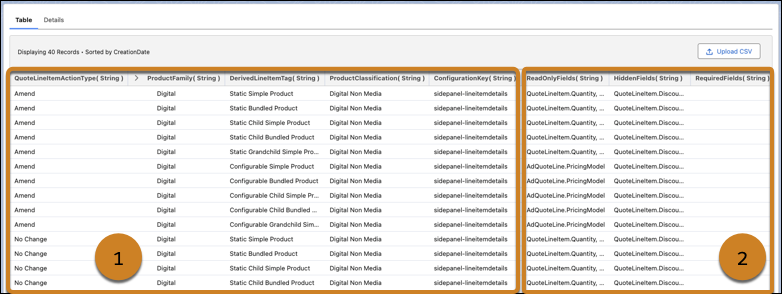
The inputs to the decision table (1) such as the media plan's media type and the related quote line action type, and the ad placement's product configuration and product classification decide the decision table's output (2). The output includes the developer names of the fields that are displayed, mandated, and hidden on the Line Item tab of the Line Item Configuration panel.
| Business Scenario | Media Plan and Ad Placement Configuration (Input) | Quick Actions and Line Item Configuration Panel Tabs (Output) |
|---|---|---|
| The decision table is deciding the configuration of the Line Item tab for a static simple ad placement which is a service in a media planner is working on. |
|
|
| The decision table is deciding the configuration of the Line Item tab for a configurable bundled product which is an ad product that an ad operations specialist is amending for an order. |
|
|
