The Revenue Schedules for Media data model includes objects and fields that publishers
can use to store and manage information about planned and actual revenue for opportunities and
their products across broadcast or Gregorian calendar months. The data model is built with
industry-wide best practices, and you can adapt and extend the data model to meet your company’s
unique needs.
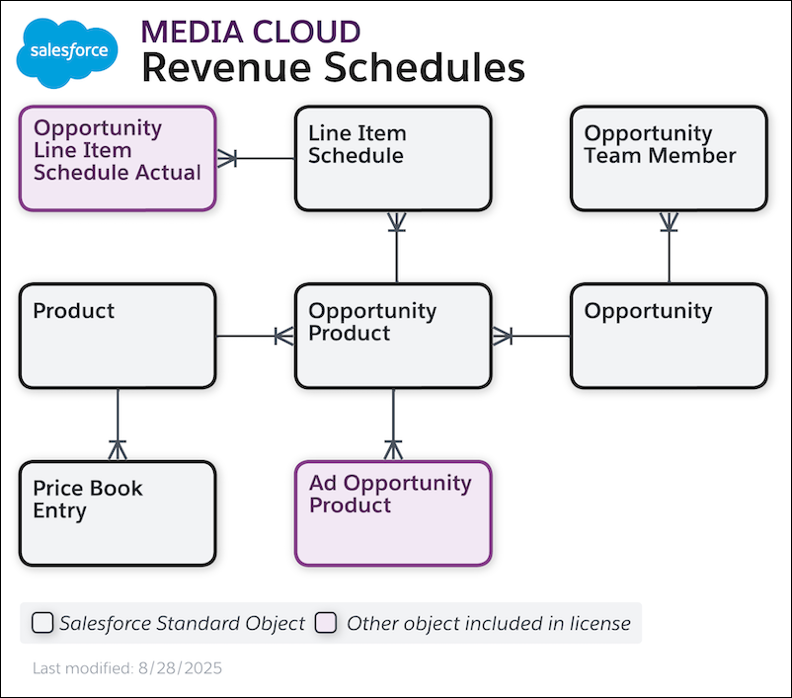
Required Editions
Available in: Lightning Experience
Available in: Enterprise, Performance, and Unlimited editions with Media Cloud -
Advanced
Product
Stores information about a product that the sales team adds to opportunities. For example,
skyscrapper and pre-roll video are products.
Price Book Entry
Stores information about the price of a product. For example, $20 is the price of the
skyscrapper product.
Opportunity
Stores information about an advertisement campaign that the sales team is working on.
Opportunity Team Member
Stores information connecting an opportunity with a sales team member who is part of an
opportunity. For example, Maria Jimenez and Roberto Alvarez are sales reps for an
opportunity.
Opportunity Product
Stores information connecting an opportunity with a product. For example, products such as
skyscrapper and pre-roll video are part of the an opportunity.
Ad Opportunity Product
Stores revenue schedule-specific information for an opportunity products. For example,
information such as calendar type and revenue distribution logic for an opportunity product's
revenue schedules are stored.
Line Item Schedule
Stores information about a schedule generated for an opportunity product. For example, a
line item schedule is generated based on the broadcast calendar for an opportunity product to
represent the November 2025 broadcast month that runs between October 27, 2025 and November
30, 2025.
Opportunity Line Item Schedule Actual
Stores information about the actual revenue realized for a line item schedule. For example,
an opportunity line item schedule actual contains the booked, delivered, and billed revenue of
an opportunity product for the November, 2025 broadcast month.
We use three kinds of cookies on our websites: required, functional, and advertising. You can choose whether functional and advertising cookies apply. Click on the different cookie categories to find out more about each category and to change the default settings.
Privacy Statement
Required Cookies
Always Active
Required cookies are necessary for basic website functionality. Some examples include: session cookies needed to transmit the website, authentication cookies, and security cookies.
Functional Cookies
Functional cookies enhance functions, performance, and services on the website. Some examples include: cookies used to analyze site traffic, cookies used for market research, and cookies used to display advertising that is not directed to a particular individual.
Advertising Cookies
Advertising cookies track activity across websites in order to understand a viewer’s interests, and direct them specific marketing. Some examples include: cookies used for remarketing, or interest-based advertising.
