Adjusted Amount Calculation Logic for Revenue Schedules for Media
When orders are executed, the actual amounts can differ across months. Based on either
of the booked, delivered, and billed amounts from previous months, the sales team can
automatically get the adjusted amounts for the future schedules. Learn about how adjusted amount
is calculated in different scenarios.
Required Editions
Available in: Lightning Experience
Available in: Enterprise, Performance, and Unlimited editions with Media Cloud -
Advanced
How is Adjusted Amount Calculated in Different Scenarios?
For an opportunity product, the aggregate actual amount from previous schedules determines the
adjusted amount for future schedules. The actual amount calculation can be based on either
of these standard fields: Booked Amount, Delivered Amount, or Billed Amount. The aggregate
actual amount is deducted from the total budget of the opportunity product and the remaining
budget is considered the adjusted amount. The adjusted amount is divided among the future
schedules based on the revenue split type of the opportunity. In case of equally split
schedules, the adjusted amount is split among the remaining schedules equally. For prorated
schedules, the adjusted amount is split among schedules based on the number of days in each
schedule.
Business Scenario
Adjusted Amount
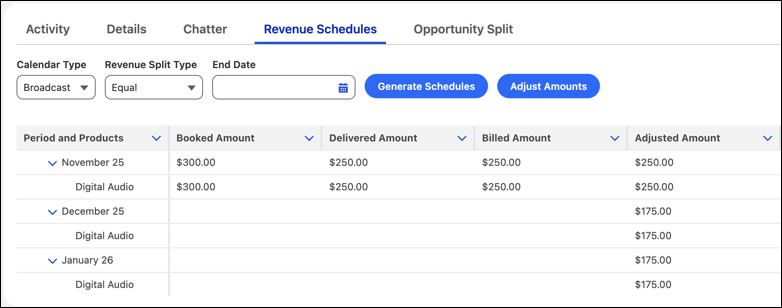
The $600 budget for an opportunity product is split equally among three
broadcast calendar-based schedules with each schedule having a budget of $200. In
the first schedule, the billed amount is $250 and the adjusted amount is calculated
based on the billed amount.
Adjusted amount for the second and third schedules are $175.
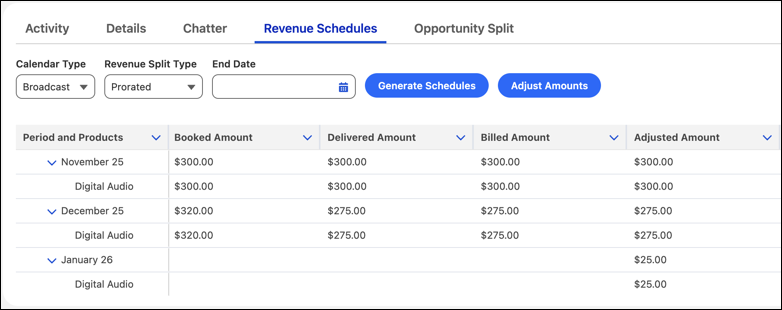
The $600 budget for an opportunity product is split in proration among three
broadcast calendar-based schedules with each schedule having a budget of $295.08,
$275.41, and $29.51. In the first two schedules, the billed amount is $300 and $275,
and the adjusted amount is calculated based on the billed amount.
Adjusted amount for the third schedule is $25.
Adjusted amount for a broadcast calendar-based revenue schedule with equal
budget split
Adjusted amount for a Gregorian calendar-based revenue schedule with prorated
budget split
Can Adjusted Amount be Calculated Based on a Custom Field?
Adjusted amounts can be calculated on the basis of a custom Currency data type field on the
Opportunity Line Item Schedule Actual object. For example, if your sales team wants to
calculate adjusted amounts based on the actual amounts paid by the advertiser across
schedules, the admin can add the Paid Amount field to the Opportunity Line Item Schedule
Actual object and set the custom field as the basis for adjusted amount calculation. To
learn about how to set a custom field for adjusted amount calculation, see Set Default Preferences for
Revenue Schedule for Media.
Did this article solve your issue?
Let us know so we can improve!
Loading
Salesforce Help | Article
Cookie Consent Manager
Cookie Consent Manager
General Information
Required Cookies
Functional Cookies
Advertising Cookies
General Information
We use three kinds of cookies on our websites: required, functional, and advertising. You can choose whether functional and advertising cookies apply. Click on the different cookie categories to find out more about each category and to change the default settings.
Privacy Statement
Required Cookies
Always Active
Required cookies are necessary for basic website functionality. Some examples include: session cookies needed to transmit the website, authentication cookies, and security cookies.
Functional Cookies
Functional cookies enhance functions, performance, and services on the website. Some examples include: cookies used to analyze site traffic, cookies used for market research, and cookies used to display advertising that is not directed to a particular individual.
Advertising Cookies
Advertising cookies track activity across websites in order to understand a viewer’s interests, and direct them specific marketing. Some examples include: cookies used for remarketing, or interest-based advertising.