You are here:
Considerations for Selecting Base Objects
Before you select a base object, we recommend that you review these considerations.
Required Editions
| Available in: Lightning Experience |
| Available in: all editions with the Industry Service Excellence licenses |
Considerations for Selecting a Base Object Other than Service Catalog Request
When creating data attributes of type Base for an object other than the Service Catalog Request object, create a lookup relationship between the base object and either the Case or Service Catalog Request object. To establish this relationship, create a base-type data attribute on the base object and select a field that’s a lookup to either Case or Service Catalog Request. If such a field doesn’t exist, create a custom field using the Object Manager. After you’ve selected the field, select the Derive attribute value at runtime checkbox and select an appropriate Reference Object.
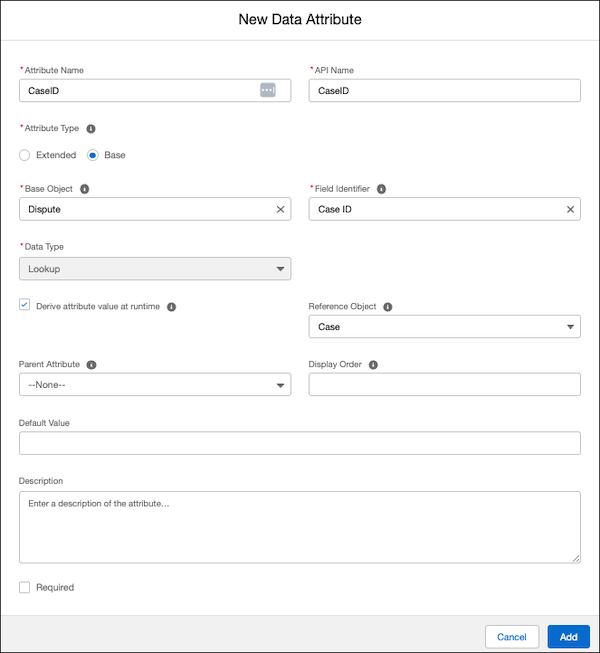
For example, to create a lookup relationship between Dispute and Case objects, define a data attribute CaseId with these details.
| Parameter | Value |
|---|---|
| Attribute Type | Base |
| Base Object | Dispute |
| Field Identifier | Case ID |
| Derive attribute value at runtime | TRUE |
| Reference Object | Case |
Considerations for Selecting More than One Base Object
You can define data attributes of type Base for up to two base objects that have a relationship between them. Additionally, one of these base objects must be related to either the Case or Service Catalog Request object.
Here’s an example of a set of base-type data attributes defined for a transaction dispute service process. The attributes are defined across two base objects—Dispute and Dispute Item. The Dispute object is connected to the Case object through the Case Id base attribute, while the Dispute Item object is connected to the Dispute object through the Dispute Id base attribute. When a case is created for the service process request with these attributes, the values for Case Id and Dispute Id attributes are derived automatically from the corresponding reference objects. However, the Account Id attribute’s value must be explicitly passed in the service process definition API payload for creating a case.
| Attribute Name | Attribute Type | Data Type | Base Object | Field Identifier | Derive Attribute Value at Runtime | Reference Object |
|---|---|---|---|---|---|---|
| Description | Base | Text | Dispute | Description | FALSE | — |
| Status | Base | Text | Dispute | Status | FALSE | — |
| Dispute Type | Base | Text | Dispute | Dispute Type | FALSE | — |
| Dispute Subtype | Base | Text | Dispute | Dispute Subtype | FALSE | — |
| Case Id | Base | Lookup | Dispute | Case ID | TRUE | Case |
| Disputed Amount | Base | Currency | Dispute | Disputed Amount | FALSE | — |
| Approved Amount | Base | Currency | Dispute | Approved Amount | FALSE | — |
| Account Id | Base | Lookup | Dispute | Account ID | FALSE | — |
| Dispute Id | Base | Lookup | Dispute Item | Dispute ID | TRUE | Dispute |
| Status | Base | Text | Dispute Item | Status | FALSE | — |
| Transaction Amount | Base | Currency | Dispute Item | Transaction Amount | FALSE | — |
| Transaction Date | Base | Date | Dispute Item | Transaction Date | FALSE | — |
