An integration definition is a framework to set up integrations with different external
endpoints quickly and efficiently.
Required Editions
Available in: Lightning Experience
Available in:
all
editions with the
Industry Service Excellence licenses
If a fulfillment flow requires Salesforce org to connect to an external API to send
details to an external system such as a banking system or healthcare system, you can use
integration definitions to quickly set up the communication with an external
endpoint.
To create the integration definitions, you can choose between two options:
External Services Defined: A low code and declarative approach to connect Salesforce
with an external endpoint. Learn more about External Services Registration in External Services
Registration.
Apex Defined: Gives greater control over the API call out. In this integration
definition type, the end-point configuration, the input processor, and the output
processor are handled in an Apex class.
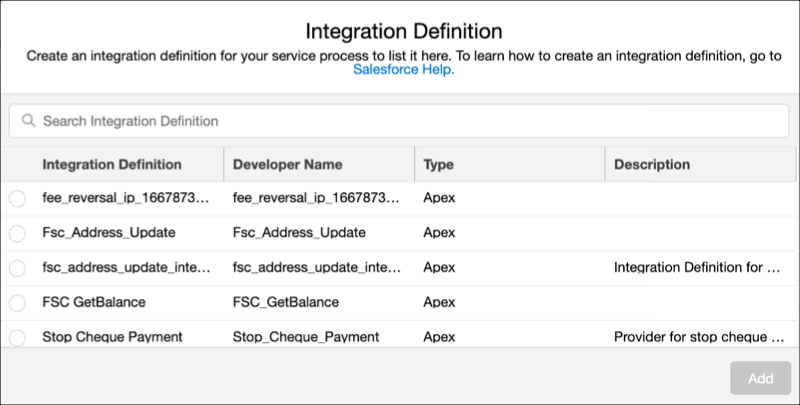
Associate the Integration Definition with a Service Process Definition
You can associate the integration definition that you plan to use within the
fulfillment flow in the Service Process Studio. When creating a service process
definition, add the integration definition in the Service Process Studio as shown in
this example. When you plan to migrate Service Process Definitions across the org,
the associated Integration Definitions are also migrated making the post migration
process easy.
Cet article a-t-il résolu votre problème ?
Dites-nous ce que nous pouvons améliorer !
Chargement
Salesforce Help | Article
Cookie Consent Manager
General Information
Required Cookies
Functional Cookies
Advertising Cookies
General Information
We use three kinds of cookies on our websites: required, functional, and advertising. You can choose whether functional and advertising cookies apply. Click on the different cookie categories to find out more about each category and to change the default settings.
Privacy Statement
Required Cookies
Always Active
Required cookies are necessary for basic website functionality. Some examples include: session cookies needed to transmit the website, authentication cookies, and security cookies.
Functional Cookies
Functional cookies enhance functions, performance, and services on the website. Some examples include: cookies used to analyze site traffic, cookies used for market research, and cookies used to display advertising that is not directed to a particular individual.
Advertising Cookies
Advertising cookies track activity across websites in order to understand a viewer’s interests, and direct them specific marketing. Some examples include: cookies used for remarketing, or interest-based advertising.