You are here:
Inventory Transaction Audit Trail
Maintain data integrity and visibility across asset-based inventory by using an automated double-entry transaction engine. By separating physical stock movements from state-bucket changes, IT Hardware Asset Management tracks inventory transitions while preserving auditability for finance reconciliations and compliance investigations.
Required Editions
| Available in: Lightning Experience |
| Available in: Enterprise, Performance, and Unlimited Editions with Agentforce IT Service. |
Dual-Ledger Data Model: PIT vs. PIAT
To support granular asset tracking across lifecycles, the inventory engine automatically logs quantitative changes by using two platform objects:
- Product Item Transaction (PIT): Standard object that tracks physical inventory movement in and out of a location by recording changes directly to Quantity On Hand.
- Product Item Additional Transaction (PIAT): Standardized object that tracks internal status shifts within state buckets, including Quantity Allocated, Quantity Soft Reserved, Quantity Damaged, and Quantity On Hold.
Asset Location & Product Item Hierarchy
- Location: Base site record configured with Usage Type set to Asset-based.
- Product Item: Represents inventory stored at a specified location.
Transaction Engine Architecture
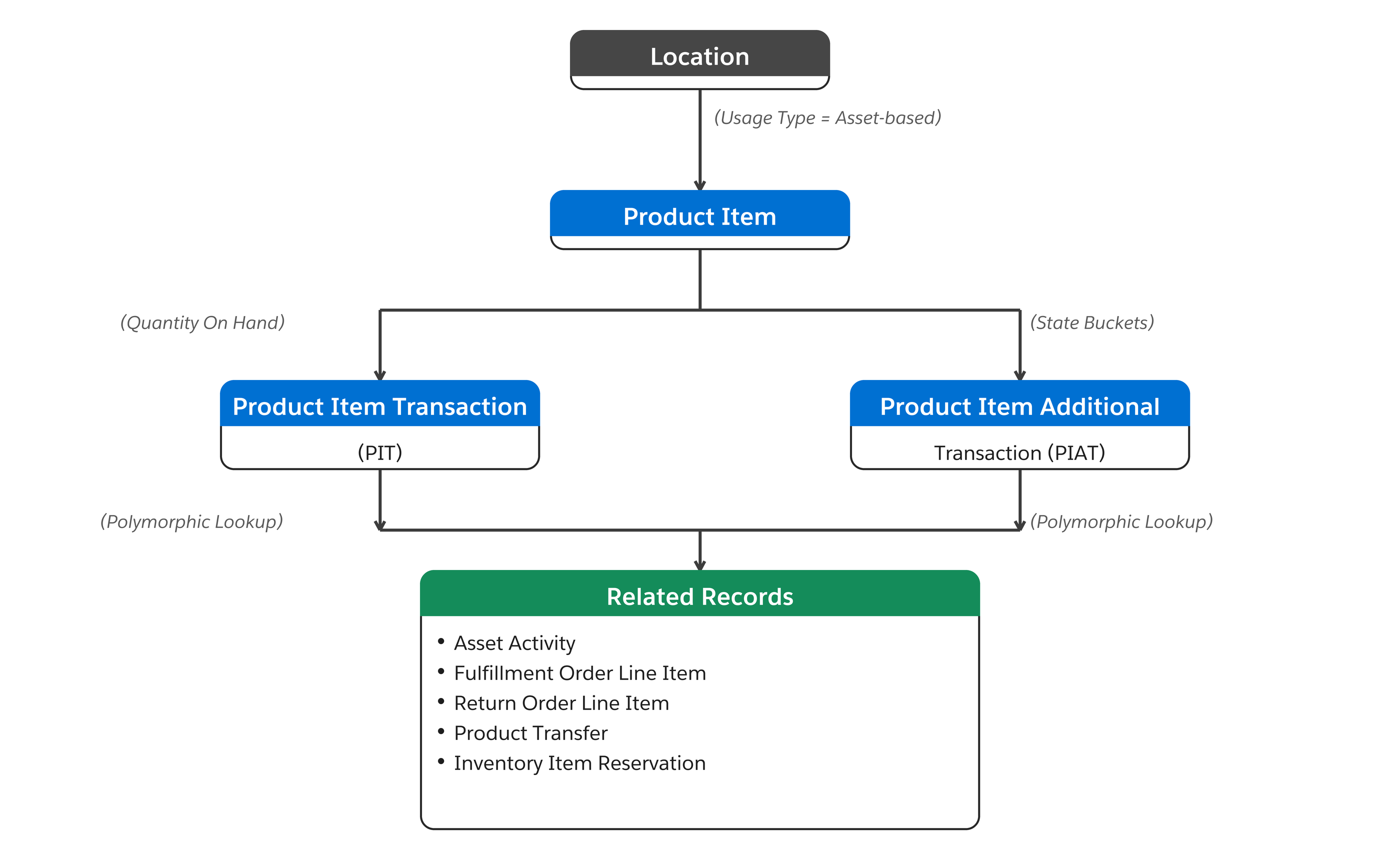
Quantitative stock changes on a Product Item split into two specialized transaction objects based on movement type:
| Object Record | Inventory Metric Tracked | Transaction Scope |
|---|---|---|
| Product Item Transaction (PIT) | Quantity On Hand | Records physical stock increases or decreases moving in and out of the location. |
| Product Item Additional Transaction (PIAT) | State Quantity Buckets | Logs internal state shifts, including Quantity Allocated, Quantity Soft Reserved, Quantity Damaged, and Quantity On Hold. |
Polymorphic Lookup Association
Both PIT and PIAT ledger entries use the polymorphic lookup field RelatedRecord to link inventory transactions back to the originating operational record:
- Asset Activity
- Fulfillment Order Line Item
- Return Order Line Item
- Product Transfer
- Inventory Item Reservation
Inventory transaction relationships
Movement Transactions
Physical updates alter total inventory counts at a location or transfer hardware between locations. These actions generate a Product Item Transaction (PIT) entry to update Quantity On Hand.
- Examples: Receiving a vendor shipment, dispatching a product transfer to a stockroom, or marking an asset as disposed.
State Change Transactions
Internal status changes shift inventory between operational states without moving physical stock out of a location. These actions generate a Product Item Additional Transaction (PIAT) entry to update designated state quantity buckets.
- Examples: Soft-reserving inventory for a request, allocating stock to an order, or marking stock as defective.
Formula Fields and Audit Behavior
Calculated inventory fields, such as Quantity Available, don’t directly generate transaction records when values change. Because Quantity Available is a formula field derived from Quantity On Hand minus state allocations, PIT and PIAT ledger entries fully capture underlying changes. Double-entry transaction records preserve complete audit trails.
