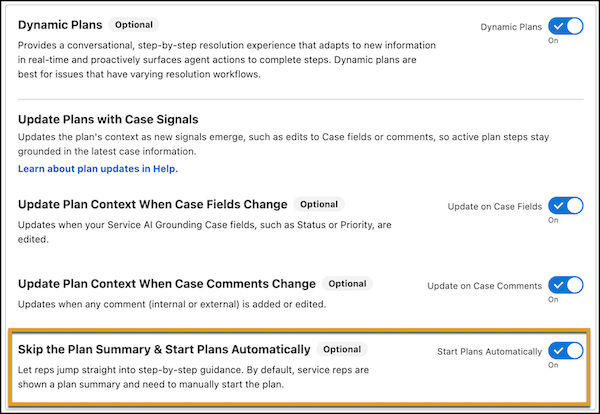
By default, service reps see a plan summary for the case and click Start
Plan to show the first step of the dynamic plan. When you turn on Skip
the Plan Summary & Start Plans Automatically, Service Assistant skips the plan
summary and shows the first step right away. Service reps don't see a plan summary or a
Start Plan button.
From Setup, in the Quick Find box, enter Service Assistant, and then
select Service Assistant Setup.
Click the Case tab.
In the Dynamic Plans section, confirm that Dynamic Plans is turned
on.
Turn on Skip the Plan Summary & Start Plans Automatically.
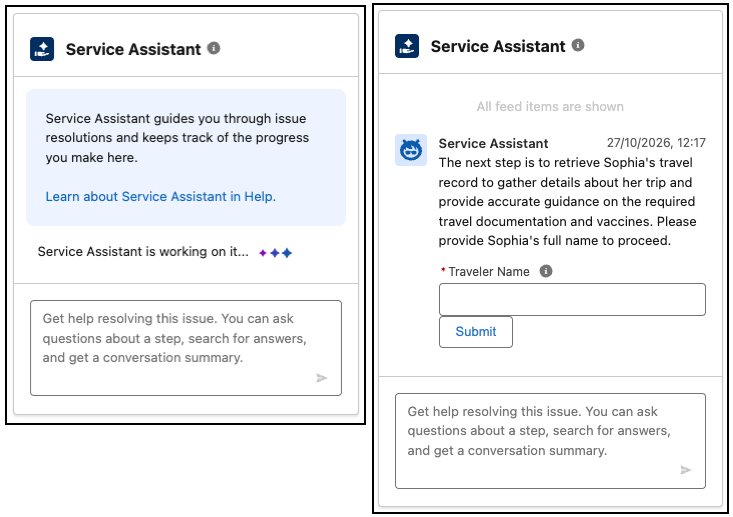
To confirm the setting works, open a new eligible case record. You see "Service Assistant is
working on it…" which means the eligibility criteria are met and the service plan is
generating. Then the first step of the plan shows automatically. There's no plan summary or
Start Plan button.
Did this article solve your issue?
Let us know so we can improve!
Loading
Salesforce Help | Article
Cookie Consent Manager
Cookie Consent Manager
General Information
Required Cookies
Functional Cookies
Advertising Cookies
General Information
We use three kinds of cookies on our websites: required, functional, and advertising. You can choose whether functional and advertising cookies apply. Click on the different cookie categories to find out more about each category and to change the default settings.
Privacy Statement
Required Cookies
Always Active
Required cookies are necessary for basic website functionality. Some examples include: session cookies needed to transmit the website, authentication cookies, and security cookies.
Functional Cookies
Functional cookies enhance functions, performance, and services on the website. Some examples include: cookies used to analyze site traffic, cookies used for market research, and cookies used to display advertising that is not directed to a particular individual.
Advertising Cookies
Advertising cookies track activity across websites in order to understand a viewer’s interests, and direct them specific marketing. Some examples include: cookies used for remarketing, or interest-based advertising.