You are here:
Pricing Components and Data Model
See how Penny Perfect Pricing separates the metadata that defines pricing logic from the condition data loaded from your ERP.
Required Editions
| Available in: Lightning Experience |
| Available in: Enterprise and Unlimited Editions in Manufacturing Cloud, Automotive Cloud, and Consumer Goods Cloud, with required add-ons. |
Penny Perfect Pricing uses a modular, layered metadata architecture to define pricing logic and structured standard objects to stage and retrieve pricing conditions.
Pricing Components
Five metadata components define how Penny Perfect Pricing evaluates and calculates prices:
- Calculation Schema Determiner
- Maps business context (order pricing type and Internal Organization Unit) to the correct Pricing Calculation Schema, routing each transaction to the right pricing logic. You can create these mappings directly, or set them up automatically by configuring a Procedure Plan Definition (in Setup) with criteria based on order pricing type and Internal Organization Unit — activating the plan version generates the underlying determiner records for you.
- Pricing Calculation Schema
- Defines the complete, ordered sequence of calculation steps performed during order pricing. It controls step execution sequence, references pricing specifications, stores interim subtotal values, and evaluates stop-processing logic.
- Pricing Specification
- Defines individual pricing elements (such as Base Price, Customer Discount, Freight Surcharge, or Sales Tax) and their calculation behavior. It specifies rounding precision, price impact (Plus or Minus), and links to a Search Strategy for condition lookups.
- Pricing Search Strategy
- Defines the prioritized sequence of search steps (waterfall) used to find matching prices. Evaluation moves from the most specific key combination to least specific fallbacks, with support for exclusive (stop on first match) or non-exclusive execution.
- Pricing Key Type
- Defines the combination of context attributes (up to 10 keys, such as Account, Customer Group, Product, or Sales Org) that form the lookup keys for pricing condition queries.
Pricing Data Model
The data model separates pricing metadata objects (logic configured by administrators) from pricing data objects (condition master rates loaded from your ERP).
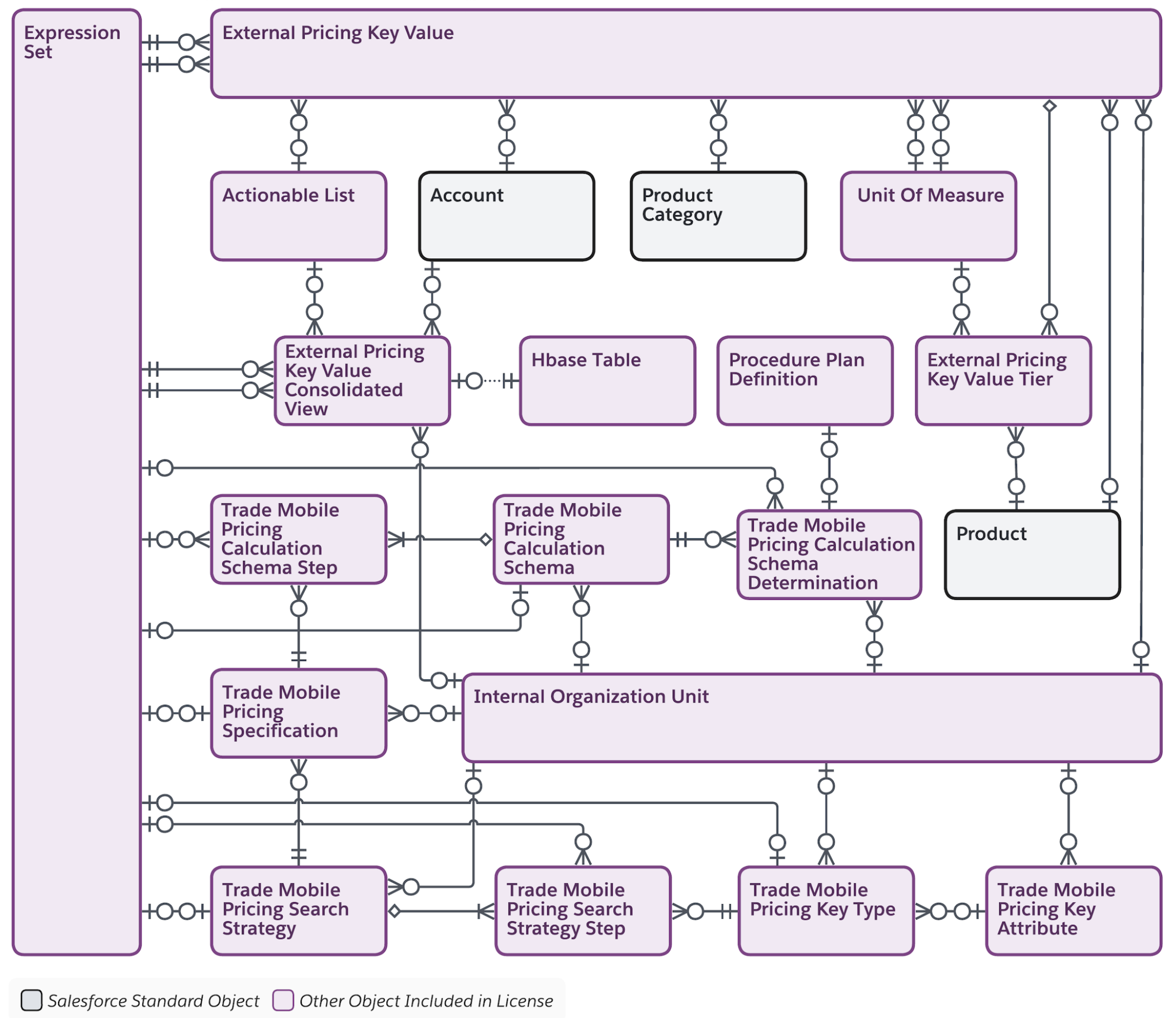
The above diagram shows the relationship between external pricing condition staging tables, the consolidated lookup view, and the underlying Expression Set metadata entities used for runtime calculation.
Pricing Metadata Objects
| Object | Purpose | Example |
|---|---|---|
| Pricing Key Type | Defines the field attributes that form the lookup key. | Customer ID + Product ID |
| Pricing Search Strategy | Defines the prioritized condition lookup sequence. | Customer → Customer Group → Base Price |
| Pricing Specification | Defines calculation rules, rounding, and price impact for an element. | Volume Discount (-10%, Graduated Scale) |
| Pricing Calculation Schema | Assembles specifications into an ordered calculation procedure. | Base Price → Discount → Tax → Net Price |
Pricing Data Objects
| Object | Managed By | Purpose |
|---|---|---|
| External Pricing Key Value | Loaded from ERP | Stores condition master records, including rates, currency, validity dates, and merge keys. |
| External Pricing Key Value Tier | Loaded from ERP | Stores scale and tier threshold boundaries for volume-based pricing conditions. |
| External Pricing Key Value Consolidated View | System Generated (Data Processing Engine) | Aggregates condition masters and tier data into an optimized, high-performance lookup table for runtime queries. |
Object Relationships and Data Flow
Here's the relationship flow from ERP condition data loading to runtime pricing calculation:
- ERP Pricing Data Import loads into External Pricing Key Value and External Pricing Key Value Tier.
- The External Pricing Key Value Consolidation DPE job consolidates both into External Pricing Key Value Consolidated View.
- At runtime, Order Submission flows through Procedure Plan → Calculation Schema → Search Strategy, querying the consolidated view to produce the Net Price Output.
