Access the Quip Template Library in Salesforce to quickly create a new Quip document
that’s automatically linked to a Salesforce record. If the template contains mail merge syntax,
it’s populated with Salesforce data automatically.
Required Editions
Available in: Lightning Experience
Ensure that you or your admin created the template that you want to use. You can only create
templates in Quip.
Ensure that you completed the connection from Quip to Salesforce in the Salesforce tab of
the Quip Account Settings window.
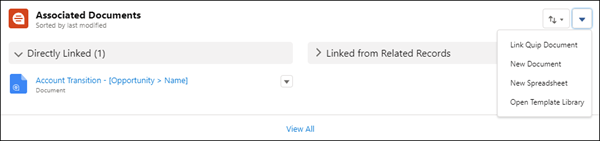
In the Quip Associated Documents component, click Open Template
Library from the dropdown.
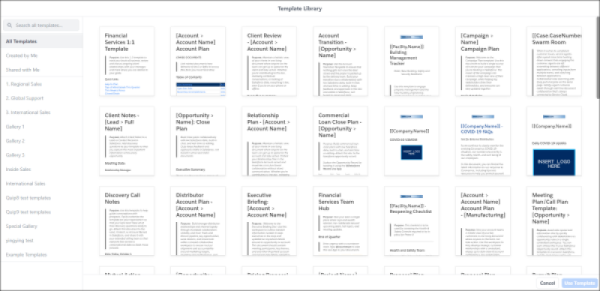
In the Template Library, select the template to use, and click Use
Template.
You can search by name across all galleries, or you can narrow your search to a specific
gallery.
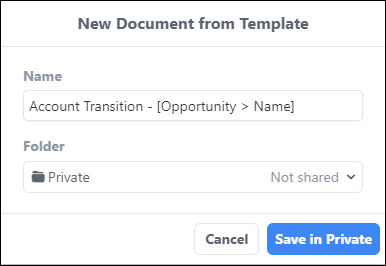
The New Document from Template window appears.
Select the Quip folder where you want to save the document.
To preserve any mail merge syntax, the document name isn’t editable.
Click Save in.
Your new document appears in the Quip canvas.
If the template contains mail merge syntax, your new document is populated with Salesforce
data right away. Link sharing also takes effect immediately.
In the background, Salesforce works on linking the document to the record and setting up any
synced sharing that you configured. When the link to the record is complete, the
document is listed in the Associated Documents component.
Edit the document as needed, and then close the Quip canvas.
We use three kinds of cookies on our websites: required, functional, and advertising. You can choose whether functional and advertising cookies apply. Click on the different cookie categories to find out more about each category and to change the default settings.
Privacy Statement
Required Cookies
Always Active
Required cookies are necessary for basic website functionality. Some examples include: session cookies needed to transmit the website, authentication cookies, and security cookies.
Functional Cookies
Functional cookies enhance functions, performance, and services on the website. Some examples include: cookies used to analyze site traffic, cookies used for market research, and cookies used to display advertising that is not directed to a particular individual.
Advertising Cookies
Advertising cookies track activity across websites in order to understand a viewer’s interests, and direct them specific marketing. Some examples include: cookies used for remarketing, or interest-based advertising.