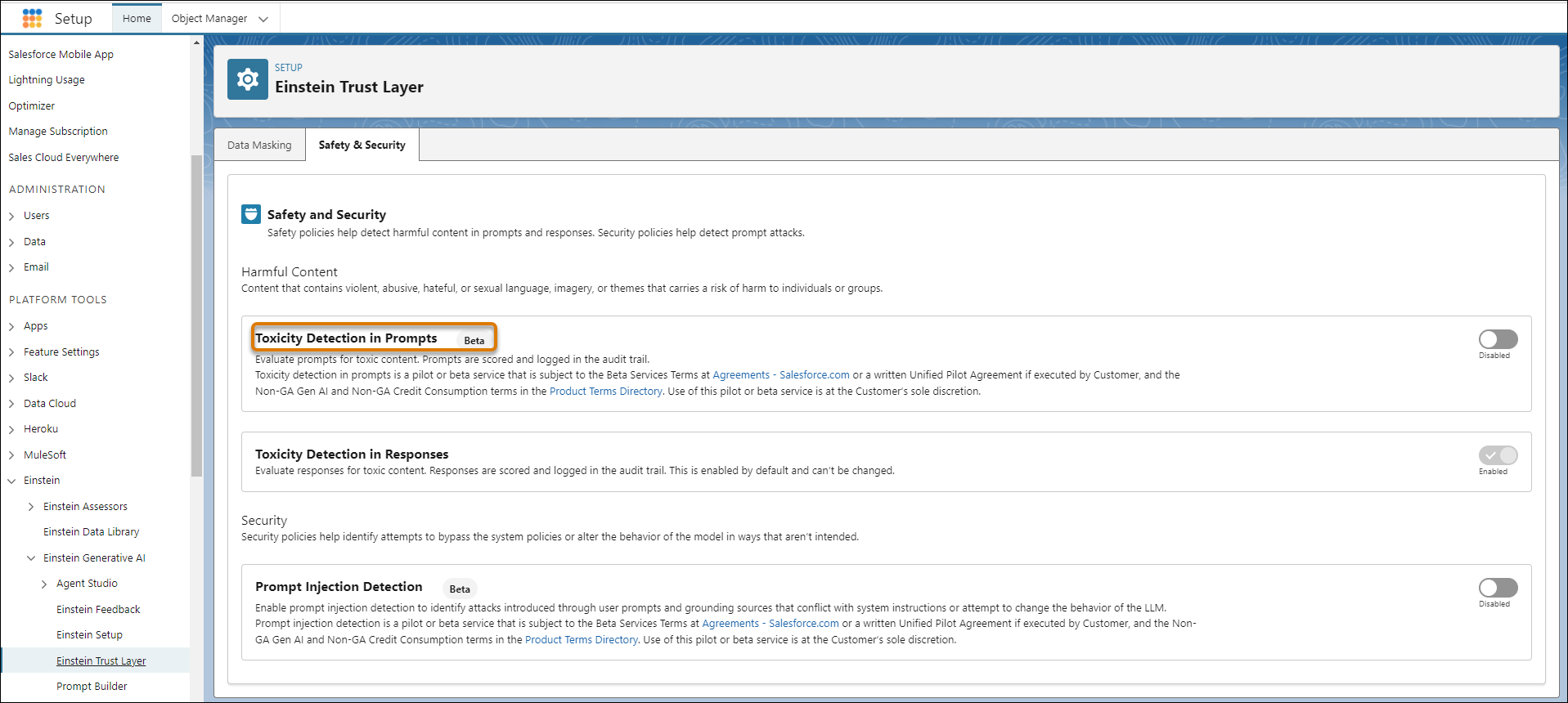
Turn on toxicity detection in prompts so you can monitor the prompts that have toxic
language and modify them accordingly. These settings are applied to your Salesforce
org.
Required Editions
Available in: Enterprise, Performance, and Unlimited
Editions with an Einstein for Sales, Einstein for Platform, Einstein for Service,
Einstein 1 Service, or Einstein GPT Service add-on. To purchase add-ons, contact
your Salesforce account executive.
User Permissions
Needed
To turn on toxicity detection in prompts:
View Setup
AND
Customize Application
Einstein Generative AI must be enabled.
Toxicity detection in responses is turned on by default and can't be turned off. By
turning on toxicity detection in prompts, you can monitor prompts that have
problematic language that can lead to toxicity in responses.
Note Toxicity Detection in prompts is in Beta.
From Setup, in the Quick Find field, enter Einstein, and
then select Einstein Trust Layer.
Note If you can’t find Einstein Generative AI Setup,
make sure that your org meets the prerequisites for any generative AI
features you plan to use. For more support, contact your Salesforce account
executive (AE).
Click Safety & Security.
Review the beta service terms. Turn on toxicity detection in prompts.
We use three kinds of cookies on our websites: required, functional, and advertising. You can choose whether functional and advertising cookies apply. Click on the different cookie categories to find out more about each category and to change the default settings.
Privacy Statement
Required Cookies
Always Active
Required cookies are necessary for basic website functionality. Some examples include: session cookies needed to transmit the website, authentication cookies, and security cookies.
Functional Cookies
Functional cookies enhance functions, performance, and services on the website. Some examples include: cookies used to analyze site traffic, cookies used for market research, and cookies used to display advertising that is not directed to a particular individual.
Advertising Cookies
Advertising cookies track activity across websites in order to understand a viewer’s interests, and direct them specific marketing. Some examples include: cookies used for remarketing, or interest-based advertising.