Get more relevant search results using prefilters in your prompt templates. Prefilters
define the conditions that limit the scope of a retriever’s search so that only the most relevant
information is returned. For example, you can use prefilters to retrieve content associated with
only a particular country or product. The filter value, such as the country code or product Id, is
specified in the prompt template at run time.
Required Editions
Available in: Lightning Experience
Available in: Enterprise, Performance, and Unlimited
Editions with the Einstein for Platform, or Einstein or Agentforce for Sales or
Service add-on, or Agentforce Foundations
User Permissions Needed
To create and manage prompt templates in Prompt Builder:
Prompt Template Manager permission set
To create and manage retrievers:
Data Cloud permission set
To run prompts with Einstein search:
Data Cloud User permission set
Note To use prefilters in Prompt Builder, the Einstein Search retriever must be configured in
AI Models (formerly Einstein Studio) with at least one filter condition with the Dynamic property selected. To learn
more, see the instructions for defining filter conditions in Create an Individual Retriever.
In Prompt Builder, create or edit a prompt template.
In the Prompt Template Workspace, click where you want to insert the retriever.
Type @ or click Insert Resource, click
Retrievers, and click Configure Retrievers
+.
Select the retriever you want to add to the prompt template.
This retriever must have at least one filter condition with the Dynamic setting
enabled.
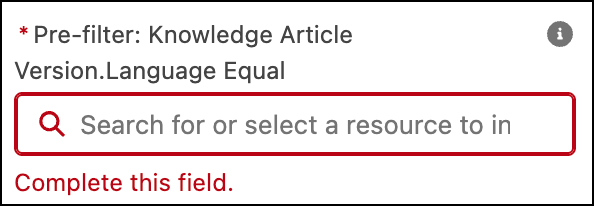
Under Template Settings, scroll to the Search Parameters section and find a Pre-filter
input field. Example:
If you don’t see a Pre-filter input field, go to AI Models and verify that the selected
retriever is configured with at least one filter condition that's configured as Dynamic.
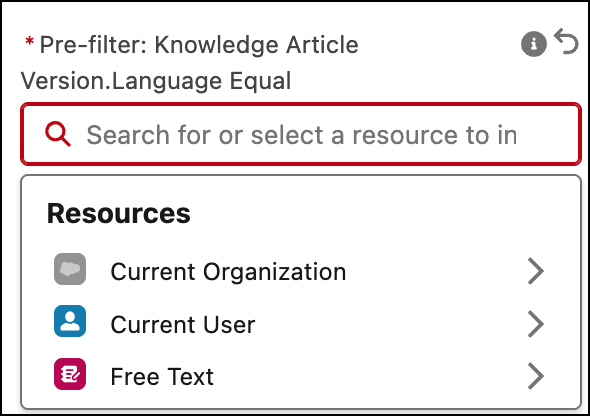
Click the Pre-filter field to open the resource
picker and select the source of the filter value for the pre-filter field.
The selected value appears in the Pre-filter field.
To remove a setting, select the X. To return to a previously selected setting, select the
undo () icon.
Change other template settings, if you want.
Click Apply and Insert.
Save your work.
Test your changes. Preview the prompt template and review the LLM-generated response.
We use three kinds of cookies on our websites: required, functional, and advertising. You can choose whether functional and advertising cookies apply. Click on the different cookie categories to find out more about each category and to change the default settings.
Privacy Statement
Required Cookies
Always Active
Required cookies are necessary for basic website functionality. Some examples include: session cookies needed to transmit the website, authentication cookies, and security cookies.
Functional Cookies
Functional cookies enhance functions, performance, and services on the website. Some examples include: cookies used to analyze site traffic, cookies used for market research, and cookies used to display advertising that is not directed to a particular individual.
Advertising Cookies
Advertising cookies track activity across websites in order to understand a viewer’s interests, and direct them specific marketing. Some examples include: cookies used for remarketing, or interest-based advertising.