
You are here:
Key Concepts for Predictive AI
Learn key concepts for working with predictive models in AI solutions.
Required Editions
| Available in: All Editions supported by Data 360. See Data 360 edition availability. |
Predictive Models
A predictive model is a custom statistical tool that predicts future business outcomes based on trends and patterns in past results, plus current business data. The model’s equation is the result of a thorough statistical analysis of past data with known outcomes, powered by machine learning and AI. Predictive models are used extensively around the world—across industries, organizations, disciplines—and they’re involved in so many aspects of everyday life. Businesses use predictive models to integrate data-driven decision making throughout all levels and functions of their organization.
Predictions
A prediction is a derived value, produced by a predictive model, that represents a possible future business outcome. An outcome is the business result you’re trying to understand and improve. An outcome is typically a key performance indicator (KPI), such as sales margin or opportunity wins. A prediction represents an output value that the model generates based on the provided input values (predictors).
Although the future is unknown and uncertain, a prediction can reduce that uncertainty by providing a value that falls within a calculated range of probability. When it does occur, the actual outcome can differ from the predicted outcome. This is expected. We measure the accuracy of the prediction by how small or large this difference is.
Top Predictors
Top predictors are the conditions that most significantly drive the predicted outcome. If requested, top predictors are returned from a predictive model in decreasing order of magnitude. A condition is a data value associated with a column. Predictors are also known as predictor variables or independent variables.
Prescriptions
A prescription is a suggested action that a user can take to improve the predicted outcome. The prescription affects the predicted outcome, not necessarily the actual one. Prescriptions are associated with variables over which users have some discretionary control or influence, such as the shipping method or a subscriber’s membership level. By enacting Einstein's suggestions, users can increase their chances of a more favorable outcome.
Predictive Models at Run Time
A predictive model organizes data by variables and records. A variable is a category of data, such as a field in a Data Model Object (DMO). A model has inputs (values for predictor variables) and outputs predictions for the outcome variable, along with additional information if requested.
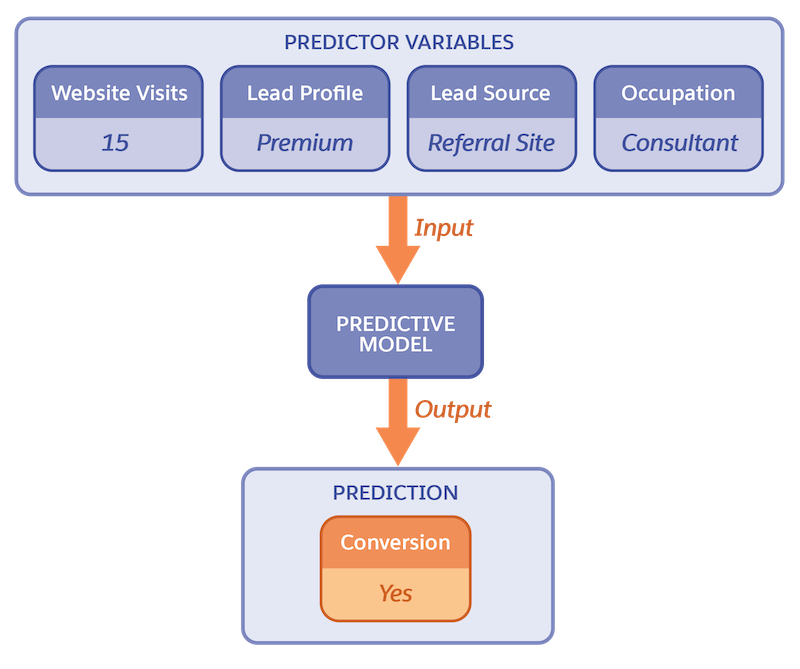
Optionally, a prediction request can be configured to include top predictors and prescriptions in the response.
How Do Predictive Models Differ from Generative Models?
Both are AI models, but they’re designed and built for different purposes. Predictive models are trained by machine learning on historical data to make predictions or decisions according to input data. Generative models create content according to input data from prompt instructions. For a detailed comparison between predictive and generative AI, see Discover AI Techniques and Applications in the Data Fundamentals for AI module in Trailhead. For more about generative models, see Einstein Generative AI.
