Learn how to create secondary indexes in Data 360 to significantly
improve query performance and reduce credit usage on Data Lake Objects (DLOs). Optimize data
retrieval beyond primary key fields.
To create a secondary index on a DLO, you must have data space access to that DLO. For
more information about data space aware objects, see Data Space Aware Objects and Features.
Use the these steps to create a secondary index.
In Data Cloud, navigate to Secondary Indexes tab.
From the App Launcher, find and select Data Cloud.
Select the Secondary Indexes tab if it's available. Otherwise,
choose More and select Secondary Indexes.
Choose New on the Secondary Indexes page to open the New
Secondary Index window.
Enter a Name for your new secondary index and optionally provide a
Description.
Ensure that the name of your secondary index is descriptive and provides context that it
is an index. Secondary Indexes are saved as a new Data Lake Object (DLO).
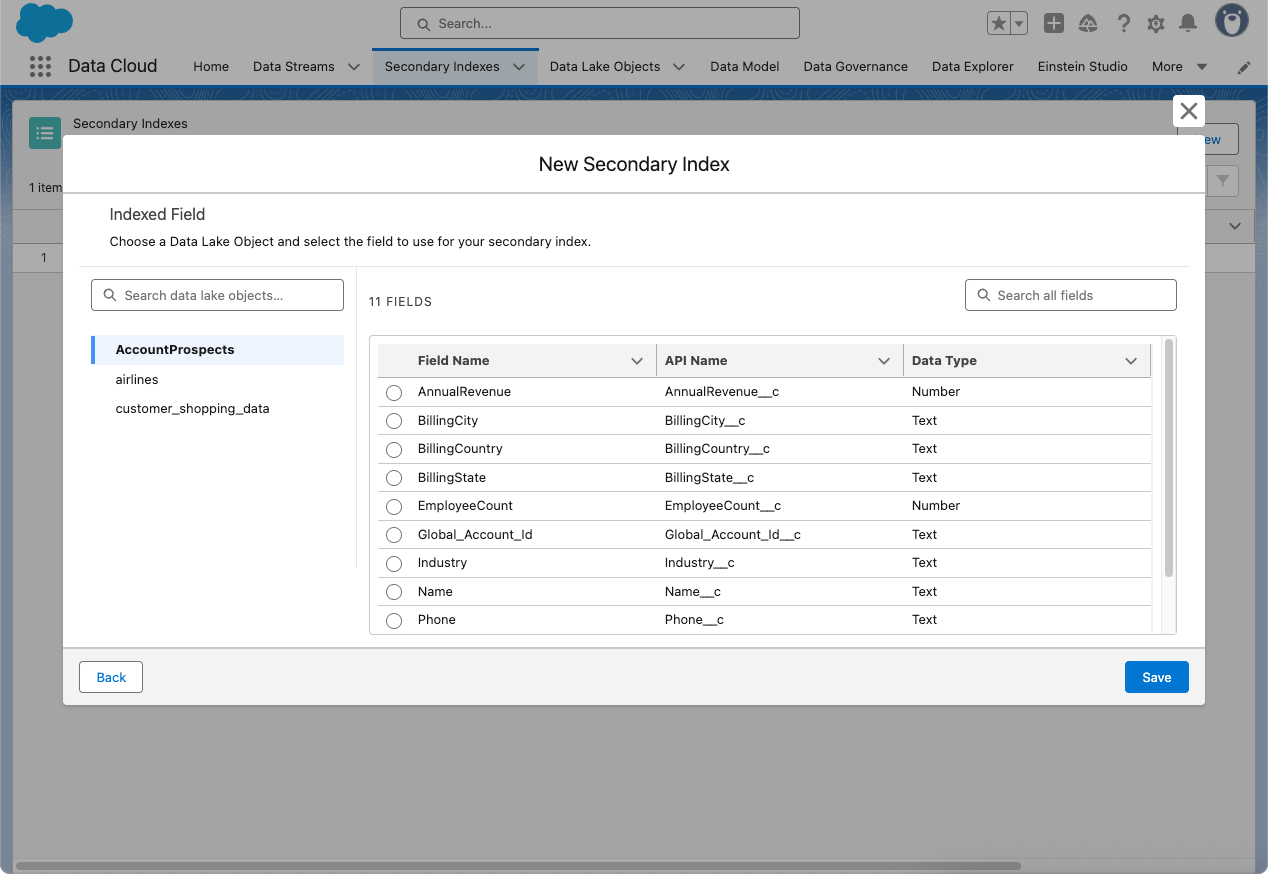
Search for and select the DLO that you want to use to create the secondary index.
Choose the field that will be used as the new secondary index and click
Save.
Note You can't edit secondary indexes after creation. To change a secondary index, delete and
recreate it. Recreating a secondary index incurs the cost of index creation.
Did this article solve your issue?
Let us know so we can improve!
Loading
Salesforce Help | Article
Cookie Consent Manager
General Information
Required Cookies
Functional Cookies
Advertising Cookies
General Information
We use three kinds of cookies on our websites: required, functional, and advertising. You can choose whether functional and advertising cookies apply. Click on the different cookie categories to find out more about each category and to change the default settings.
Privacy Statement
Required Cookies
Always Active
Required cookies are necessary for basic website functionality. Some examples include: session cookies needed to transmit the website, authentication cookies, and security cookies.
Functional Cookies
Functional cookies enhance functions, performance, and services on the website. Some examples include: cookies used to analyze site traffic, cookies used for market research, and cookies used to display advertising that is not directed to a particular individual.
Advertising Cookies
Advertising cookies track activity across websites in order to understand a viewer’s interests, and direct them specific marketing. Some examples include: cookies used for remarketing, or interest-based advertising.