Share and grant other users access to a semantic model in Tableau Semantics. You can
share a model with individual users, or you can set general access to make the model available to
all users in your org.
You can share a semantic model if you are the owner or have the ModifyAllRecords
permission. This allows flexibility in cases where the owner is unavailable or when sharing is
needed across companion orgs.
Note Semantic models can be shared both from Data 360 and from Tableau Next. In Tableau Next,
models can only be shared at Viewer level. To allow edit access from Tableau Next, you must use
workspace sharing. See Share Assets in Tableau Next.
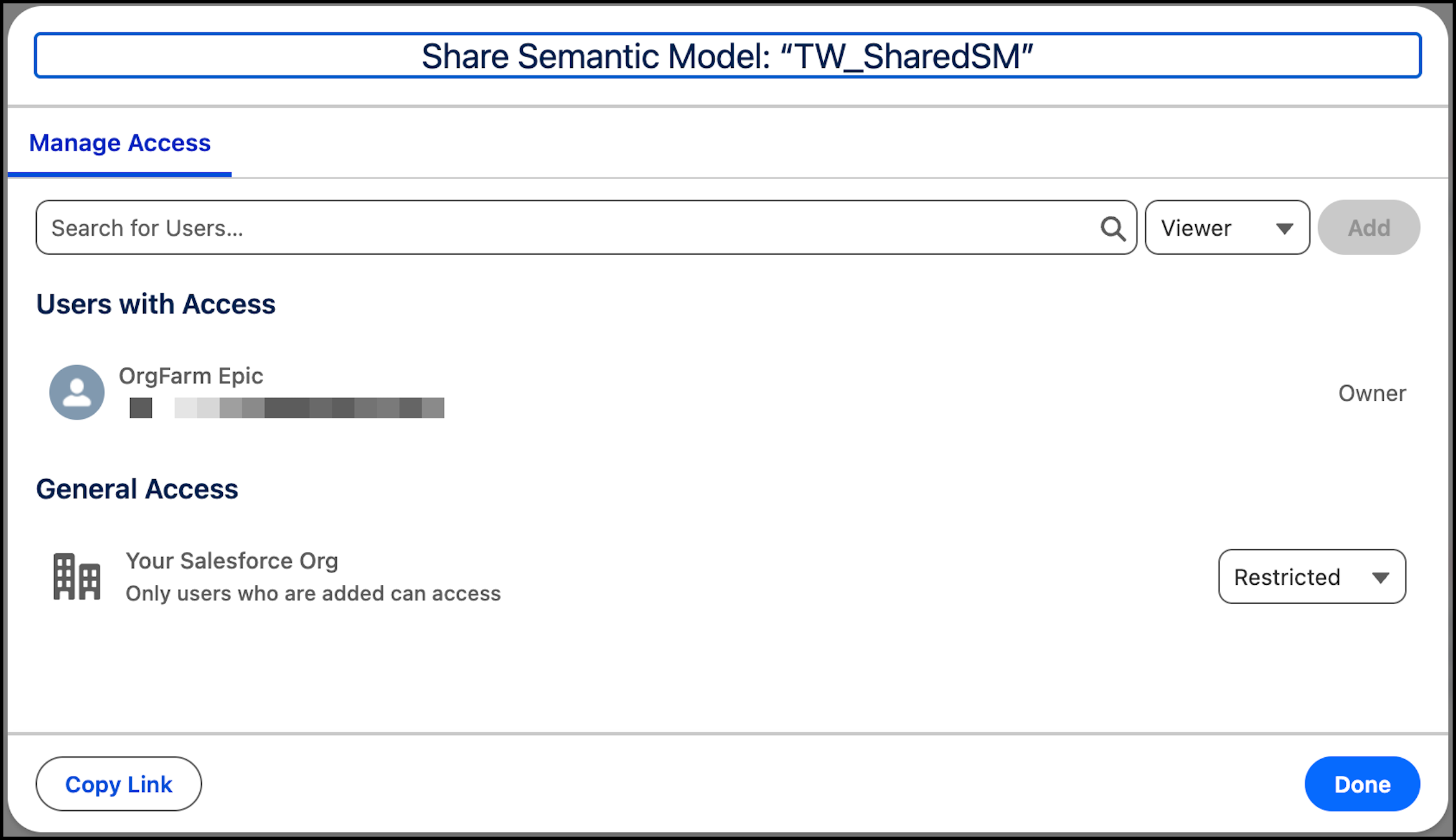
In Data Cloud, go to the Semantic Layer tab and select Share from
the drop-down list of options for the semantic model. Alternatively, open the model and click
Share in the top right corner.
The Share Semantic Model window opens.
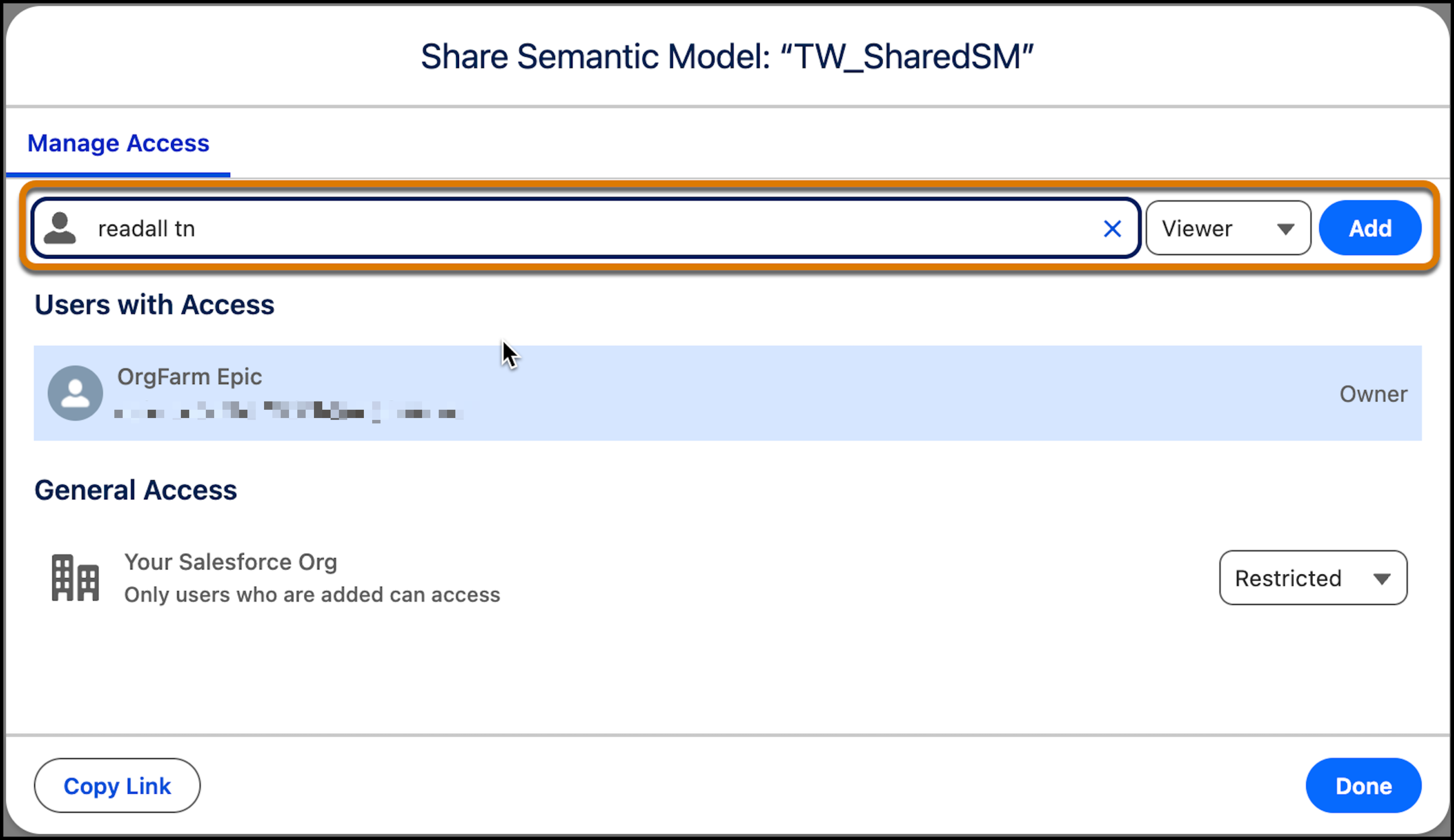
Enter the name of the user you want to share the model with, then select the user.
Choose either the Viewer or Editor role.
Click Add to assign the role to the user.
Click Done.
Set general access for all users
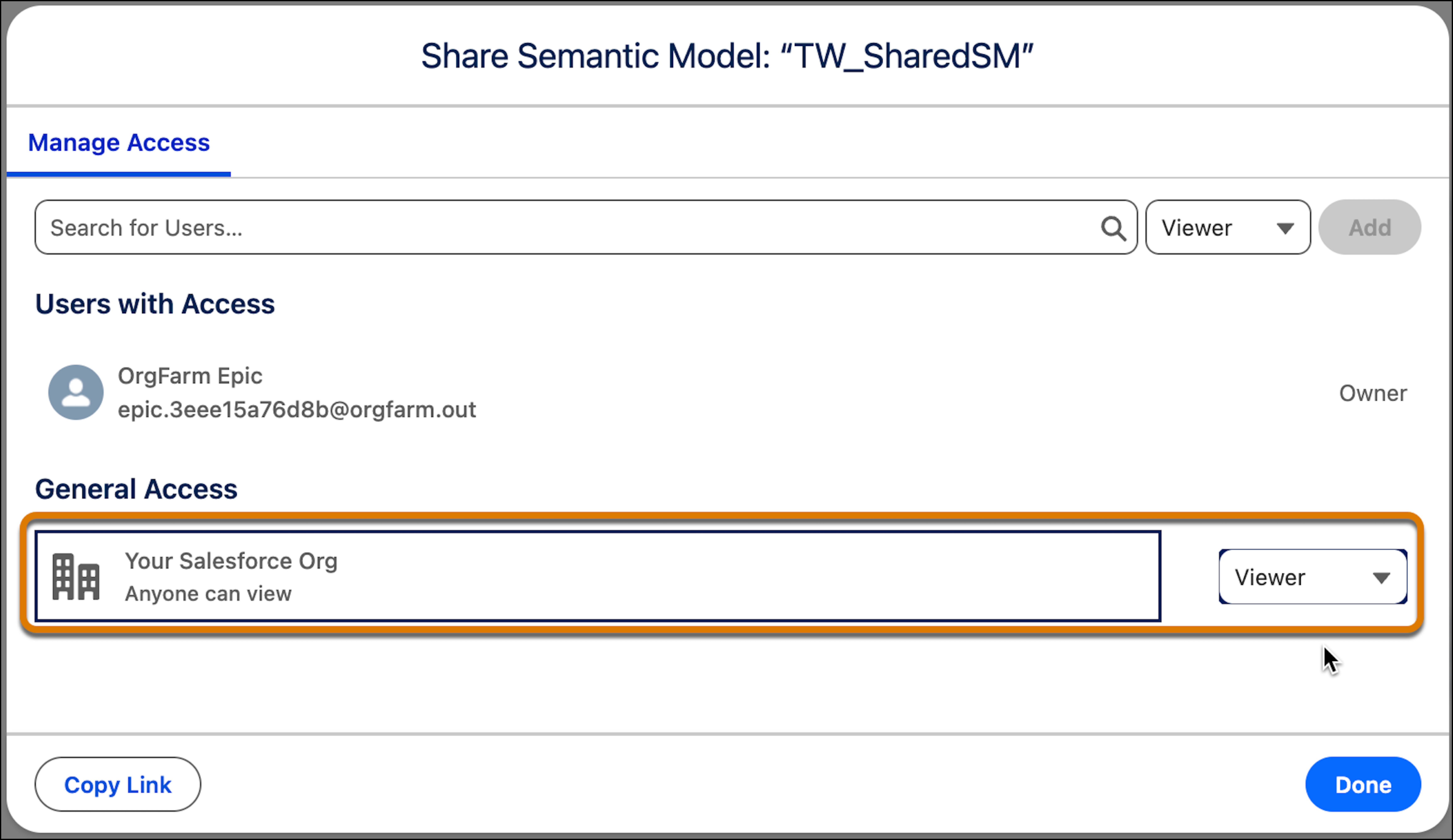
General access is the default level of access to a semantic model for all users in an
org. When you create a model, general access is restricted. Only users you share with
individually can access the model.
If you set the general access for a semantic model to Viewer, you can still grant
individual users Editor access.
If you grant an individual user Viewer access and set the general access to Editor, that
user has Editor access because the higher level of access takes precedence.
In Data Cloud, go to the Semantic Layer tab and select Share from
the drop-down list of options for the semantic model. Alternatively, open the model and click
Share in the top right corner.
The Share Semantic Model window opens.
Under General Access, select the access level for all users in the org.
Click Done.
Did this article solve your issue?
Let us know so we can improve!
Loading
Salesforce Help | Article
Cookie Consent Manager
General Information
Required Cookies
Functional Cookies
Advertising Cookies
General Information
We use three kinds of cookies on our websites: required, functional, and advertising. You can choose whether functional and advertising cookies apply. Click on the different cookie categories to find out more about each category and to change the default settings.
Privacy Statement
Required Cookies
Always Active
Required cookies are necessary for basic website functionality. Some examples include: session cookies needed to transmit the website, authentication cookies, and security cookies.
Functional Cookies
Functional cookies enhance functions, performance, and services on the website. Some examples include: cookies used to analyze site traffic, cookies used for market research, and cookies used to display advertising that is not directed to a particular individual.
Advertising Cookies
Advertising cookies track activity across websites in order to understand a viewer’s interests, and direct them specific marketing. Some examples include: cookies used for remarketing, or interest-based advertising.