Combine related objects to segment customers based on demographics, behavior, or
purchasing patterns. You can also use a group to correct data errors, such as combining CA,
Calif., and California into one data point, or to answer “what if” questions (“What if we combined
the East and West regions?”). Reference groups directly in calculated fields to build custom
metrics and dimensions using group labels.
In Data Cloud, on the Semantic Layer tab, select a data model.
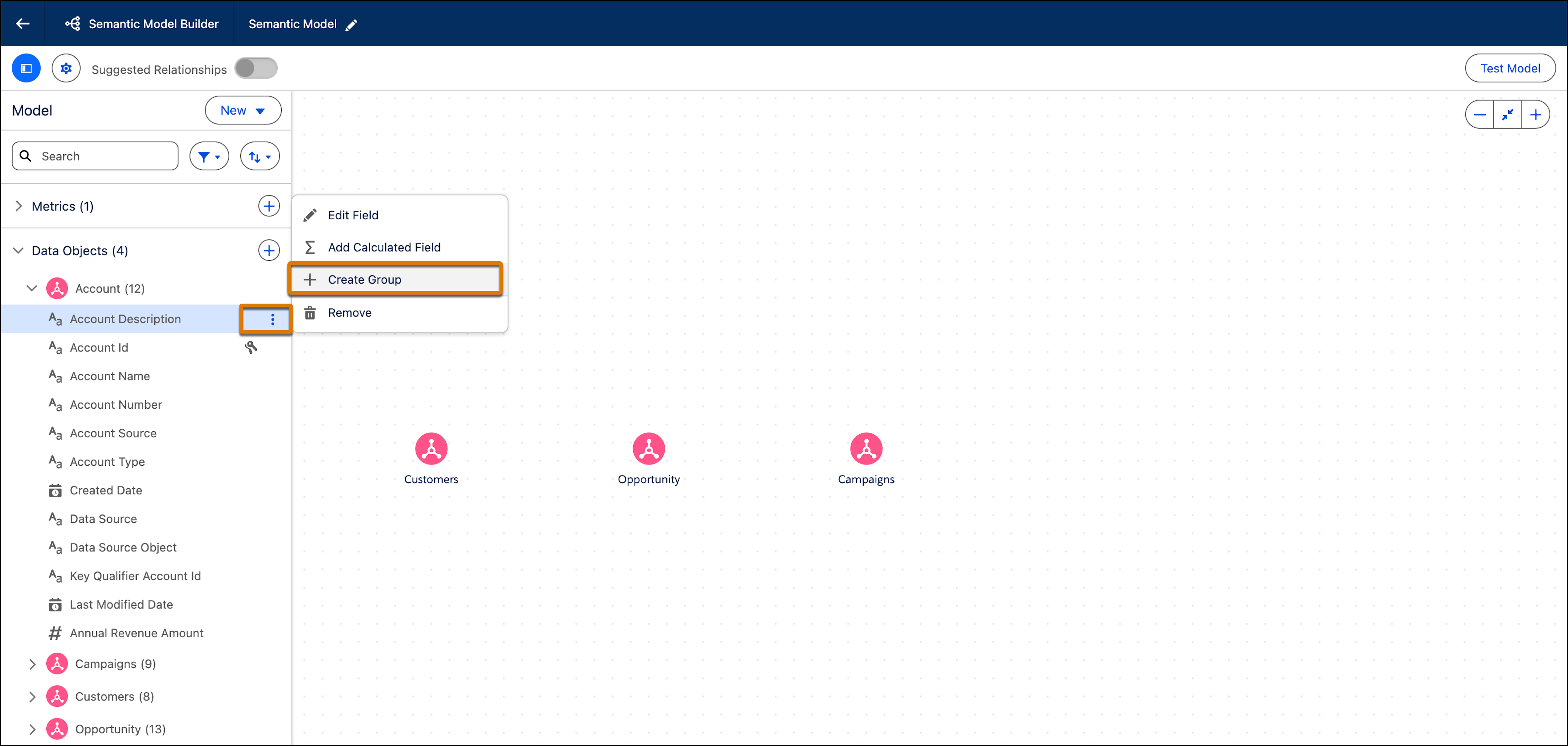
On the Model tab, expand Data Objects.
Hover over the dimension or measure that you want to group.
From the options menu, select Create Group.
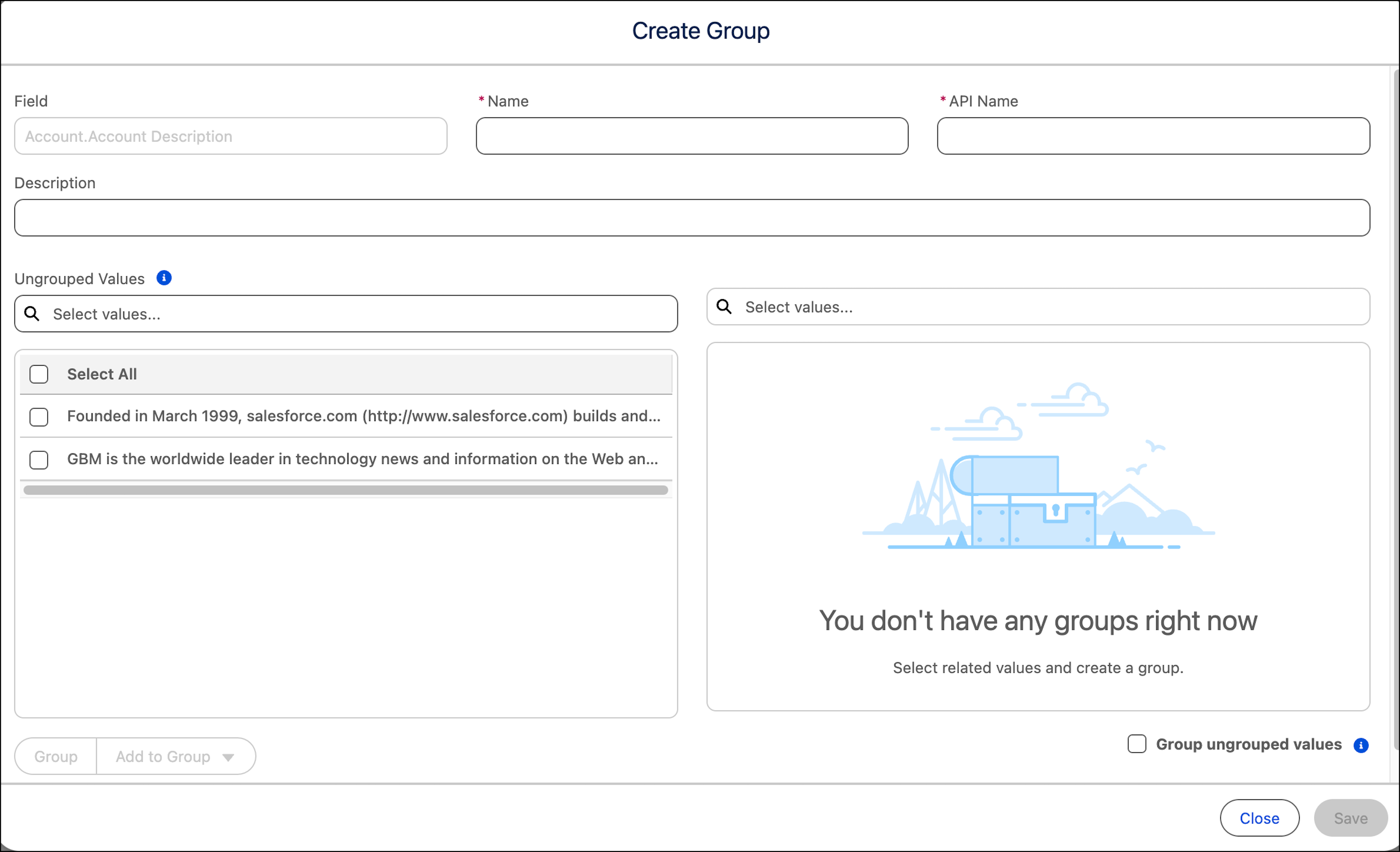
In the Create Group window enter a group Name, API name, and an optional Description.
Ungrouped values within the object show under the Ungrouped Values column. Grouped Values
appear under the Grouped Values column.
In the Ungrouped Values column, select one or more ungrouped values, and then click
Group.
To add the values to an existing group, click Add to Group.
You can create as many groups as you like. If you have ungrouped values that don’t belong
to an existing group, select Group ungrouped values. All ungrouped
values are added to the Other group after you save.
To edit a group name, hover over the group and click the edit icon.
To delete a group, click the delete icon.
Save your group.
After the group is saved, it appears as a field under the object within Tableau
Semantics. The new group is also added as a field to the model. You can query the field with
the Tableau Semantics Query Generator.
Did this article solve your issue?
Let us know so we can improve!
Loading
Salesforce Help | Article
Cookie Consent Manager
General Information
Required Cookies
Functional Cookies
Advertising Cookies
General Information
We use three kinds of cookies on our websites: required, functional, and advertising. You can choose whether functional and advertising cookies apply. Click on the different cookie categories to find out more about each category and to change the default settings.
Privacy Statement
Required Cookies
Always Active
Required cookies are necessary for basic website functionality. Some examples include: session cookies needed to transmit the website, authentication cookies, and security cookies.
Functional Cookies
Functional cookies enhance functions, performance, and services on the website. Some examples include: cookies used to analyze site traffic, cookies used for market research, and cookies used to display advertising that is not directed to a particular individual.
Advertising Cookies
Advertising cookies track activity across websites in order to understand a viewer’s interests, and direct them specific marketing. Some examples include: cookies used for remarketing, or interest-based advertising.