Find Object Management Settings in Lightning Experience
Salesforce lets you customize your object model with features like custom fields, page
layouts, and validation rules. Most objects are available from the Object Manager in Setup.
Required Editions
Available in: Lightning Experience
Available in: All editions
Standard Objects and Custom Objects
A standard object, such as Account or Contact, comes out of the box with your
Salesforce organization. A custom object is an object that you or another
administrator created.
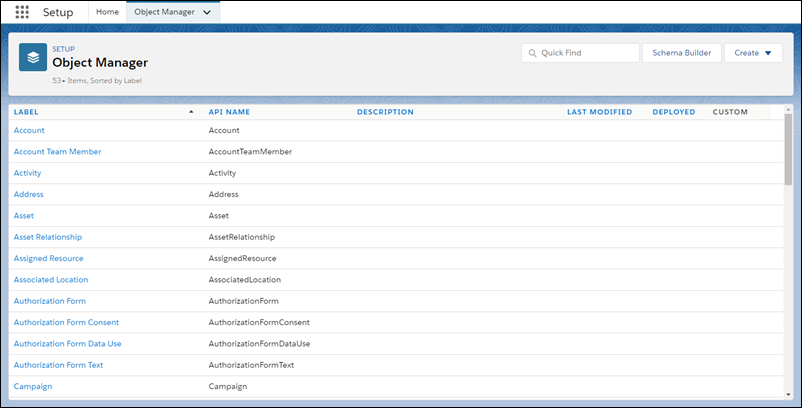
From Setup, at the top of the page, select Object
Manager. Select one of the objects in the list, and then select a specific
customization from the left pane.
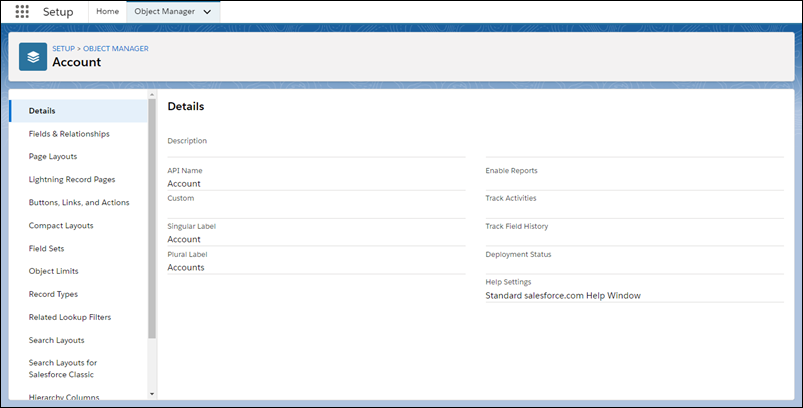
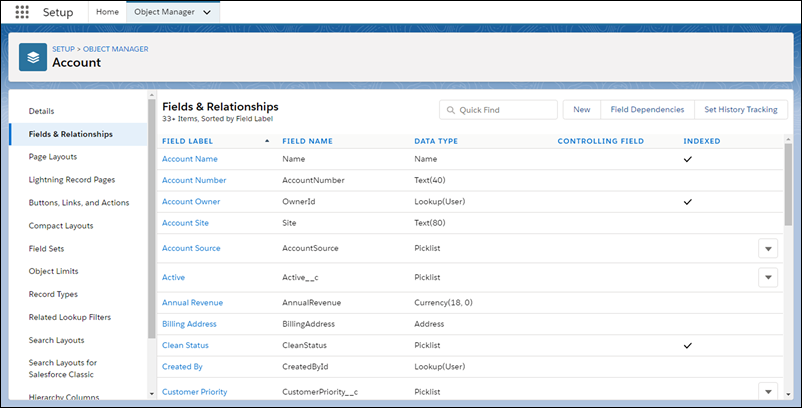
For example, to add a custom field to the Account object, select Object
Manager from the top of the Setup page. Next, select
Account, and then Fields & Relationships.
Select New.
Note If you’ve renamed any objects or fields, the Object Manager uses their assigned custom
names.
Other Standard Objects
Some standard objects aren’t housed in the Object Manager. Standard objects with more
specific purposes and customizations can be found in Setup using the Quick Find box.
From
Setup, enter the object name in the Quick Find box, then select the customization.
Custom Objects
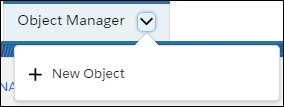
You can also create custom objects from the Object Manager. From Setup, at the top of the
page, select Object Manager. Then select New
Object.
External Objects
An external object is similar to custom objects, except that it maps to data
that’s stored outside your Salesforce organization.
From Setup, enter External
Objects in the Quick Find box, then select External
Objects. Next, click one of the external objects in the list. Then scroll to the
section for the specific customization.
For example, to add a custom field to the Orders
external object, enter External Objects in the Quick Find box, then
select External Objects. Click Orders, and then
scroll to Custom Fields and Relationships.
We use three kinds of cookies on our websites: required, functional, and advertising. You can choose whether functional and advertising cookies apply. Click on the different cookie categories to find out more about each category and to change the default settings.
Privacy Statement
Required Cookies
Always Active
Required cookies are necessary for basic website functionality. Some examples include: session cookies needed to transmit the website, authentication cookies, and security cookies.
Functional Cookies
Functional cookies enhance functions, performance, and services on the website. Some examples include: cookies used to analyze site traffic, cookies used for market research, and cookies used to display advertising that is not directed to a particular individual.
Advertising Cookies
Advertising cookies track activity across websites in order to understand a viewer’s interests, and direct them specific marketing. Some examples include: cookies used for remarketing, or interest-based advertising.