
You are here:
Create Vehicle Definitions in Automotive Cloud
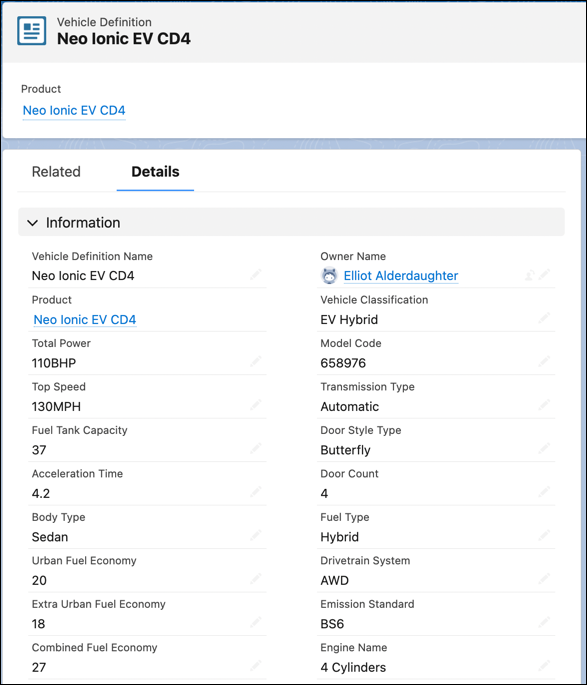
Create Vehicle Definition records to capture key information about the specifications of a vehicle model. The make, model, model year, body style, trim level, and other details impact the cost of a vehicle. While you create Product records for a vehicle type, create Vehicle Definition records to add more details, such as the vehicle's dimensions, and battery, fuel, and transmission specifications.
Required Editions
| Available in: Enterprise, Unlimited, and Developer Editions. |
Make sure you create Geo Country records before you create vehicle definitions.
Here’s information about the fields available on a Vehicle Definition record.
| Field | Definition |
|---|---|
| Model Specifications | |
| Vehicle Classification | The classification or category of the vehicle such as sport, utility, or sedan. |
| Model Code | The unique code for the vehicle model. |
| Variant Name | The variant of a specific vehicle model, such as Neo EV White XD. |
| Geo Country | The country associated with the specific vehicle model and variant. Sometimes a company can launch different variants of the same vehicle model for different countries. The vehicle can have different stylistic specifications and a different name. |
| Product | The product related to the vehicle definition. Details such as make name, model name, vehicle trim level and classification are populated on the product record. |
| Stylistic Details | |
| Transmission System | The transmission type of the vehicle, such as manual or automatic. |
| Body Type | The body type or style of the vehicle model, such as hatchback, SUV, or coupe. |
| Door Style | The style of doors in the vehicle model, such as wing doors, swing-up doors, or switchblade doors. |
| Door Count | The number of doors in the vehicle model, such as 2 or 4. |
| Emission Details | |
| Emission Standard | The emission standard applicable to the vehicle model, such as EURO 5, or LEV. |
| Fuel Source | The power source used in the vehicle such as Gasoline, CNG, Hybrid, Battery, or Diesel. |
| Fuel Tank Capacity | The volume of fuel that the tank can hold, such as 45 liters or 12 gallons. |
| Battery Details | |
| Battery Type | The type of battery used in the vehicle model, such as Lithium Ion,lead acid battery (Wet Cell), or gel cell battery (Dry Cell). |
| Auxiliary Battery Type | The type of supplemental battery used in the vehicle model, such as deep cycle battery, lithium ion (Li-Ion) battery, or nickel metal hydride battery. |
| Battery Capacity | The total charge or energy capacity of the battery, such as 100 kWh, or 35 AH. |
| Battery Minimum Range | The minimum distance the vehicle travels on a single charge, such as 50 miles. |
| Battery Maximum Range | The maximum distance the vehicle travels on a single charge, such as 200 miles. |
| Engine Details | |
| Engine Name | The engine used in the vehicle model, such as 1.0 TFSI Ultra 70 kW. |
| Engine Capacity | The engine capacity of the vehicle model, such as 1900 cc. |
| Maximum Torque | The maximum torque for the vehicle model, such as 113 NM. |
| Total Power | The maximum power that the vehicle model can deliver, such as 88 BHP. |
| Drivetrain System | The drivetrain system used in the vehicle model, such as RWD, FWD, or AWD. |
| Dimensions | |
| Maximum Gross Weight | The weight of the vehicle model plus the maximum payload that it can carry, such as 4500 pounds or 3000 kg. |
| Curb Weight | The weight of the vehicle model without any payload, such as 3000 pounds or 2000 kg. |
| Length | The length of the vehicle model, such as 4314 mm. |
| Height | The height of the vehicle model, such as 1620 mm. |
| Width | The width of the vehicle model, such as 1809 mm. |
| Wheelbase | The distance between the front and rear axles, such as 2585 mm. |
| Speed Details | |
| Acceleration Time | The change in velocity in a defined unit of time, such as 0–60 mph in 4 seconds or 8.3 seconds. |
| Top Speed | The highest speed the vehicle model can achieve, such as 180 kmph. |
| Fuel Economy Details | |
| Urban Fuel Economy | The fuel consumption in the city-driving environment, such as 11.5 kmpl or 40 mpg. |
| Extra Urban Fuel Economy | The fuel consumption in the country roads and motorways driving environment, such as 13 kmpl or 44 mpg. |
| Combined Fuel Economy | The overall fuel consumption, which is the average of urban and extra-urban fuel consumption, such as 12.3 kmpl or 42 mpg. |

Note In Spring ‘24, we’re deprecating the following fields, and we’ve introduced new fields to
replace them. The deprecated fields will be permanently retired in the Winter ‘24 release. Make
sure you update your business processes to replace the deprecated fields with the new
fields.
| Deprecated Field | New Field To Use |
|---|---|
| Door Style Type | Use the field Door Style. |
| Drivetrain Type | Use the field Drivetrain System. |
| Fuel Type | Use the field Fuel Source. |
| Transmission Type | Use the field Transmission System. |
Did this article solve your issue?
Let us know so we can improve!
