
Loading
Feature Degradation | Agentforce Voice Read More
Automotive Cloud
Table of Contents
Select Filters

          No results
          No results
          Here are some search tips

          Check the spelling of your keywords.
          Use more general search terms.
          Select fewer filters to broaden your search.

          Search all of Salesforce Help
          How Assets and Vehicles Are Related in Automotive Cloud

          How Assets and Vehicles Are Related in Automotive Cloud

          An asset is either a physical item that you sell or it’s something that you install as part of another item. Each vehicle finally sold to a customer is an asset in Automotive Cloud. Likewise, all the parts and accessories that are finally installed in vehicles or sold as spares to customers are also assets. With asset-level information, original equipment manufacturers (OEMs) and dealers can get complete visibility into a vehicle, its associated parts, and accessories.
          Required Editions

          Available in: Enterprise, Unlimited, and Developer Editions.

          Assets and Vehicle Fields

          All vehicles are assets, but all assets are not vehicles.

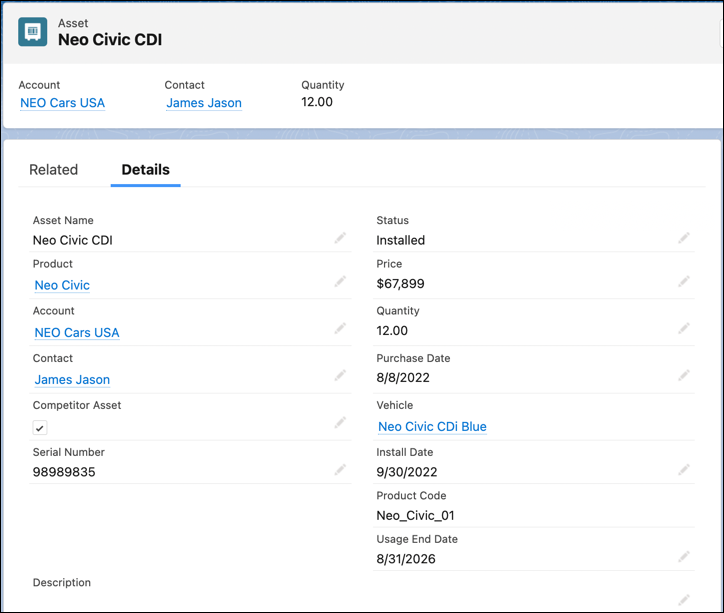
          Some details are commonly captured across all types of assets, whether they’re vehicles or parts and accessories. Examples include name, quantity, price per unit, related account and contact, and date of purchase or installation. For a vehicle asset, you want to capture additional details that are specific to automotive use cases, such as the market value, registration details, odometer readings, and more. To capture vehicle-specific details, you create a Vehicle record in addition to the Asset record.

          Vehicle records act like extensions of the Asset record to capture vehicle-specific information. So, Neo Power XS-Equinox Black with VIN number 4S1YL65888P411429 is both an Asset and a Vehicle record. But the engine used in this car, Neo Engine_9S with serial number SER678954 is just an Asset record.

          Assets and Vehicles in Relation to Products

          Think of assets as specific instances of a product. For example, if Neo Power XS-Equinox is a specific vehicle model, a physical car built to this model’s specifications is a Vehicle record and at the same time, an Asset record.

          Now, think of a product such as an electric car battery, Neo Furio Battery_8A, compatible with specific vehicle models. Each battery with this product’s specifications that is manufactured, installed, or sold, is an Asset record, but not a Vehicle record.

          Asset Information Shown on Vehicle

          Automotive Cloud extracts data from a vehicle’s asset record to show key information on the Vehicle page so that users can get a 360-degree view of a car. Examples include information about the hierarchy of child assets, related assets like upgrades and replacements, asset milestones, and asset account and contact participants. If you have enabled Automotive Scheduler in your org, you can also view the list of test drive appointments for a Vehicle record where the Asset is used as service resource.

          Automotive Cloud also gives you an asset console that you can use to get a 360-degree view of parts and accessories. The asset console comes with a predefined timeline showing work orders, related lists showing information about claims, warranties, repair orders, cases, and an Actions & Recommendations component.

          If you have Field Service enabled in your org, you can also take advantage of capabilities such as scheduling inspections, and associating maintenance plans with an asset. Then, you can configure timelines and related lists on Vehicle that show the information about maintenance plans, inspections, and work orders from the underlying Asset record.

          An Asset record with a related Vehicle lookup.

           
          Loading
          Salesforce Help | Article
