
Loading
Feature degradation | Gmail Email delivery failureRead More
Automotive Cloud
Table of Contents
Select Filters

          No results
          No results
          Here are some search tips

          Check the spelling of your keywords.
          Use more general search terms.
          Select fewer filters to broaden your search.

          Search all of Salesforce Help
          Take a Tour of the Service Console for Automotive

          Take a Tour of the Service Console for Automotive

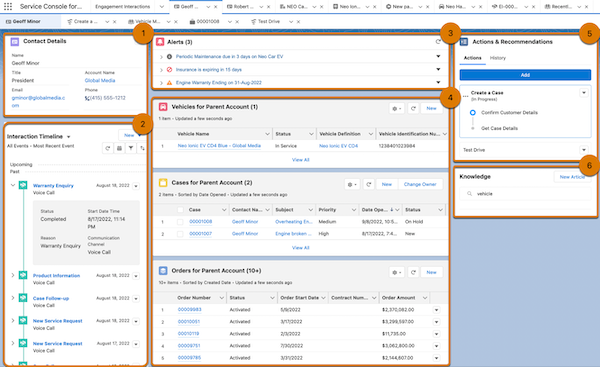
          Customer service representatives (CSRs) can orchestrate every step of the service journey for dealers and end-customers with a unified console. CSRs can use Service Console for Automotive to get a 360-degree view of their customers without opening multiple applications and to multitask without losing the context of the interaction. They can also track previous conversations on a timeline, inspect related Vehicle, Order, and Case records, and initiate actions, such as booking a test drive or scheduling a dealer visit.

          Required Editions

          Available in: Enterprise, Unlimited, and Developer Editions.

          Service Console for Automotive brings together powerful Service Excellence components on a single console page. These components can be extended and customized to meet the business needs of an original equipment manufacturer, both within the console and with standard apps.

          To view a caller’s information in the console, a CSR can open their Contact record. When a customer calls, an Engagement Interaction record is created in the background. The CSR can verify the customer’s details with the Identity Verification flow that automatically redirects them to the console page.

          Note
          Note The initiating attendee of the Engagement Interaction record must be a contact so that the preconfigured Identity Verification flow can direct you to the console page with that contact’s information.
          Service Console for Automotive

          Here’s what CSRs can do within the console.

          View Contact Details

          CSRs can view the contact details of the customer or dealer [1]. This helps CSRs maintain the flow of the interaction without missing a beat.

          Track Engagements on a Timeline

          CSRs can track previous interactions with dealers or customers on a chronological, visual timeline to ensure continuity and gauge a caller’s sentiment and queries across conversations [2]. While Service Console for Automotive comes with a preconfigured timeline that shows previous engagement interactions, you can customize the timeline to show other records like cases and orders.

          See Alerts For Records That Require Action

          With timely, contextual alerts, CSRs can keep a note of the items that need attention and make proactive recommendations to customers or dealers [3]. Get business-specific alerts on records that need attention like vehicle insurance expiration, upcoming engine maintenance, or warranty upselling opportunities.

          Manage Vehicle, Case, and Order Records

          Get snapshots of the Vehicle, Case, and Order records related to a dealer or customer [4]. CSRs can view the details of related vehicles, cases, and orders by opening the records in the console as subtabs. They can also edit records and create records from the related list in the console.

          Take Relevant Actions

          CSRs can quickly resolve customer requests by checking for recommended actions and launching the relevant actions [5]. CSRs can launch the actions that are configured for their use case, for example, creating work orders, selling warranties, or scheduling product training for dealer sales representatives. If a customer calls, you can initiate actions such as booking a service appointment, scheduling a test drive, and providing roadside assistance. CSRs can also look at the history of the previously executed actions.

          Refer to Knowledge Articles

          CSRs can answer the questions of dealers and end- customers by searching for and opening the relevant Knowledge articles [6].

           
          Loading
          Salesforce Help | Article
