Cloud Kicks sells products across the United States and operates using USD as its
currency. The company has configured these tax rates in Standard Tax for the Acme_US legal
entity.
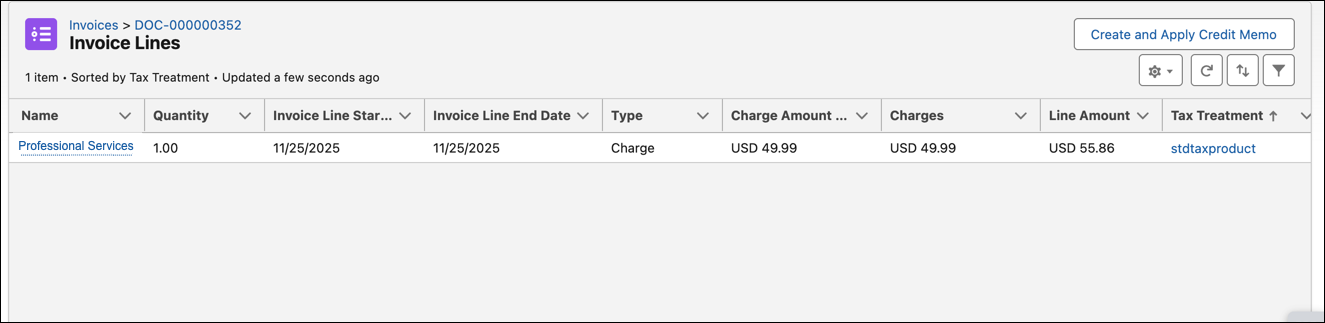
Consider an invoice generated on 11/25/2025, with a single invoice line having a
Professional Services product for a customer based out of San Francisco, California.
When Acme Corp invoices a customer in San Francisco, California, using the Standard
Tax Engine, Revenue Management matches the invoice line to the applicable tax rates by using the
in-built decision table.
The matching logic considers the invoice line’s Legal Entity,
Country ISO code, and State ISO code, Currency ISO Code, Product Code to filter the tax rate
records which are applicable.
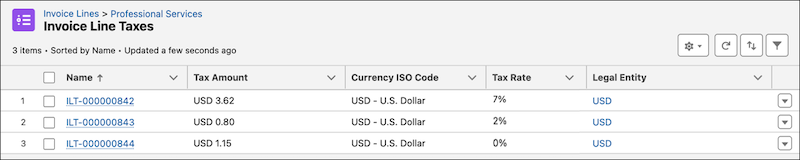
In our example the first four rows match and the
resulting invoice line taxes generated.
Did this article solve your issue?
Let us know so we can improve!
Loading
Salesforce Help | Article
Cookie Consent Manager
Cookie Consent Manager
General Information
Required Cookies
Functional Cookies
Advertising Cookies
General Information
We use three kinds of cookies on our websites: required, functional, and advertising. You can choose whether functional and advertising cookies apply. Click on the different cookie categories to find out more about each category and to change the default settings.
Privacy Statement
Required Cookies
Always Active
Required cookies are necessary for basic website functionality. Some examples include: session cookies needed to transmit the website, authentication cookies, and security cookies.
Functional Cookies
Functional cookies enhance functions, performance, and services on the website. Some examples include: cookies used to analyze site traffic, cookies used for market research, and cookies used to display advertising that is not directed to a particular individual.
Advertising Cookies
Advertising cookies track activity across websites in order to understand a viewer’s interests, and direct them specific marketing. Some examples include: cookies used for remarketing, or interest-based advertising.