Salesforce provides a few standard out-of-the-box key attributes such as customer,
product, order, or customer sets. You can define key attributes that aren’t a part of the standard
set of attributes by using custom key attributes. With custom key attributes, you can define a
special or specific search key.
Required Editions
Available in: Lightning Experience
Available in: Enterprise and
Unlimited Editions that have Consumer Goods Cloud enabled
User Permissions Needed
To create a custom key attribute:
(CGCloud Business Admin
OR
CGCloud Retail Business Admin)
AND
Penny Perfect
Pricing
These steps apply only to the Consumer Goods Cloud desktop app. If a key attribute is present in
the Salesforce org, you can directly add the key attribute without creating a pricing context
definition. For more information on standard key attributes, see Create a Key Attribute.
From the App Launcher, find and select Pricing Context
Definition.
Click New.
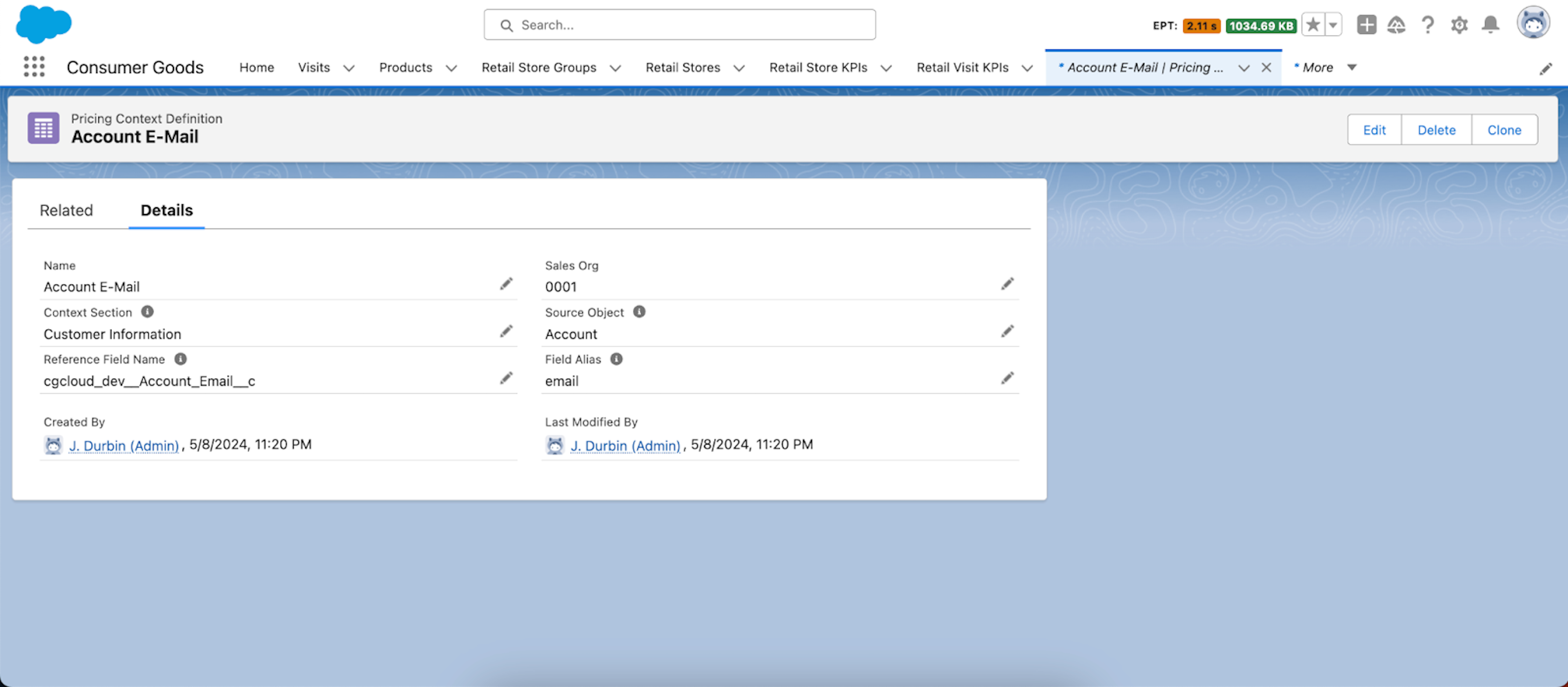
Provide the API name and alias name for the reference field name and field alias.
Provide the required fields and save your changes.
From the App Launcher, find and select Key Attribute.
Click New.
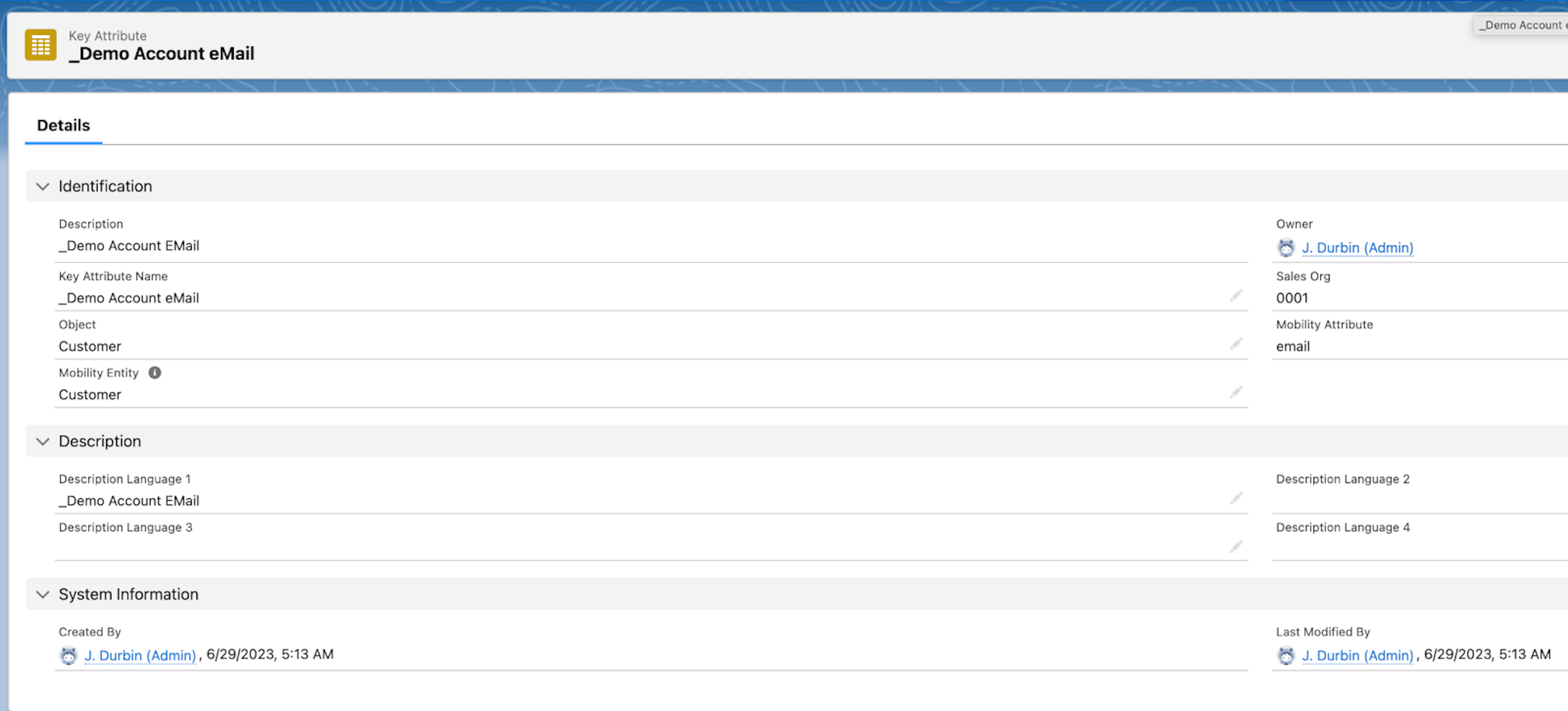
Provide the key attribute name, description, sales org, source object, and field
alias.
Save your changes.
Example Condition Search with an additional customer attribute (email).
The image shows the UI
to create a pricing content definition for the custom attribute.
The image shows the UI to create the custom key attribute.
The Mobility Attribute field must match the field alias given in the Pricing Context
Definition.
Create a key type and select the custom key attribute in the key definition section. For
more information on penny perfect pricing configuration, see Setup for
Penny Perfect Pricing.
Adjust the query CndCpReadCustomerAttributes (can be a Product, or Order, or Order Item attribute) in
the data source DsComplex_Pricing_sf on the modeler and add
the custom attribute with the same name as created.
We use three kinds of cookies on our websites: required, functional, and advertising. You can choose whether functional and advertising cookies apply. Click on the different cookie categories to find out more about each category and to change the default settings.
Privacy Statement
Required Cookies
Always Active
Required cookies are necessary for basic website functionality. Some examples include: session cookies needed to transmit the website, authentication cookies, and security cookies.
Functional Cookies
Functional cookies enhance functions, performance, and services on the website. Some examples include: cookies used to analyze site traffic, cookies used for market research, and cookies used to display advertising that is not directed to a particular individual.
Advertising Cookies
Advertising cookies track activity across websites in order to understand a viewer’s interests, and direct them specific marketing. Some examples include: cookies used for remarketing, or interest-based advertising.