Custom scopes use a configurable field in the line item or product object as the scope
identifier. This identifier defines how fulfillment line items and steps are instantiated.
During decomposition and orchestration, custom scopes group fulfillment order line items and
steps according to the scope identifier.
Required Editions
Available in: Enterprise, Unlimited, and Developer
Editions
User Permissions
Needed
To create custom fulfillment scope configuration:
DRO Admin User
To create a custom scope, define a custom scope configuration with a context tag mapped
to a scope identifier field in the order product or a sales transaction item. Configure the
custom scope as the custom decomposition scope in the technical product and the custom
fulfillment scope in the fulfillment step definition. Update the scope identifier field in the
configured order line item and order product. During decomposition, fulfillment order line
items are grouped per scope identifier and during orchestration, fulfillment steps are grouped
per scope identifier.
From Setup, in the Quick Find box, enter Dynamic Revenue Orchestrator
Settings and select it.
Click Custom Fulfillment Scope Config.
Click New Custom Fulfillment Scope Config.
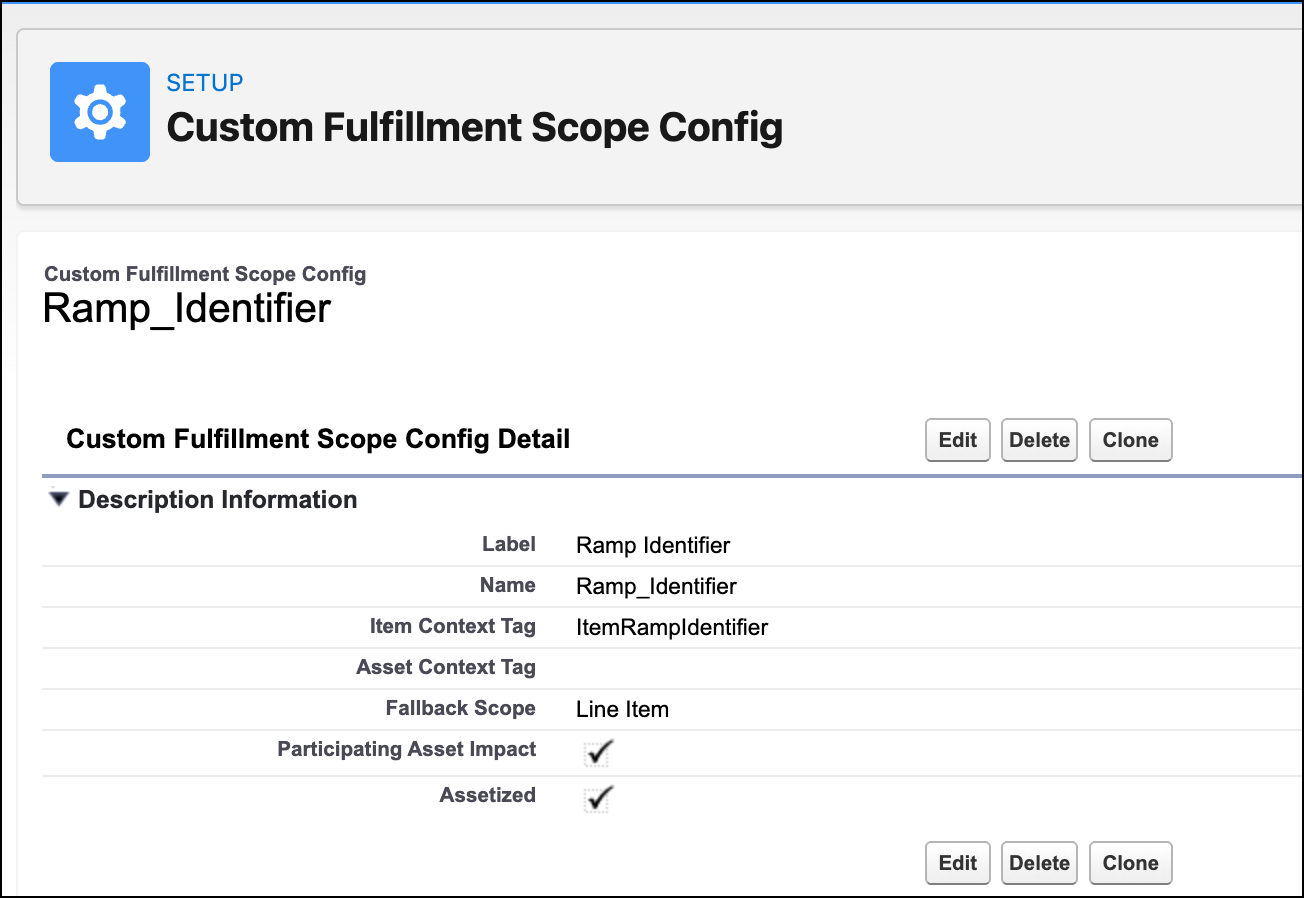
Enter a label for the Custom Fulfillment Scope Config.
Enter the item context tag.
This tag in the Sales Transaction Context Definition points to the field in Order
Product or Fulfillment Order LIne Item that specifies the custom scope identifier. To use
the custom tag during decomposition, define it in the Context Node for Sales Transaction
Item. For usage in plan generation, define the custom tag in either Context Node for Sales
Transaction Item or Context Node for Fulfillment Transaction Item. Map the custom tag in
Context Node for Sales Transaction Item to the custom scope identifier field in Order
Product. Map the context tag in Context Node for Fulfillment Transaction Item to the
custom scope identifier field in Fulfillment Order LIne Item.
Select the Participating Asset Impact checkbox if you want
technical assets related to sales transactions to affect the decomposed line item
actions.
When the Participating Asset Impact checkbox is selected, adding a product with the
same scope identifier as an existing asset to the order will amend the existing asset. If
the Participating Asset Impact checkbox isn't selected, adding any products to the order
will create a new fulfillment asset, regardless of the scope identifier.
Select the Assetized checkbox to assetize the decomposed line
items.
Save your work.
Note Line Item scope is the default fallback scope and is used when no custom scope is
derived.
Did this article solve your issue?
Let us know so we can improve!
Loading
Salesforce Help | Article
Cookie Consent Manager
Cookie Consent Manager
General Information
Required Cookies
Functional Cookies
Advertising Cookies
General Information
We use three kinds of cookies on our websites: required, functional, and advertising. You can choose whether functional and advertising cookies apply. Click on the different cookie categories to find out more about each category and to change the default settings.
Privacy Statement
Required Cookies
Always Active
Required cookies are necessary for basic website functionality. Some examples include: session cookies needed to transmit the website, authentication cookies, and security cookies.
Functional Cookies
Functional cookies enhance functions, performance, and services on the website. Some examples include: cookies used to analyze site traffic, cookies used for market research, and cookies used to display advertising that is not directed to a particular individual.
Advertising Cookies
Advertising cookies track activity across websites in order to understand a viewer’s interests, and direct them specific marketing. Some examples include: cookies used for remarketing, or interest-based advertising.