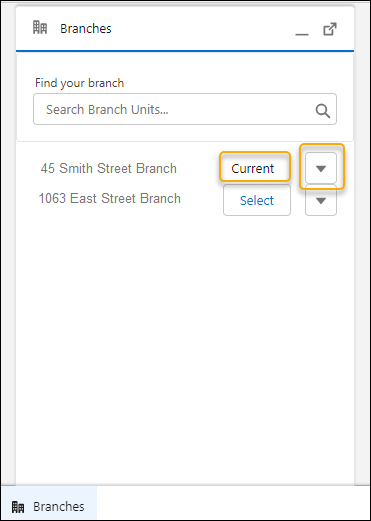
The branch selector allows you to select a current branch to associate your customer
interactions. You can view branch details, search for, add, and remove branches from the branch
selector without contacting your Salesforce admin.
Required Editions
Available in: Lightning Experience
Available in: Professional, Enterprise, and Unlimited Editions
where Financial Services Cloud is enabled
User Permissions Needed
To use the Branch Selector:
Financial Services Cloud Extension OR FSC Sales
AND
Read, Create, and Delete on Branch Unit Business Member
AND
Read on Branch Unit
AND
Read and Edit on Banker
Note When a user adds themselves to a branch where they don’t have an active branch unit
business member record, it is automatically created and set to active.
From the App Launcher, select Branch Management app, or another app
your Salesforce org uses.
Click Branches utility bar component.
A list of branches displays. Current indicates the branch you’re assigned to. All record
interactions are attributed to your current branch.
Click the actions menu to remove a branch from the selector or view branch details.
Click Search Branch Units... and enter the name of a branch to
search for and add a new branch to the branch selector.
Click Select to choose a new current branch.
Did this article solve your issue?
Let us know so we can improve!
Loading
Salesforce Help | Article
Cookie Consent Manager
Cookie Consent Manager
General Information
Required Cookies
Functional Cookies
Advertising Cookies
General Information
We use three kinds of cookies on our websites: required, functional, and advertising. You can choose whether functional and advertising cookies apply. Click on the different cookie categories to find out more about each category and to change the default settings.
Privacy Statement
Required Cookies
Always Active
Required cookies are necessary for basic website functionality. Some examples include: session cookies needed to transmit the website, authentication cookies, and security cookies.
Functional Cookies
Functional cookies enhance functions, performance, and services on the website. Some examples include: cookies used to analyze site traffic, cookies used for market research, and cookies used to display advertising that is not directed to a particular individual.
Advertising Cookies
Advertising cookies track activity across websites in order to understand a viewer’s interests, and direct them specific marketing. Some examples include: cookies used for remarketing, or interest-based advertising.