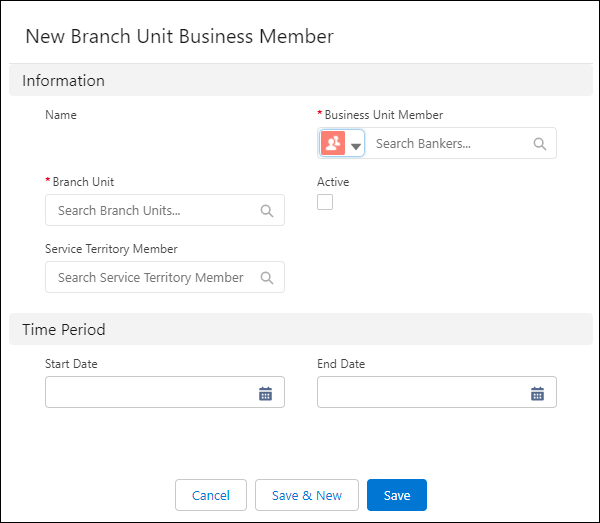
A branch unit business member links a branch unit and a banker. It enables a banker to
select the branch where they’re working that day so their customer interactions are associated
with the correct branch.
Required Editions
Available in: Lightning Experience
Available in: Professional, Enterprise, and Unlimited Editions
where Financial Services Cloud is enabled
Tip Salesforce creates a Branch Unit Business Member record automatically when you
add a banker with a branch assignment. Make sure your Banker record page layout includes Current
Branch Start Date and Current Branch fields. Then, on the Bankers tab or the Bankers related
list of a Branch Unit record, click New. Specify a branch in the Current
Branch field.
Select Branch Unit Business Member from the navigation bar.
If you don't see Branch Unit Business Member, click Edit in the
navigation bar menu, and then search for and add Branch Unit Business Member.
Click New.
Select the Banker icon from the Business Unit Member dropdown. Then search for and select a
user.
Select a Branch Unit.
Select Active and save your changes.
Note A branch unit can be selected by a banker only if the branch unit business member and
branch unit are set to active.
Did this article solve your issue?
Let us know so we can improve!
Loading
Salesforce Help | Article
Cookie Consent Manager
Cookie Consent Manager
General Information
Required Cookies
Functional Cookies
Advertising Cookies
General Information
We use three kinds of cookies on our websites: required, functional, and advertising. You can choose whether functional and advertising cookies apply. Click on the different cookie categories to find out more about each category and to change the default settings.
Privacy Statement
Required Cookies
Always Active
Required cookies are necessary for basic website functionality. Some examples include: session cookies needed to transmit the website, authentication cookies, and security cookies.
Functional Cookies
Functional cookies enhance functions, performance, and services on the website. Some examples include: cookies used to analyze site traffic, cookies used for market research, and cookies used to display advertising that is not directed to a particular individual.
Advertising Cookies
Advertising cookies track activity across websites in order to understand a viewer’s interests, and direct them specific marketing. Some examples include: cookies used for remarketing, or interest-based advertising.