Create service process definitions in Service Process Studio for the service processes
that you want to configure eligibility rules for. After you create the definitions, the service
processes are listed as products in Product Catalog Management so that you can define the
eligibility rules to determine how and for whom the service processes are visible.
Required Editions
Available in: Lightning Experience
Available in:
Enterprise and
Unlimited Editions with the required licenses
User Permissions Needed
To create and activate service process definitions:
From Setup, in the Quick Find box, enter Service Process Studio, and
then select Service Process Studio.
Click New Service Process.
Enter Fee Reversal as the service process name.
Save your changes.
Similarly, create the Temporary Credit Limit Increase, Manage Standing Instructions, and
Update Profile service processes.
Select each service process that you created and associate it with a request form.
Click Request Form, and then click Add Request
Form.
Select a request form relevant to the service process, click Add,
and then save the changes.
Note Ensure that you already created and activated an
OmniScript
that you plan to use as a request form for your service process so that it’s visible in
Service Process Studio for you to select.
Activate the service process definitions.
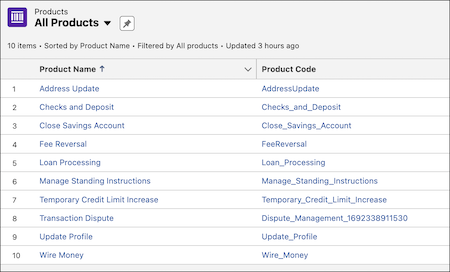
Verify if the service processes are listed as products in Product Catalog Management.
From the App Launcher, find and select Product Catalog
Management.
Click Products.
On the All Products list view page, check if the Fee Reversal, Temporary Credit
Limit Increase, Manage Standing Instructions, and Update Profile service processes are listed
as products.
We use three kinds of cookies on our websites: required, functional, and advertising. You can choose whether functional and advertising cookies apply. Click on the different cookie categories to find out more about each category and to change the default settings.
Privacy Statement
Required Cookies
Always Active
Required cookies are necessary for basic website functionality. Some examples include: session cookies needed to transmit the website, authentication cookies, and security cookies.
Functional Cookies
Functional cookies enhance functions, performance, and services on the website. Some examples include: cookies used to analyze site traffic, cookies used for market research, and cookies used to display advertising that is not directed to a particular individual.
Advertising Cookies
Advertising cookies track activity across websites in order to understand a viewer’s interests, and direct them specific marketing. Some examples include: cookies used for remarketing, or interest-based advertising.