By creating categories for a revenue metric, you can measure and track the performance
of the metric. When creating categories, you can select the fields that store opportunity-related
stage information.
Required Editions
Available in: Lightning Experience in Enterprise and Unlimited Editions
where Financial Services Cloud is enabled.
User Permissions Needed
To create categories:
RI for Fins Admin
You must set up objects and fields before you create categories.
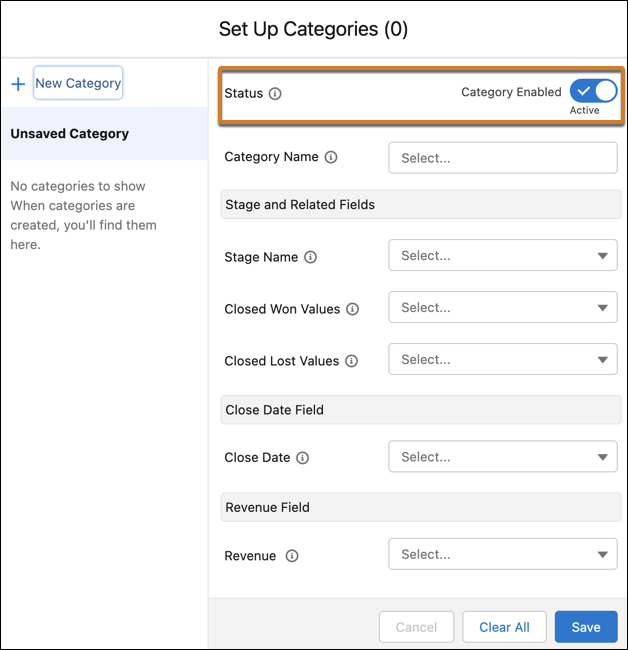
On the Revenue Management Setup page, from the Configure Objects and Categories step, click
Create Categories.
Enter a name for the category.
From the Stage Name list, find and select the field from the Revenue Data Source that you
selected in the Set Up Objects and Fields step.
From the Closed Won Values list, find and select the picklist values that represent the
Closed Won stage.
From the Closed Lost Values list, find and select the picklist values that represent the
Closed Lost stage.
From the Close Date list, find and select the field from Revenue Data Source that stores
the opportunity close date.
From the Revenue list, find and select the field from the Revenue Data Source object that
stores the revenue details as either amount or quantity.
In the CRM Analytics app, revenue is aggregated to provide visibility into opportunity
performance.
To activate and access the category from the analytics dashboard, from the top-right corner
of the window, turn on the Status toggle.
Did this article solve your issue?
Let us know so we can improve!
Loading
Salesforce Help | Article
Cookie Consent Manager
Cookie Consent Manager
General Information
Required Cookies
Functional Cookies
Advertising Cookies
General Information
We use three kinds of cookies on our websites: required, functional, and advertising. You can choose whether functional and advertising cookies apply. Click on the different cookie categories to find out more about each category and to change the default settings.
Privacy Statement
Required Cookies
Always Active
Required cookies are necessary for basic website functionality. Some examples include: session cookies needed to transmit the website, authentication cookies, and security cookies.
Functional Cookies
Functional cookies enhance functions, performance, and services on the website. Some examples include: cookies used to analyze site traffic, cookies used for market research, and cookies used to display advertising that is not directed to a particular individual.
Advertising Cookies
Advertising cookies track activity across websites in order to understand a viewer’s interests, and direct them specific marketing. Some examples include: cookies used for remarketing, or interest-based advertising.