Control the visibility of service processes to your customers and users by creating
qualification rules. To create a qualification rule, enter values for the input criteria that the
service process product must meet to be qualified. Customers and users can see service process
products when the service process products meet the qualification criteria.
Required Editions
Available in: Lightning Experience
Available in:
Enterprise and
Unlimited Editions with the required licenses
User Permissions Needed
To create a qualification rule:
Product Catalog Management Designer
From the App Launcher, find and select Product Catalog
Management.
Click Qualification Rules.
From the list of Qualification Decision Tables, select the SvcProcessEligibility decision
table.
On the Table tab on the decision table page, click View Object Record
Page.
On the Product Qualifications list view page, select New.
Enter the values for the input criteria.
In this example, create a qualification rule for each service process product that you
want to qualify.
Note As of Spring ‘24, the Action Launcher doesn’t qualify service processes if they’re
configured for eligibility based on product categories and subcategories.
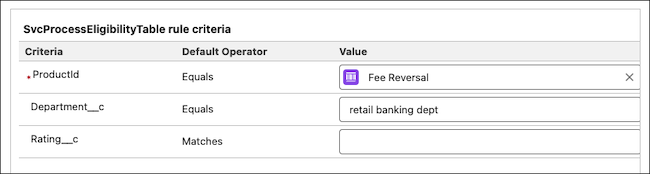
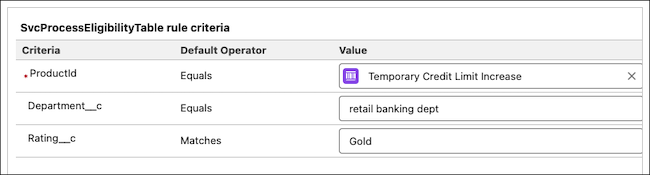
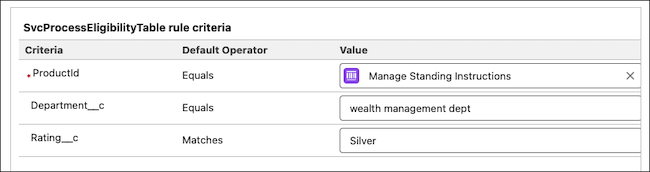
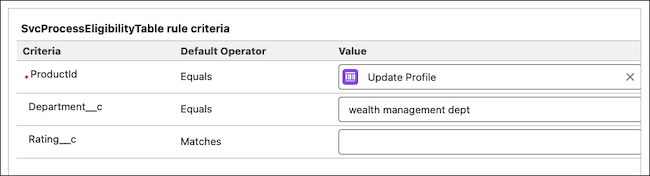
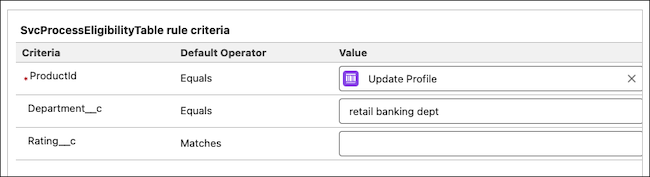
Here are the qualification rules for the service process products.
Save your changes.
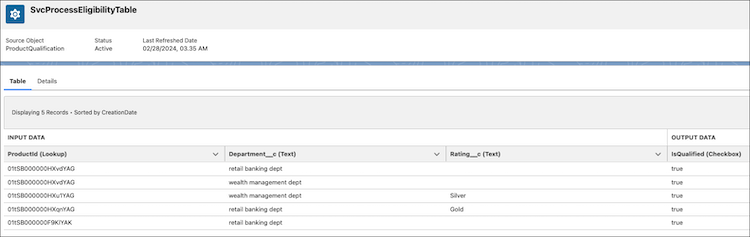
Here’s the decision table for the service process products with their corresponding
qualification criteria.
We use three kinds of cookies on our websites: required, functional, and advertising. You can choose whether functional and advertising cookies apply. Click on the different cookie categories to find out more about each category and to change the default settings.
Privacy Statement
Required Cookies
Always Active
Required cookies are necessary for basic website functionality. Some examples include: session cookies needed to transmit the website, authentication cookies, and security cookies.
Functional Cookies
Functional cookies enhance functions, performance, and services on the website. Some examples include: cookies used to analyze site traffic, cookies used for market research, and cookies used to display advertising that is not directed to a particular individual.
Advertising Cookies
Advertising cookies track activity across websites in order to understand a viewer’s interests, and direct them specific marketing. Some examples include: cookies used for remarketing, or interest-based advertising.