
Transaction Dispute Management for Financial Services Cloud
Use Transaction Dispute Management to process disputes for credit cards, debit cards, and Automated Clearing House (ACH) transactions. Manage the entire dispute lifecycle, from initial intake to final resolution by integrating with payment networks.
Required Editions
| Available in: Lightning Experience |
| Available in: Professional, Enterprise, and Unlimited Editions |
Transaction Dispute Management Key Benefits
- Deflect non-qualifying disputes early by presenting clear merchant details, such as merchant name, logo, and URL.
- Capture the complete dispute details for a transaction by using a guided intake form that automatically shows specific assessment questions for each dispute reason.
- Reduce the dispute processing time by integrating directly with payment networks for real-time evidence submission and status tracking.
- Automate routine communications and data entry by using generative AI and prebuilt prompt templates.
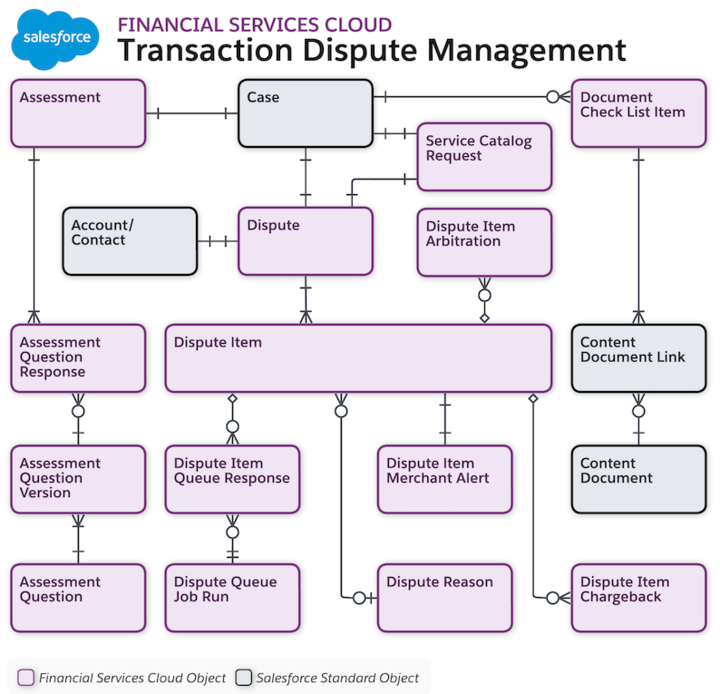
Transaction Dispute Management Data Model
Watch this video to understand how to streamline dispute resolution, enhance customer satisfaction, and optimize operational efficiency for retail banks.
If you aren’t able to watch the video in full screen, open the video in a new tab:  Get to Know Transaction Dispute Management for Financial Services
Cloud.
Get to Know Transaction Dispute Management for Financial Services
Cloud.
- Learn About Transaction Dispute Management
Transaction Dispute Management organizes the dispute resolution process into three operational phases: intake, enrichment, and resolution. Understand these phases to plan your configuration and integration strategies. - Transaction Dispute Management Glossary of Terms
Collection of terms from a real-world example of a concert ticket purchase to equip you with the vocabulary to navigate Transaction Dispute Management. - Transaction Dispute Management Setup and Configuration
Setting up Transaction Dispute Management transforms your Salesforce instance into a unified workspace for resolving financial disputes. To configure Transaction Dispute Management, enable permissions, define the data model, and establish connections with external systems. - Dispute Request Picklist Values
To configure Transaction Dispute Management, make sure your Salesforce org contains the standard and network-specific picklist values. Add these values to the corresponding objects and fields during setup. - Dispute Intake OmniScript Components
You can customize the dispute intake OmniScript to suit your business needs. - Sample Dispute Reason Codes and Subcodes
Reason codes and subcodes are essential for managing transaction disputes effectively throughout the various phases of a dispute lifecycle. Use these codes to categorize disputes, streamline the initial capture process, guide the dispute process, and ensure consistency and clarity for all stakeholders involved in dispute resolution. - Working with Transaction Dispute Management
Guide service representatives and dispute specialists through the operational workflow of transaction disputes, from initial submission to final resolution. Capture dispute details effectively and use integrated tools to generate timely responses at key stages of the dispute lifecycle. - Transaction Dispute Management as a Self-Service Process
Capture customer requests for transaction disputes through a self-service channel. - Transaction Dispute Management Solution
Explore features for resolving financial transaction disputes end to end with Transaction Dispute Management Solution. This solution deploys preconfigured features and sample data so you can get hands-on experience with minimal manual setup.
Did this article solve your issue?
Let us know so we can improve!
