Flow Screen Input Component: Single-Select Table
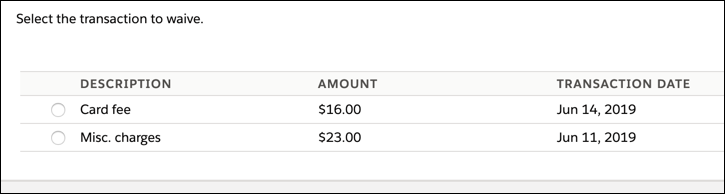
Display a table with a radio button next to each row in the table. A user can select one of the rows in the table.
Required Editions
| Available in: Lightning Experience |
| Available in: Professional, Enterprise, and Unlimited Editions |
For information about adding screen components to your flow screen, see Screen.

Configure the Single-Select Table Component
You can select resources from the flow, such as variables or global constants, or you can manually enter a value.
| Attribute | Description |
|---|---|
| Columns | Required. Defines columns for the table. Add a Text collection variable that contains a list of field API names that you want to include in the table. |
| Records | Required. Defines rows for the table. Add a Text collection variable that contains a list of record IDs that you want to include in the table. Ensure that the variable contains at least one record ID. Otherwise, the component shows an error message when you run the flow. |
| Error Messages | Add a Text variable to store error messages returned by the component. |
| Selected Record | Add a Text variable to store the selected record. |
Store the Single-Select Table Component’s Values in the Flow
The flow stores values automatically. If you store values manually, store the attribute’s output value in a variable.
To store values manually, select Manually assign variables (advanced).
All attributes are available to store in flow variables, but the Selected Record attribute is the most likely attribute to store. The value is assigned when the user navigates to the next screen.
To store the record that the user selected, map the Selected Record attribute to a text variable.


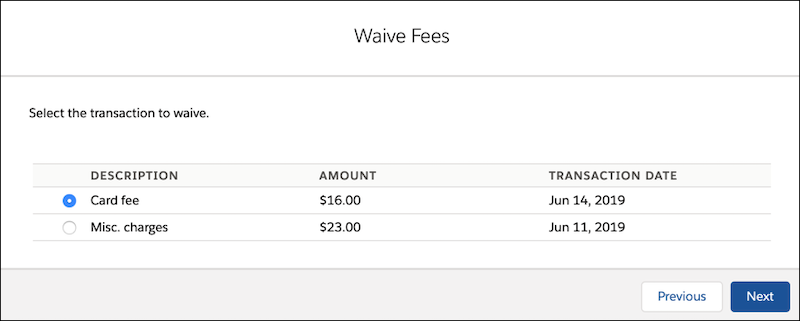
In a Waive Fees flow, a table shows all the transactions for the selected financial account. Users can select only one transaction to waive.
- Define the columns for the table.
- Create a Text collection variable.
- Use an Assignment element to assign the API names of the fields to the Text collection
variable. The fields must be from the same object. Add the fields in the order in which you
want them to appear in the table.
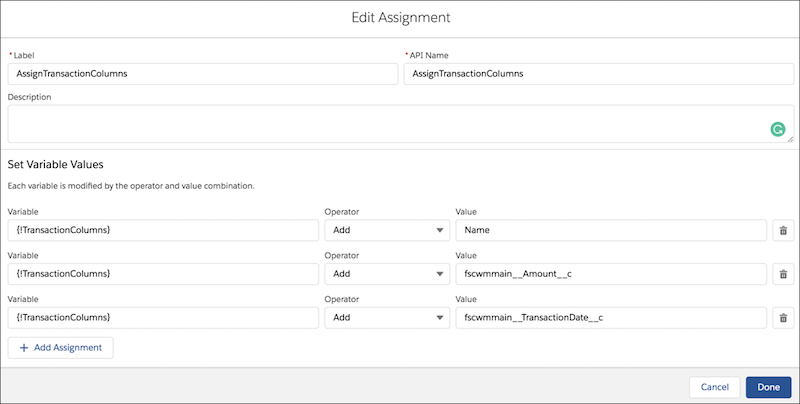
- Connect the Assignment element at the appropriate place in the flow.
- Define the rows for the table.
- Create a Record collection variable.
- Use a Get Records element to populate the Record collection variable with the records that you want to include in the table.
- Create a Text collection variable.
- Create a loop that iterates over the Record collection variable to fetch individual record IDs. Within the loop, use an Assignment element to add the fetched record IDs to the Text collection variable.
- At the end of the loop, use the Text collection variable as an input to the table.
When a user runs the flow, the table shows all the transactions for the financial account that the user selects.