On a business account or person account page, by default, the Policy component shows
only the policies that the client owns. It doesn’t show the policies in which the client is a
participant. Similarly, on a household page, the Policy component shows only the policies that
the household members own. It doesn’t show the policies in which household members are
participants.
Required Editions
Available in: Lightning Experience
Available in: Professional, Enterprise, and Unlimited
Editions
You can edit your account or household page, and configure the Policy component to include
one or more participant roles such as beneficiary, driver, or subscriber. When you do that,
the policy list includes both the owned policies and the policies where the client or the
household members are participants.
And, at the top of the list, click the filter . You see the Show only owned policies option. Select this
option to view only the owned policies and exclude any participant policies.
The policies are grouped by policy type. The policies that don’t have a policy type are
grouped under the Others policy type. A group can show a maximum of five policies. Use the All
Policies link at the bottom of the Policy component to view all the policies owned by the
client or the household.
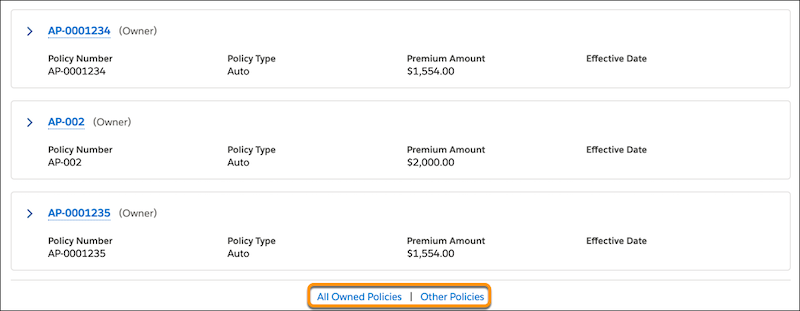
If you don’t select the Show only owned policies option, you see two links at the bottom of
the list: All Owned Policies and Other Policies.
For an account, the All Owned Policies link opens the Insurance Policies list view, which
shows all the policies that the client owns. The Other Policies link opens the Insurance
Policy Participants list view, which shows all participant records for the client.
For a household, the All Owned Policies link opens the Household Insurance Policies list
view, which shows all the policies that the household members own. The Other Policies link
opens the Household Insurance Policy Participants list view, which shows all participant
records for household members.
We use three kinds of cookies on our websites: required, functional, and advertising. You can choose whether functional and advertising cookies apply. Click on the different cookie categories to find out more about each category and to change the default settings.
Privacy Statement
Required Cookies
Always Active
Required cookies are necessary for basic website functionality. Some examples include: session cookies needed to transmit the website, authentication cookies, and security cookies.
Functional Cookies
Functional cookies enhance functions, performance, and services on the website. Some examples include: cookies used to analyze site traffic, cookies used for market research, and cookies used to display advertising that is not directed to a particular individual.
Advertising Cookies
Advertising cookies track activity across websites in order to understand a viewer’s interests, and direct them specific marketing. Some examples include: cookies used for remarketing, or interest-based advertising.