
Know Your Customers
By using the Know Your Customer (KYC) data model, your users can perform identity verification, risk assessment, and screening checks of parties with ease. Parties can be accounts, contacts, or leads.
Required Editions
| Available in: Lightning Experience in Enterprise and Unlimited Editions that have Financial Services Cloud enabled |
The KYC data model has several use cases. For example, your Onboarding team can use the model to validate a prospect’s information that’s submitted during an assessment. Or, your Operations team can use the model to verify the prospect’s information and assign a risk rating.
Know Your Customer Data Model
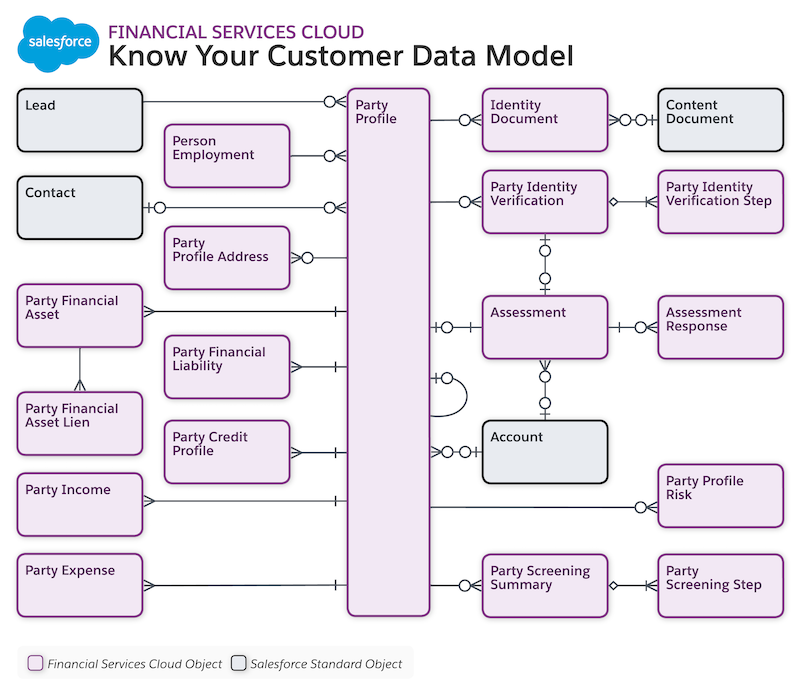
Example: Streamline Onboarding with KYC Data Model and Integrated Onboarding Data Model
A new resident, Rachel Adams, visits Cumulus Bank to open a savings account. The relationship manager, Tim, helps her with the application. As required by regulations, the bank performs KYC checks on Rachel. After a successful KYC verification, Rachel is onboarded, and her savings account is created. Six months later, Rachel returns to Cumulus Bank to apply for a credit card. Because the bank already has her validated KYC information from her previous application, the credit card application process is significantly faster and smoother.
To ensure a smooth onboarding for Rachel Adams, Cumulus Bank uses both the KYC data model and the Integrated Onboarding data model. The KYC model fast-tracks identity verification, and the Integrated Onboarding data model streamlines the application process.
Understand Applicant, Party Profile, and Account Objects
Applicant, Party Profile, and Account objects play distinct roles. This table provides the details of these objects and their functionalities in the onboarding use case.
| Object | Definition | Use Case | Example |
|---|---|---|---|
| Applicant | Represents information about the individual or group that’s applying for a product. | An applicant record is created specifically to track the details of a single product application. A new applicant record is created for each product that an individual or group applies for. | Rachel Adams is new to the bank and an applicant record is created in Salesforce for Rachel Adams with Savings Account as the application form product. |
| Party Profile | Represents the KYC profile of the individual or group. Stores a party's profile details, including KYC information such as ID verification, credit score, and background checks. | Create a party profile record and link the record to an applicant for KYC purposes. After the KYC verification is complete, you can reuse the same party profile record for future applications submitted by the same individual. By using the same record, you can eliminate the need for redundant verification steps, saving time and effort. | To verify Rachel Adams' identity according to KYC regulations, a party profile record is created in Salesforce. You can use this record in the future, either for a periodic re-verification (KYC refresh) or for any new product application that Rachel submits. |
| Account | Represents a record created after a successful application for a specific product. It represents the ongoing customer relationship with that product. | Created when the application is approved application approval. Tracks the transactions and activity related to the specific product. | When Rachel Adams' savings account application is approved, a corresponding Account is created for her in Salesforce. |
- Enable Know Your Customer for Financial Services Cloud
Use the Know Your Customer (KYC) data model to store information collected from a party during a KYC process. You can then use the data from Identity and Verification service providers or Screening service providers to verify the identity of the party or to perform various screening checks for the party. - Frequently Asked Questions on the Know Your Customer (KYC) Data Model
Get answers to the most frequently asked questions regarding the Know Your Customer (KYC) data model, using the context of onboarding an applicant for a product for better comprehension.
