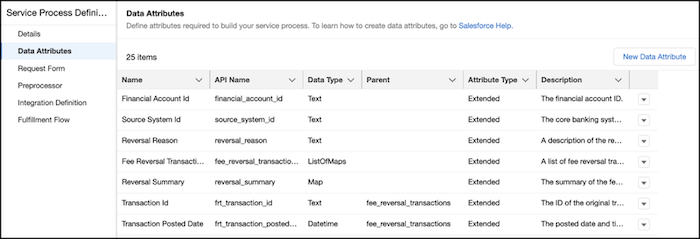
Optionally, create data attributes to store information from a client. The Fee Reversal
service process has predefined data attributes. You can create more as needed to meet the needs of
your business.
Required Editions
User Permissions Needed
To set up Fee Reversal service process:
Industries Service Process, Industry Service Excellence, and OmniStudio
Case
and Service Catalog Request objects Read, Create, Edit, Delete, View All
Records
AND
Financial Services Cloud
Extension
OR
Financial Services Cloud Basic
OR
Financial
Services Cloud Standard
To use Fee Reversal service process:
Industries Service Process, Industry Service Excellence, and OmniStudio
Case, and
Service Catalog Request Items objects: Read, Create, Edit, Delete
AND
Financial
Services Cloud Extension
OR
Financial Services Cloud
Basic
OR
Financial Services Cloud Standard
In Setup, in the Quick Find box, enter Service Process Studio, and
then click Service Process Studio.
Edit an existing service process or create one.
Select Data Attributes and then click New Data
Attribute.
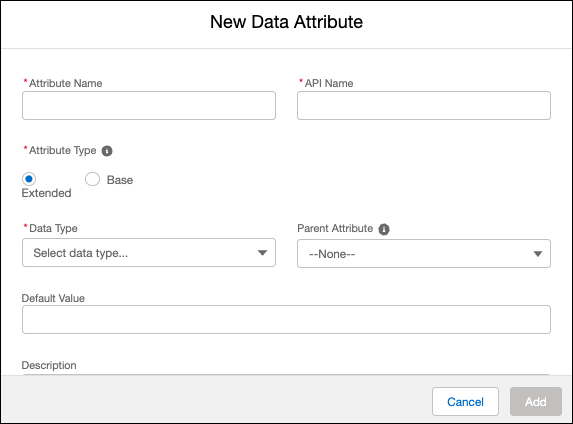
Enter an Attribute Name and API Name.
Select an Attribute Type.
Select a Data Type.
Optionally, select a Parent Attribute.
Optionally, enter a Default Value and Description.
Optionally, select Required.
Click Add.
Save your changes.
Did this article solve your issue?
Let us know so we can improve!
Loading
Salesforce Help | Article
Cookie Consent Manager
Cookie Consent Manager
General Information
Required Cookies
Functional Cookies
Advertising Cookies
General Information
We use three kinds of cookies on our websites: required, functional, and advertising. You can choose whether functional and advertising cookies apply. Click on the different cookie categories to find out more about each category and to change the default settings.
Privacy Statement
Required Cookies
Always Active
Required cookies are necessary for basic website functionality. Some examples include: session cookies needed to transmit the website, authentication cookies, and security cookies.
Functional Cookies
Functional cookies enhance functions, performance, and services on the website. Some examples include: cookies used to analyze site traffic, cookies used for market research, and cookies used to display advertising that is not directed to a particular individual.
Advertising Cookies
Advertising cookies track activity across websites in order to understand a viewer’s interests, and direct them specific marketing. Some examples include: cookies used for remarketing, or interest-based advertising.