Configure Expression Set to Determine Coverage Information Extensions
Reference the decision matrix for determining coverage information in the pre-built
CDS_DetermineCoverageExtensions expression set. Create resources for each input and output
variable defined in the decision matrix. Then, map the variables to the resources.
Required Editions
Available in: Lightning Experience
Available in: Enterprise and Unlimited Editions with Health Cloud
User Permissions Needed
To create, update, and delete expression sets:
Rule Engine Designer
To use a decision matrix in Business Rules Engine:
Rules Engine Runtime
From the App Launcher, find and select Expression Set
Templates.
Open CDS_DetermineCoverageExtensions.
In the Lookup Table Details field, enter the name of the decision matrix you created and
select it to reference it in the expression set.
Create a variable resource for each input and output variable defined in the decision
matrix.
Click , then click Add Resource.
Select the resource type, enter the resource name, and select the data type. For example,
to add a resource for CPTCode, select Variable as the resource type,
enter MemberCPTCode as the resource name, and select
Text as the data type.
Repeat these steps for each input and output variable.
Click Done.
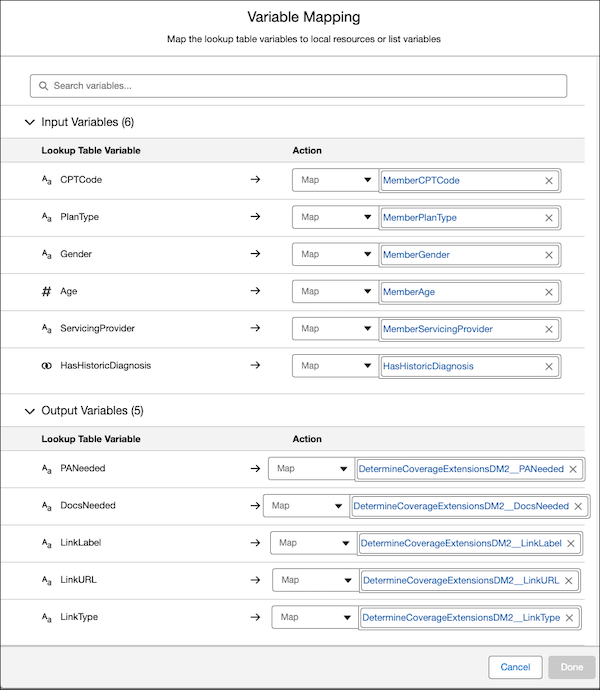
In the lookup table element you added, click Map Variables.
Map each input and output variable in the decision matrix to the corresponding resource you
created. For example, to map the CPTCode input variable, select Map as
the action, then search and select MemberCPTCode as the resource.
When you complete the mapping for each variable, click Done.
We use three kinds of cookies on our websites: required, functional, and advertising. You can choose whether functional and advertising cookies apply. Click on the different cookie categories to find out more about each category and to change the default settings.
Privacy Statement
Required Cookies
Always Active
Required cookies are necessary for basic website functionality. Some examples include: session cookies needed to transmit the website, authentication cookies, and security cookies.
Functional Cookies
Functional cookies enhance functions, performance, and services on the website. Some examples include: cookies used to analyze site traffic, cookies used for market research, and cookies used to display advertising that is not directed to a particular individual.
Advertising Cookies
Advertising cookies track activity across websites in order to understand a viewer’s interests, and direct them specific marketing. Some examples include: cookies used for remarketing, or interest-based advertising.