You are here:
Manage Workers’ Compensation Claims
Track claimant earnings that are used to calculate compensation, establish recurring payment schedules, and track formal progress toward someone's capacity to return to work after sustaining a work-related injury or other disability. Objects designed for workers' compensation claim administration make compliance easier for claims adjusters and help get timely, accurate payments to injured workers.
For example, Anna has a workers' compensation insurance plan through her employer, Cloud Kicks. After she's injured on the job, Anna visits a doctor, files a workers' compensation claim, and submits doctor's notes that certify her capacity to work. She receives workers' compensation payments every two weeks until she's fully recovered.
Event Timeline for the Injured Party |
Records Managed by the Claims Adjuster |
|
Date |
Event |
|
January 10 |
File workers' compensation claim |
Claim Claim participants include:
|
January 11 |
Submit doctor's note that says Anna has 0% work capacity for the next 3 months |
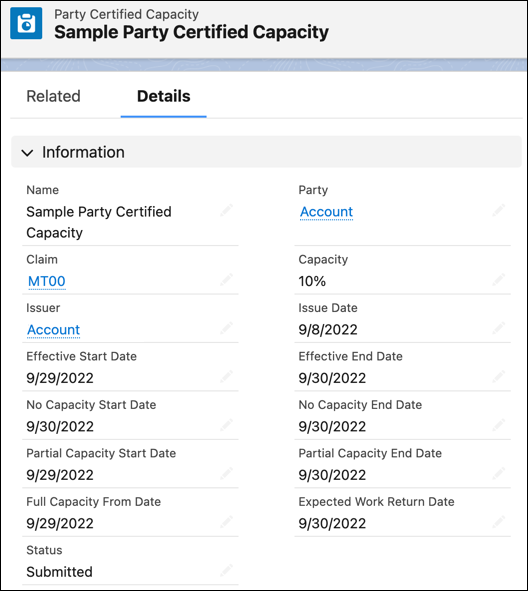
Party Certified Capacity The Party Certified Capacity record shows details captured from a worker's certificate of capacity, such as the party's capacity to work, a timeline for recovery, and the return to work. The percentage of capacity is used to calculate compensation for claim payouts. Based on Anna's initial diagnosis, her payments are calculated as 100% of her income. Workers typically get re-certified periodically to confirm the initial prognosis. |
|
||
January 11 |
Provide proof of prior income |
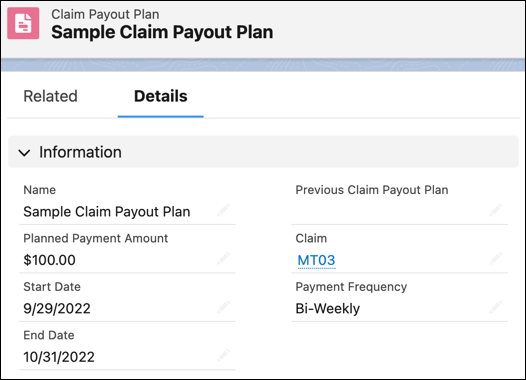
Party Income The Party Income record stores claimant earnings that are used to calculate compensation for claim payouts. Define this as the amount a claimant earned before getting injured or disabled. For Claim, enter the workers' compensation claim associated with the party income. For Party, enter ClaimParticipant. Claim Payout Plan The Claim Payout Plan tracks the amount to pay to a claimant on a scheduled or recurring basis, typically used for weekly wage compensation. The payout plan includes details such as payment frequency, duration, and payouts. Anna's plan sets a payment schedule of every two weeks for the next 3 months. Claims adjusters can see scheduled payments when they review claim financials. |
|
||
January 31, February 15, February 28 |
Receive 100% workers' compensation payments |
Claim Coverage Payment Detail A batch process issues a payment on scheduled dates per the Claim Payout Plan. |
March 2 |
Submit doctor's note that says Anna has 50% work capacity for the next month. |
Party Certified Capacity Good news! Anna's recovering nicely and can return to work sooner than planned. A new Party Certified Capacity record defines her payments as 50% of her income. Claim Payout Plan Anna's new Claim Payout Plan schedules payments every two weeks for the next month. |
March 15, March 31 |
Receive 50% workers' compensation payments |
Claim Coverage Payment Detail A batch process issues a payment on scheduled dates per the Claim Payout Plan. |
April 1 |
Return to work full-time |
After the final scheduled payment is issued and Anna returns to work, the claims adjuster's job is done. |
To prepare your org for workers' compensation claim management:
-
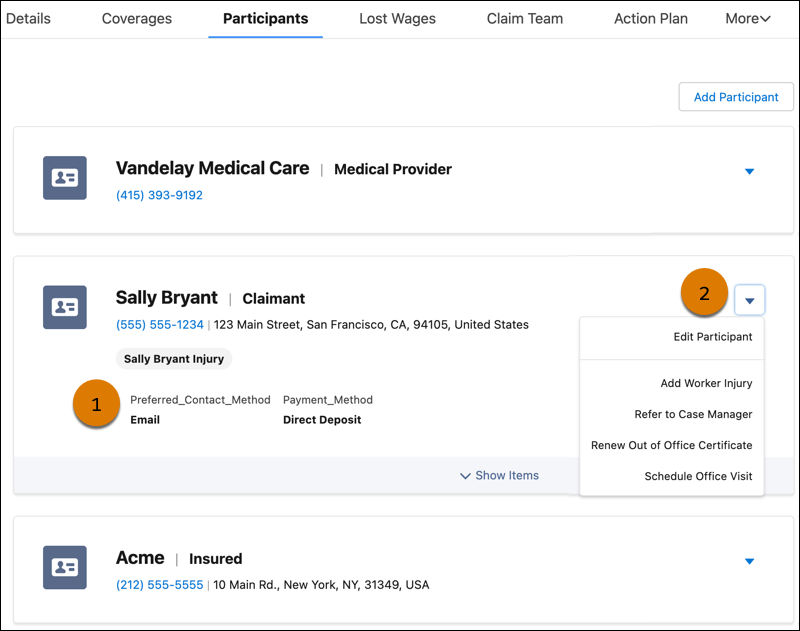
Configure the Claim Participant card to show different fields (1) and actions (2) depending on whether a participant is an injured party, healthcare provider, employer, or in a different role.
-
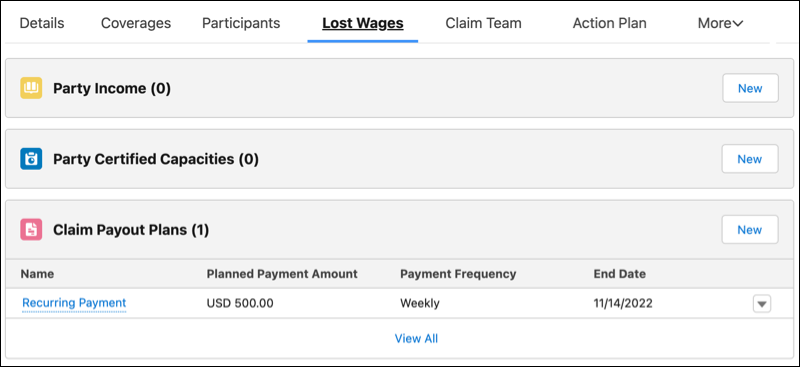
Add workers' compensation data to the Claim page layout. For example, show the income used to calculate payments, the certificates of capacity to return to work, and recurring payment schedules.
-
Create batch processes that issue workers' compensation payments on scheduled dates based on claim payout plans.
