You are here:
Policy Product Management Definitions
Vlocity Insurance provides a robust administration environment to model and administer a wide range of insurance products. Correctly structuring products ensures consistent enforcement of pricing and rules throughout the policy lifecycle and reduces the effort of maintaining a large set of products.
The Vlocity Insurance product model is designed to reflect the reality of the insurance industry, while also maximizing the reuse of components across the products. The set-up and ongoing administration of the product is managed completely within the Salesforce Lightning Experience, with minimal need for custom coding.
The illustration below details the different components used in creating a product and how they interact.
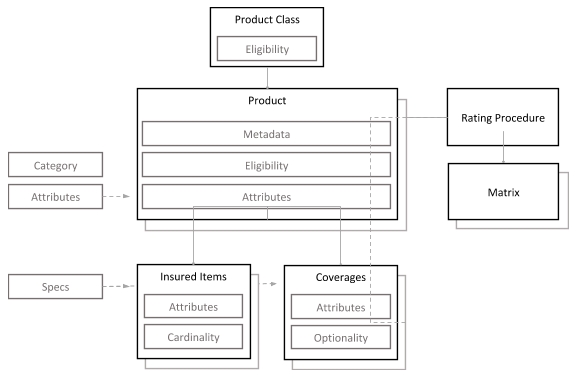
The components of the model are described in the table below:
Term |
Definition |
Example |
|---|---|---|
Insured Item Spec |
The blueprint of the different types of objects that can be covered by the insurance product. See Create Insured Item Specs. |
For Watercraft Insurance, the insured items could refer to the vessel and the operator. For Pet Insurance, the insured item could refer to the eligible pet types, like dog, cat, or horse. |
Coverage Spec |
The type of coverage the insurance provides. See Create Insurance Coverage Specs. |
For Watercraft Insurance, the coverage could include damage to the vessel along with liability insurance for the operator. For Pet Insurance, the coverage could include co-insurance, annual deductible, and annual benefit limit. |
Products |
A Product refers to an Insurance Product. It is composed of coverage and insured items, see Root Product Specs |
A Watercraft Insurance product could be composed of the vessel and operator for Insured Items and damage and operator liability for Coverage. A Pet Insurance product could be composed of a Pet for the Insured Item and the coverage could consist of Annual Deductible and Co-Insurance. |
Eligibility Rules |
Eligibility Rules help determine the type of Insurance Products a user is eligible for based their information. See Create Eligibility Rules. |
If a user's age is greater than or equal to 65 they are eligible for Medicaid. If the user's age is less than 65, they are not eligible. |
Underwriting Rules |
Underwriting Rules can help you better automate progression through the quoting process. See Creating Underwriting Rules |
For Watercraft Insurance, you could create an underwriting rule that automatically declines applications where the vessel's age is over 25 years. |
Calculation Matrix |
Calculation Matrices are used in conjunction with Calculation Procedures to determine the insurance rates. See Using a Matrix Lookup with Insurance Rules . |
For Watercraft Insurance, the hull material is a factor in the insurance price. For example, the WatercraftHullMaterial matrix may have an entry for Wood with a physical damage factor of 1.8 and liability factor of 1; an entry for Metal with physical damage factor of 1.05 and liability factor of 1. |
Calculation Procedures |
Calculation Procedures are used along with Calculation Matrix Lookup to determine the final price for an insurance quote, see Declarative Calculation Procedures. |
A Calculation Procedure for Boat Insurance would have variables and constants along with the calculation steps. A variable would be WatercraftHullMaterial and a Constant would be baseLiability number that is always consistent. The calculation steps consist of matrix lookups and calculations. |
Get Rated Products |
The service used in the OmniScript to return the eligible priced products based on the end user's input. |
|
Reprice Product |
The service used in the OmniScript to return the price of the product based on the end user's specifications. |
|
Create Update Quote |
The service used in the OmniScript to create a new quote or update an existing quote. |
|
Create Update Policy |
The service used in the OmniScript to create a new policy or update an existing policy. |
