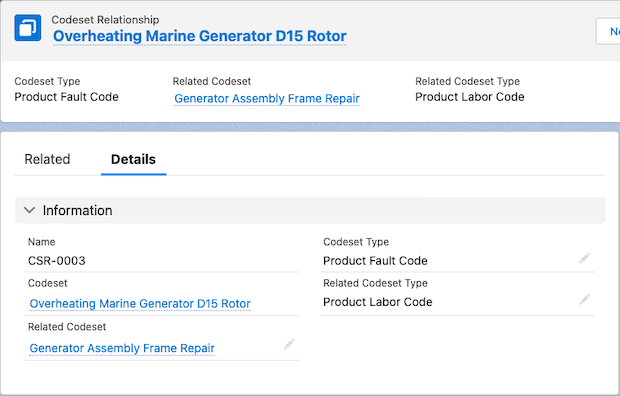
Define codeset relationships to associate a code set with another code set. For example,
create codeset relationships between product fault codes and product labor codes to map the
combinations of product defects with the different labor services that can rectify
them.
Required Editions
Available in: Enterprise, Unlimited, and Developer
Editions
User Permissions Needed
To create and update Product Fault Codes:
Warranty Lifecycle Management permission set
Note To select a Codeset Type and a Related Codeset Type for a Codeset Relationship,
ensure that your admin has added picklist values for the Code Set Type field on the Code Set
object.
From the App Launcher, find and select Codeset Relationships.
Click New.
For Codeset, specify a code set.
For example, specify a product fault code.
For Codeset Type, select the type of the code set.
For Related Codeset, specify the code set that’s to be associated with the other code
set.
For example, specify a product labor code.
For Related Codeset Type, specify the type of the code set that’s to be associated with the
other code set.
Save your changes.
Example
The warranty manager at Thomas Railways Equipment, Inc., a manufacturer, defines two codeset
relationships.
Codeset Relationship 1
Codeset: Overheating Drill Head
Codeset Type: Product Fault Code
Related Codeset: Drill Head Replacement
Related Codeset Type: Product Labor Code
Codeset Relationship 2
Codeset: Malfunctioning Torque Control
Codeset Type: Product Fault Code
Related Codeset: Torque Control Repair
Related Codeset Type: Product Labor Code
Did this article solve your issue?
Let us know so we can improve!
Loading
Salesforce Help | Article
Cookie Consent Manager
Cookie Consent Manager
General Information
Required Cookies
Functional Cookies
Advertising Cookies
General Information
We use three kinds of cookies on our websites: required, functional, and advertising. You can choose whether functional and advertising cookies apply. Click on the different cookie categories to find out more about each category and to change the default settings.
Privacy Statement
Required Cookies
Always Active
Required cookies are necessary for basic website functionality. Some examples include: session cookies needed to transmit the website, authentication cookies, and security cookies.
Functional Cookies
Functional cookies enhance functions, performance, and services on the website. Some examples include: cookies used to analyze site traffic, cookies used for market research, and cookies used to display advertising that is not directed to a particular individual.
Advertising Cookies
Advertising cookies track activity across websites in order to understand a viewer’s interests, and direct them specific marketing. Some examples include: cookies used for remarketing, or interest-based advertising.