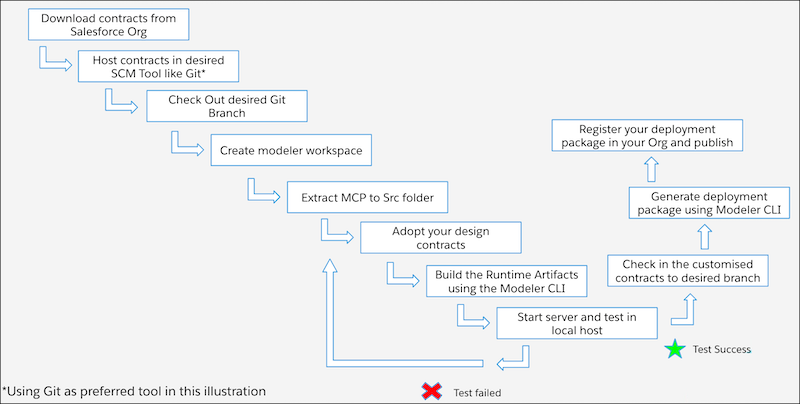
Consumer Goods Cloud Offline Mobile App Customization Workflow
You can customize the core design contracts or add custom contracts and define the
desired customization. Test the customization in the simulator app and deploy the customizations
to Consumer Goods Cloud offline mobile app users.
Required Editions
Available in: Lightning Experience in Enterprise and Unlimited
Editions that have Consumer Goods Cloud enabled
User Permissions
Needed
To customize the CG Cloud offline mobile app:
Customizer, Admin
The workflow explains how you can plan, develop, test, and deploy your Consumer
Goods Cloud offline mobile app customizations.
In the Salesforce Lightning App Builder, download the Modeler Design Contracts package
from the Custom - Managed section.
Set up a source control management system (Git recommended) to host the design
contracts.
In Git, check out the feature branch where you want to implement and test your
customization project.
Create a workspace by running sf modeler workspace
create.
Extract the Modeler Design Contracts ZIP file and copy the contents of the
contracts folder to the src folder in your
workspace.
Customize the core contracts for your project. You can also create a custom module and
add the required contracts and logic files. To add a custom module and its contracts by
running sf modeler workspace add.
Test and verify the customization in the simulator app UI.
If the customization fails, fix the issues and repeat the steps starting with
extracting the Modeler Design Contracts ZIP file until the customization is successfully
implemented.
Check in the customized design contracts to the feature branch.
Generate the deployment ZIP file by running sf modeler
workspace package.
Register the deployment file in the Sync Management app and publish the customization
changes to the Consumer Goods Cloud offline mobile app users.
Did this article solve your issue?
Let us know so we can improve!
Loading
Salesforce Help | Article
Cookie Consent Manager
General Information
Required Cookies
Functional Cookies
Advertising Cookies
General Information
We use three kinds of cookies on our websites: required, functional, and advertising. You can choose whether functional and advertising cookies apply. Click on the different cookie categories to find out more about each category and to change the default settings.
Privacy Statement
Required Cookies
Always Active
Required cookies are necessary for basic website functionality. Some examples include: session cookies needed to transmit the website, authentication cookies, and security cookies.
Functional Cookies
Functional cookies enhance functions, performance, and services on the website. Some examples include: cookies used to analyze site traffic, cookies used for market research, and cookies used to display advertising that is not directed to a particular individual.
Advertising Cookies
Advertising cookies track activity across websites in order to understand a viewer’s interests, and direct them specific marketing. Some examples include: cookies used for remarketing, or interest-based advertising.