Ground the information in the uploaded disclosure reports to create comprehensive
records that capture the essential fields and data. Einstein generative AI uses the information
to produce accurate, relevant, and contextually appropriate outputs based on your data and use
cases allowing for more personalized and trusted responses.
Required Editions
Available in: Lightning Experience
Available in: Enterprise, Performance, Unlimited, and
Developer Editions with the Net Zero Cloud Growth license or the Net Zero
Cloud User add-on license and the Agentforce for Net Zero Cloud add-on license.
Einstein generative AI is available in Lightning Experience.
Available with the Salesforce Foundations license.
To purchase the Agentforce for Net Zero Cloud add-on, contact your Salesforce
account executive
User Permissions Needed
To generate disclosure and compliance reports:
Disclosure and Compliance Hub User
To search for disclosures in files using generative AI:
From the App Launcher, find and select Disclosure and Compliance
Hub.
From the Disclosures and Compliance Hub menu, select Disclosures and
Compliance Hub.
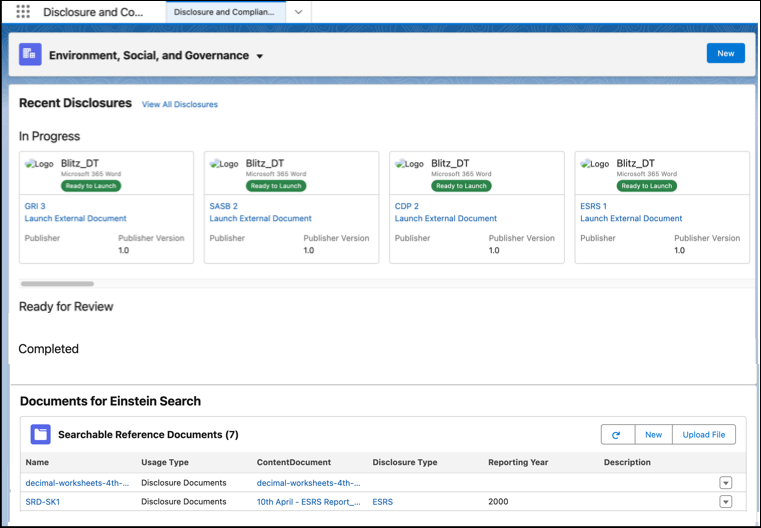
In the Searchable Reference Documents section, click Upload
File.
Select a valid disclosure document (past reports or financial statements) and upload
the file.
Note If you’re directly creating the Searchable Reference Document record, ensure that you upload
the file into Salesforce Files before you create the record.
Net Zero Cloud extracts the disclosure information from the uploaded files and the
search engine breaks up the searchable content into smaller pieces, called tokens. It stores
the tokens in a search index. Indexing content helps the search engine quickly find relevant
results when you search. After you upload the files, it can take up to 24 hours for Net Zero Cloud to extract the content from the files.
Did this article solve your issue?
Let us know so we can improve!
Loading
Salesforce Help | Article
Cookie Consent Manager
Cookie Consent Manager
General Information
Required Cookies
Functional Cookies
Advertising Cookies
General Information
We use three kinds of cookies on our websites: required, functional, and advertising. You can choose whether functional and advertising cookies apply. Click on the different cookie categories to find out more about each category and to change the default settings.
Privacy Statement
Required Cookies
Always Active
Required cookies are necessary for basic website functionality. Some examples include: session cookies needed to transmit the website, authentication cookies, and security cookies.
Functional Cookies
Functional cookies enhance functions, performance, and services on the website. Some examples include: cookies used to analyze site traffic, cookies used for market research, and cookies used to display advertising that is not directed to a particular individual.
Advertising Cookies
Advertising cookies track activity across websites in order to understand a viewer’s interests, and direct them specific marketing. Some examples include: cookies used for remarketing, or interest-based advertising.