Salesforce Pricing doesn't work directly with the
SalesTransactionContext__stdctx base context definition. To configure
Standard Pricing Actions, always extend the base context. An extended context
definition inherits the structure, nodes, and attributes from the base context definition
while allowing you to add custom nodes, attributes, and tags for your pricing
logic.
The standard Calculate Price button is only for pricing Salesforce objects
and doesn't support custom data hydration.
The more complex Quotes and Orders
logic, which uses custom hydration for bundles and derived products, requires a
custom-built pricing button that can act on persisted (saved) data. Therefore, the
standard button should not be considered a replacement for Transaction Management's
pricing logic.
From Setup, in Object Manager, select any one of these objects: Quote, Order, Contract,
Case, and Opportunity. For example, let’s select Opportunity.
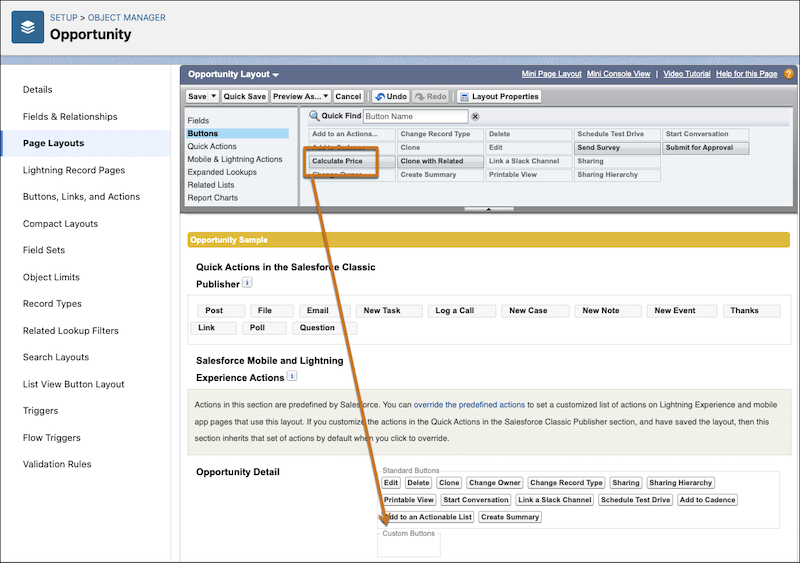
Select Page Layouts, and then click Opportunity
Layout.
In the palette, click Buttons.
Drag Calculate Price to the Opportunity Detail section under
Salesforce Mobile and Lightning Experience Actions in the layout.
Save your changes.
Did this article solve your issue?
Let us know so we can improve!
Loading
Salesforce Help | Article
Cookie Consent Manager
Cookie Consent Manager
General Information
Required Cookies
Functional Cookies
Advertising Cookies
General Information
We use three kinds of cookies on our websites: required, functional, and advertising. You can choose whether functional and advertising cookies apply. Click on the different cookie categories to find out more about each category and to change the default settings.
Privacy Statement
Required Cookies
Always Active
Required cookies are necessary for basic website functionality. Some examples include: session cookies needed to transmit the website, authentication cookies, and security cookies.
Functional Cookies
Functional cookies enhance functions, performance, and services on the website. Some examples include: cookies used to analyze site traffic, cookies used for market research, and cookies used to display advertising that is not directed to a particular individual.
Advertising Cookies
Advertising cookies track activity across websites in order to understand a viewer’s interests, and direct them specific marketing. Some examples include: cookies used for remarketing, or interest-based advertising.